

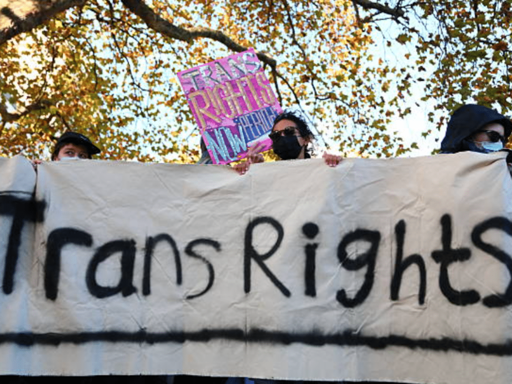
On Monday 1 June, the first day of Pride, the UK government held a debate on the Equality and Human Rights Commission’s (EHRC) latest attempt at a draft code of conduct to further exclude trans people from daily life.
Over recent years, Labour party stalwarts including PM Kier Starmer, leadership hopeful Andy Burnham, and newly minted health secretary James Murray have abandoned trans people at their earliest political convenience.
However, the queer community across the country may be pleased to find that not of their political representatives have turned their backs.
At Monday’s debate, several Labour backbenchers, Lib Dems, Scottish National Party (SNP), and Plaid Cymru MPs stood up and made their voices heard as allies of the trans and queer community.
‘Trans-exclusionary at its core’
Sarah Owen, Labour MP for Luton North, highlighted the dire timing of the debate:
I really wish that there was a better beginning to Pride Month than what we are discussing. Although the code is marginally different from its draft, it is still a trans-exclusionary one at its core, and unfortunately not inclusive. Moves like this from the EHRC and the Government have seen the UK slip from third in 2019 to 22nd in the European rankings for LGBT+ people to live and feel safe.
The SNP’s Peter Wishart later built on the same point, adding that:
Not only have we fallen to No. 22 in the rainbow index, but we are now 45th out of 49 European nations for the service of transgender people across Europe.
This is completely true. It remains true for all that equalities minister Seema Malhotra insists the government are “treating trans people with dignity”.
We can look to the International Lesbian, Gay, Bisexual, Trans and Intersex Association’s (ILGA) Rainbow Map as an example. The UK now ranks 22nd among all European countries for LGBT+ rights. That’s the lowest among all Western European countries.
How far they have fallen
Tom Gordon, Lib Dem MP for Harrogate and Knaresborough, also got in a jab at the two-faced politicians who’ve orchestrated that fall. He highlighted that:
Just a few Prime Ministers ago, Theresa May said: “Indeed when it comes to rights and protections for trans people, there is still a long way to go.” Well, how far the Tory party has fallen from those words. As a member of the Joint Committee on Human Rights, I attended the evidence session when we interviewed the new chair of the EHRC, and for the Minister to say that that was an independent process when the Government rammed it through despite cross-party consensus that the new chair was not fit for the role is, quite frankly, surprising.
That EHRC chair would be Mary-Ann Stephenson. Both the Women and Equalities Committee and the Joint Committee on Human Rights refused to endorse her due to a lack of experience in advocacy work beyond a narrow, and distinctly transphobic, focus on women’s rights.
However, she didn’t exactly have a high bar to clear. Stephenson took over from Kishwer Falkner, who instituted an “anti-LGBT” culture to the extent that current and former staff members branded her an “enemy of human rights”.
‘Ill-defined and highly subjective’
Labour’s Rupa Huq voiced her constituents’ dismay that:
under this guidance, the vague, ill-defined and highly subjective term “discomfort of service users” becomes the litmus test for excluding people from essential services.
As the Canarypreviously highlighted, that vague “discomfort” is a very low bar. There’s no way to verify whether or not someone is trans by official documentation. As such, a service provider is expected to question anybody’s sex — cis or trans — according to how they and other service-users feel.
Likewise, the fact that the draft trans code is an unworkable mess came up frequently. Plaid Cymru’s Liz Saville Roberts, for example, offered solidarity to trans people, but said her party would “uphold the rule of law”. However, how to actually uphold the law is another matter entirely:
as we have heard on numerous occasions today, in this guidance it appears that there is a lack of clear, workable guidance for services supporting transgender people, which is causing huge concerns.
‘Legitimising exclusion’
On that note, several MPs stressed that it’s not just trans people that this code impacts. Labour Co-op MP Stella Creasy asked:
Does the Minister accept that, to prevent being people’s gender being judged by their appearance—which we know will harm many more people than, I suspect, even those people who wish to see harm through this guidance would like—the safest option for most businesses will be getting rid of women’s toilets altogether? Will that not be an inevitable consequence of this guidance?
Likewise, Labour’s Nadia Whittome stated that the draft code opens up all women to “gender policing based on stereotypes”. Cat Eccles, Labour MP for Stourbridge, said:
A number of LGBTQ+ charities and equality organisations have warned that the guidance risks legitimising exclusion and increasing harassment of both trans people and gender non-conforming cis people.
In fact, the government’s own impact assessment shares the position that . The Lib Dems’ Josh Babarinde pointed out:
The Government’s own equality impact assessment has said of the draft code that “Women who are considered masculine may face greater scrutiny about their sex as a result of the changes. This will likely have a negative impact on this group”. In what way does this enhance the privacy, dignity and safety of women?
Gender policing
This gender-policing problem is not a hypothetical. Gender non-conforming women have already reported increased hostility following the Supreme Court’s anti-trans ruling. As the Lib Dems’ Marie Goldman stated:
There have already been stories of women with mastectomies being challenged when accessing women-only spaces because they do not look like women.
Mary-Ann Stephenson insisted that there would be no “toilet police” due to the draft code. The *Canary,*instead, highlighted that we would see (were already seeing) a toilet militia.
Both the government and the transphobic movement at large know this. At best, they view gender-non-conforming individuals as acceptable sacrifices. At worst, attacks against butches and queer presentation in general only sweeten the deal.
Goldman also went on to add that:
For trans, non-binary and intersex people, the code operates from a position of exclusion. It risks driving those small minorities away from public life, as leading mental health charities have since warned. The guidance conflicts with our core British values of tolerance, decency, respect for individual liberty and the rule of law. That is why I urge the Minister to withdraw it and to accept that this issue needs to be resolved by Parliament as law makers.
Here, we get to the crux of the matter. The EHRC’s draft code remains a draft for a 40-day period of parliamentary scrutiny. Crucially, if either house disapproves, the government doesn’t have to pass it.
‘Why not instead withdraw the guidance’?
Nadia Whittome stated same the issue clearly:
The EHRC code of practice fails everyone. It effectively pushes trans people out of public life, it subjects all women to gender policing based on stereotypes, and it does not provide clarity to organisations that want to be trans-inclusive. […] Why are the Government pushing ahead with this? Why not instead withdraw the guidance, and legislate to clarify that the Equality Act 2010 was always intended to be trans inclusive? For goodness’ sake, it was passed after the last Labour Government passed the Gender Recognition Act in 2004.
The Supreme Court ruled that the 2010 Equality Act treats the category ‘women’ as excluding trans women. However, it was ruling on the letter of the law, not its spirit or intent. The Gender Recognition Act, by the way, reads:
Where a full gender recognition certificate is issued to a person, the person’s gender becomes for all purposes the acquired gender (so that, if the acquired gender is the male gender, the person’s sex becomes that of a man and, if it is the female gender, the person’s sex becomes that of a woman).
That act hasn’t gone anywhere. It’s still in effect, for all that the government may try to ignore it.
The draft code has already gone back to the drawing board once over its sheer unworkability. As multiple MPs across several parties highlighted, the new attempt remains a discriminatory, opaque, unrealistic mess. It remains entirely within Parliament’s power to reject it on those grounds.
Nevertheless, it seems likely to pass. Remember this: the government’s current, visciously hostile attitude to trans people is a choice. The damage they are doing to intersex people, gender non-conforming people, and all women is entirely optional.
As queer and women’s rights continue to erode in the UK, day by day, we must remember precisely who did this to us.
Happy Pride to those MPs who stood up for trans and intersex people, for the queer community, non-conformists, and all women.
Featured image via Alishia Abodunde / Getty Images
From Canary via This RSS Feed.