


By Nikos Mottas
Communism has supposedly been reduced to a relic of the past for more than three decades. Bourgeois politicians, media commentators and professional anti-communists have spent years assuring us that Marxism-Leninism belongs to the past, that socialism was decisively defeated, and that history has already delivered its final verdict. Yet a simple question remains unanswered:
If communism is truly dead, as they claim, why do so many governments continue to fight it so fiercely?
Across the world, communist parties face bans and legal restrictions, communist symbols are criminalized, activists are prosecuted, and entire chapters of twentieth-century history are systematically rewritten. From court rulings and security laws to anti-communist institutes and state-sponsored historical revisionism, enormous political and financial resources continue to be devoted to combating ideas that we are repeatedly told no longer matter.
Particularly striking is the situation in parts of Eastern Europe and the European Union. Since the restoration of capitalism in the 1990s, anti-communism has increasingly evolved into an official political doctrine. Through resolutions, commemorative initiatives and the promotion of the hideously unhistorical “two extremes” theory, European institutions have helped legitimize the equation of communism with fascism and encouraged anti-communist policies across member states. In several countries, this process has gone hand in hand with the rehabilitation of anti-Soviet collaborationist forces, the dismantling of anti-fascist monuments and the systematic demonization of the socialist period.
Elsewhere, anti-communism remains embedded in national-security doctrines, anti-terror legislation, political persecution and campaigns aimed at suppressing labor movements, peasant organizations and revolutionary politics. Different countries employ different methods, but the objective remains remarkably similar: to prevent the re-emergence of communist politics and ensure that capitalism appears as the only possible social order.
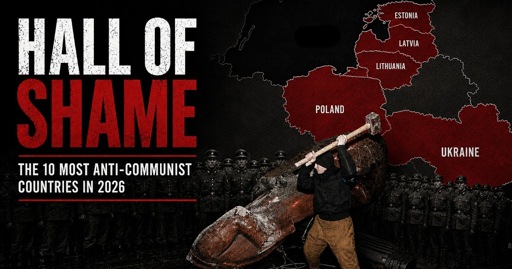
The following list is not a mathematical ranking. Rather, it highlights ten countries where anti-communism remains deeply embedded in legislation, state institutions, official historical narratives and political practice. Some are liberal democracies, others are authoritarian systems, and some are still emerging from conflict and instability. What unites them is a determination to marginalize, criminalize or exclude pro-working class politics from public life.
After all, no other political ideology is declared dead so often while being fought so relentlessly.
- Ukraine
If anti-communism were to have a contemporary capital, Ukraine would be among the strongest contenders. Following the Euromaidan events of 2014, in which far-right and ultra-nationalist organizations such as Right Sector played a visible role, the country’s new political leadership launched one of the most sweeping anti-communist offensives seen in Europe since the Cold War.
The turning point came in 2015 with the adoption of the so-called decommunization laws. These measures outlawed communist symbols, prohibited communist propaganda, mandated the removal of Soviet monuments and place names, and effectively equated communism with Nazism. Thousands of streets, squares and public institutions were renamed as part of a state-directed campaign to erase the Soviet legacy from public life.
The offensive soon moved beyond symbols. The Communist Party of Ukraine, once one of the country’s largest political forces and a party that had received millions of votes in national elections, was progressively excluded from political activity before eventually being banned altogether. In parallel, anti-Soviet, fascist figures such as Stepan Bandera were elevated to positions of official prominence, while organizations associated with Nazi collaboration were increasingly rehabilitated in public discourse.
The role of far-right formations has remained significant throughout this process. Groups linked to the Azov movement and other ultra-nationalist currents acquired influence far beyond their electoral weight, helping shape a political climate in which militant anti-communism became a central component of state ideology.
The anti-communist offensive extended beyond the Communist Party itself. Trade unions, anti-fascist organizations and other left-wing groups increasingly found themselves operating within a political climate shaped by aggressive nationalism, historical revisionism and the growing influence of far-right currents. Anti-communism became not simply a state policy but a defining feature of the country’s post-2014 political order.
The result is a country where anti-communism is no longer merely a political tendency or historical interpretation. It has become an official doctrine, embedded in legislation, education, public memory and national identity.
- Indonesia
If Ukraine represents anti-communism through legislation and historical revisionism, Indonesia represents anti-communism through terror, mass violence and historical amnesia.
The destruction of the Communist Party of Indonesia (PKI) in 1965-66 remains one of the largest anti-communist crimes of the twentieth century. At the time, the PKI was one of the world’s largest communist parties, with millions of members and supporters among workers, peasants, intellectuals and youth. Following the military coup led by General Suharto, a campaign of mass slaughter — tolerated, if not assisted by the U.S and Britain — was unleashed against communists and alleged sympathizers. Estimates vary, but hundreds of thousands were killed, while countless others were imprisoned, tortured or blacklisted.
Unlike many historical atrocities, this campaign was never seriously repudiated by the Indonesian state. On the contrary, anti-communism became one of the ideological foundations of the post-Suharto political order. To this day, communist organizations remain effectively prohibited, while the public promotion of Marxism-Leninism is heavily restricted. The display of communist symbols can lead to police intervention, while public discussions concerning the PKI are frequently met with hostility from state institutions and right-wing groups.
Perhaps the most remarkable aspect of the Indonesian case is that anti-communism continues to dominate public discourse more than half a century after the destruction of the communist movement. Few countries have spent so many decades fighting an organization that no longer exists.
Indonesia demonstrates how anti-communism can survive long after its original target has been physically eliminated. The massacre ended the PKI, but anti-communism remained—transformed into a permanent feature of political life.
- Poland
Among European Union member states, Poland has emerged as one of the most aggressive promoters of institutional anti-communism. Successive conservative and right-wing governments have invested heavily in reshaping historical memory, portraying the entire socialist period as a foreign-imposed dictatorship while systematically downplaying its achievements in industrialization, education, social welfare and anti-fascist reconstruction.
A central role in this campaign has been played by the infamous Institute of National Remembrance (IPN), a state-funded institution that has spearheaded efforts to remove monuments, rename streets and promote the theory that communism and fascism represent equivalent historical phenomena. Article 256 of the Polish Penal Code, which criminalizes the promotion of so-called “totalitarian ideologies,” has also been repeatedly invoked in anti-communist campaigns.
The most dramatic escalation came in late 2025, when Poland’s Constitutional Tribunal ruled that the Communist Party of Poland was incompatible with the constitutional order. Whatever legal arguments were employed, the political message was unmistakable: a communist party was declared unwelcome in a country that routinely presents itself as a model democracy.
Poland’s anti-communism extends beyond domestic politics. Warsaw has been among the most active advocates of anti-communist resolutions within the European Union, helping institutionalize the equation of communism with fascism at the continental level.
For Poland’s political establishment, anti-communism is not merely about the past. It is a weapon used to define the limits of acceptable political discourse in the present.
- Czech Republic
The Czech Republic offers one of the clearest examples of anti-communism moving from rhetoric into criminal law.
For years, anti-communist narratives have dominated public institutions and official memory politics. Yet in 2025, the country’s political establishment went significantly further. President Petr Pavel signed amendments to the Criminal Code that criminalized the promotion of communist movements and ideology, placing communism on the same legal footing as Nazism. The legislation allows prison sentences for individuals accused of supporting or promoting communist organizations.
The significance of this measure extends well beyond the Czech Republic. It reflects a broader trend across parts of Eastern Europe and the European Union, where anti-communism increasingly seeks legal expression rather than remaining confined to historical debates. The objective is no longer simply to criticize the socialist past but to stigmatize communist politics itself.
Supporters of the legislation present it as a defense of democracy. Yet the logic behind the measure is revealing. Rather than confronting communist ideas politically, the state seeks to place them under the shadow of criminal law. The result is a dangerous precedent in which a political ideology representing millions of people throughout modern history is treated as inherently illegitimate.
In a continent that constantly celebrates political pluralism, the criminalization of communist ideology exposes the profoundly selective nature of that commitment.
- South Korea
South Korea is frequently presented in Western media as a model liberal democracy. Yet beneath its democratic institutions lies one of the most durable anti-communist legal frameworks in the world.
At the heart of this system stands the National Security Act, a Cold War-era law that grants authorities broad powers to prosecute individuals accused of supporting, praising or expressing sympathy toward North Korea or organizations deemed hostile to the state. For decades, the law has been used not only against alleged security threats but also against political activists, journalists, academics and left-wing organizations.
One of the most revealing examples came in 2014, when the Constitutional Court ordered the dissolution of the Unified Progressive Party, accusing it of harboring pro-North Korean sympathies. The decision marked the first dissolution of a political party in democratic South Korea and demonstrated the continuing power of anti-communism within the country’s political institutions.
The anti-communist culture cultivated during decades of military rule has by no means disappeared. Instead, it has been adapted to contemporary circumstances, where the threat of communism continues to serve as a convenient justification for restricting political dissent and policing the boundaries of acceptable discourse.
- Latvia
Few countries have made anti-communism as central to their national identity as Latvia. Since the restoration of independence in the early 1990s, successive governments have built an official historical narrative centered on the concept of Soviet “occupation,” transforming anti-communism into a cornerstone of state ideology.
The legal framework reflects this approach. Soviet symbols, including the hammer and sickle, have been prohibited in various public contexts and placed in the same category as Nazi symbols. This legal equation between communism and fascism has become a defining feature of Latvian memory politics.
Yet perhaps the most controversial aspect of Latvia’s anti-communism lies elsewhere. While communist symbols are banned and Soviet memorials dismantled, annual commemorations involving veterans of the Latvian Waffen-SS have repeatedly taken place with varying degrees of political tolerance. Critics have long argued that the country’s anti-communist narrative has opened the door to the rehabilitation of elements associated with wartime collaboration under Nazi occupation.
The message sent by this historical revisionism is unmistakable. Those who fought under the banner of socialism against fascism are condemned as occupiers, while elements associated with collaboration are increasingly portrayed as patriots. Few examples illustrate the political function of anti-communism more clearly.
The contradiction is striking. The movement that played the decisive role in defeating fascism is criminalized and delegitimized, while individuals who fought under Nazi command are increasingly integrated into narratives of national resistance.
Latvia’s ruling elite presents this as historical justice. In reality, it reflects the extent to which anti-communism has become the organizing principle of official memory.
- Lithuania
Lithuania has long been one of the most active promoters of anti-communism both domestically and within the European Union. Since the collapse of the Soviet Union, successive governments have pursued policies aimed at removing communist symbols from public life while promoting the doctrine that communism and fascism constitute equivalent forms of totalitarianism.
Lithuanian legislation restricts the public display of Soviet symbols and has repeatedly been used to reinforce an official interpretation of history that presents the entire socialist period as a foreign occupation. Educational institutions, museums and public commemorations consistently reproduce this framework, leaving little room for a more complex assessment of the period.
Like Latvia, Lithuania has also witnessed efforts to rehabilitate sections of the anti-Soviet nationalist movement, including figures whose wartime records remain highly controversial due to their links with collaboration during the Nazi occupation.
What makes Lithuania particularly significant is its role beyond its borders. Successive governments have been among the most vocal advocates of anti-communist initiatives at the European level, helping push resolutions and commemorative projects that equate communism with fascism.
Lithuania has also been among the most enthusiastic supporters of European initiatives promoting the “two extremes” doctrine. By presenting communism and fascism as historical equivalents, the country’s political elite has helped normalize anti-communism not only at home but across the European Union.
The country’s anti-communism is therefore not merely a domestic phenomenon. It forms part of a broader political effort to institutionalize anti-communist ideology throughout Europe.
- Estonia
Estonia shares many features with its Baltic neighbors, but anti-communism has increasingly merged with national-security politics, giving it a particularly aggressive character.
Since independence, Estonian governments have promoted the view that the Soviet period constituted an occupation rather than a chapter of the country’s social and economic development. This interpretation has become deeply embedded in public institutions, educational programs and official commemorations.
In recent years, authorities have intensified restrictions concerning Soviet symbols and memorials, particularly in the context of growing tensions between Russia and the West. Monuments commemorating Red Army soldiers have been removed, while investigations and legal actions related to the public display of Soviet symbols have increased significantly.
As elsewhere in the Baltics, anti-communism has frequently gone hand in hand with efforts to elevate anti-Soviet nationalist forces while minimizing the historical role of communist movements in the struggle against fascism. The result is a historical narrative in which the socialist period appears only as repression, while the achievements of Soviet industrialization, education and anti-fascist resistance are largely erased.
Estonia illustrates how anti-communism can be repackaged as a matter of national security, transforming historical interpretation into a political weapon. In this framework, the past is not merely remembered—it is actively mobilized to shape contemporary political loyalties and suppress alternative narratives.
- Philippines
The Philippines has developed one of the most sophisticated anti-communist apparatuses in the contemporary world. While the country’s political establishment regularly presents itself as democratic and pluralistic, anti-communism remains deeply embedded in state institutions, security policy and public discourse.
At the center of this system stands the practice known as “red-tagging”—the public branding of individuals and organizations as communist sympathizers or fronts for the Communist Party of the Philippines and the New People’s Army. Trade unionists, peasant leaders, student activists, journalists, lawyers and human-rights defenders have all found themselves targeted by such accusations.
The creation of the National Task Force to End Local Communist Armed Conflict (NTF-ELCAC) further institutionalized this approach. Critics argue that the task force has blurred the distinction between armed insurgency and legitimate political activism, creating a climate in which labor struggles, social protests and grassroots organizing can be portrayed as threats to national security.
The consequences are far from theoretical. Human-rights organizations have repeatedly documented cases in which red-tagging has been followed by harassment, arbitrary arrests, intimidation and violence. In this sense, anti-communism in the Philippines functions not merely as an ideology but as a mechanism for disciplining social movements and protecting entrenched political and economic interests.
Few countries illustrate more clearly how anti-communism can be used to criminalize dissent while preserving the appearance of democratic governance.
- Syria
Syria’s place on this list reflects a different form of anti-communism. Unlike several European states, anti-communism here is not primarily expressed through decommunization laws, constitutional rulings or symbol bans. Instead, it emerges from the growing influence of reactionary Islamist forces whose ideological foundations are fundamentally hostile to communism, secularism and class-based politics.
Following years of war and instability, political forces associated with Ahmad al-Sharaa and Hayat Tahrir al-Sham have assumed a central role in shaping Syria’s new political landscape. While efforts have been made to present these forces as pragmatic and moderate, their political roots lie in movements that have historically viewed communists and secular leftists as ideological enemies.
Wherever jihadist organizations have exercised power across the Middle East, communist organizations, trade unions, women’s movements and secular political forces have faced repression, exclusion or outright elimination. The Syrian case therefore represents a different but equally significant expression of anti-communism—one rooted not in liberal anti-totalitarian rhetoric, but in religious reaction and militant anti-leftism.
The tragedy is particularly striking given Syria’s long history of communist activity and secular political traditions. Today, those traditions face one of their most difficult periods, overshadowed by forces whose vision of society leaves little room for socialist politics or class struggle.
Syria reminds us that anti-communism does not always wear the language of democracy. Sometimes it arrives wrapped in the banners of religious fundamentalism and political reaction.
Honorable Mentions
United States
No serious discussion of global anti-communism can ignore the United States. Although communist parties remain formally legal, Washington spent much of the twentieth century constructing the international architecture of anti-communism. From McCarthyism and the persecution of communists at home to support for anti-communist coups, dictatorships and military interventions abroad, the United States played a central role in shaping the global struggle against communist movements. The methods have changed over time, but anti-communism remains deeply embedded in the country’s political culture and foreign-policy establishment.
Germany
Germany deserves mention not because communist parties are currently outlawed, but because anti-communism has long been institutionalized within the post-war political order. The 1956 ban of the Communist Party of Germany remains one of the most significant acts of political repression in post-war Western Europe. Today, communist organizations continue to face surveillance, while official narratives frequently reduce the entire experience of the German Democratic Republic to a story of dictatorship and repression. Anti-communism remains a powerful force in German memory politics and public discourse.
Taiwan
Taiwan’s modern political system emerged from decades of anti-communist rule under the Kuomintang. During the period known as the White Terror, thousands of communists, trade unionists and left-wing activists were imprisoned, persecuted or executed. While Taiwan has undergone significant democratization, anti-communism remains deeply woven into its political identity and continues to shape public debate, particularly in the context of tensions with the People’s Republic of China. The legacy of the White Terror still casts a long shadow over the island’s political culture.
Conclusion
The countries examined in this article differ in history, culture and political institutions. Some are members of the European Union. Others are strategic allies of the United States. Some describe themselves as liberal democracies, while others are emerging from war or political upheaval. Yet all of them share one common feature: a determination to marginalize, criminalize or suppress communist politics.
The methods vary. In Ukraine, anti-communism takes the form of decommunization laws and party bans. In Poland and the Czech Republic, it increasingly appears through courts and legislation. In the Baltic states, it is intertwined with historical revisionism and the rehabilitation of anti-Soviet collaborationist forces. In South Korea and the Philippines, anti-communism remains embedded in security doctrines and political repression. In Indonesia, it survives as the ideological legacy of one of the greatest anti-communist massacres in modern history. In Syria, it emerges through the rise of reactionary forces fundamentally hostile to secular and socialist politics.
But beneath these differences lies a common objective: to sever working people from their own history, to erase the achievements of socialist construction, and to portray any alternative to capitalism as illegitimate, dangerous or impossible.
Within the European Union, these developments have increasingly received ideological legitimacy through official resolutions and commemorative initiatives promoting the despicable theory of the “two extremes.” Under the banner of defending democracy, anti-communist narratives have been elevated to the level of official memory policy, encouraging governments to equate communism with fascism and further marginalize communist politics. The result is a paradoxical situation in which institutions that claim to defend political pluralism contribute to the stigmatization of one of the most influential political movements of the modern era.
The continuing assault on communist parties, symbols, historical memory and political activity is not a sign of confidence. It is a sign of fear. Fear that workers may draw lessons from the past. Fear that new generations may question the existing order. Fear that socialism may once again emerge as a real political alternative in a world increasingly marked by war, inequality, exploitation and capitalist crisis.
More than a century after the October Revolution, anti-communism remains an essential weapon of the ruling classes precisely because the social contradictions that gave birth to the communist movement have not disappeared. Socialism-communism is today more alive and necessary than ever. And the people’s enemies know that perfectly well.
* Nikos Mottas is the Editor-in-Chief of In Defense of Communism.
From In Defense of Communism via This RSS Feed.