

Bullets:
China imports 85% of their natural rubber consumption, and enjoys strong trading relationships with the top rubber producers.
But the war in the Persian Gulf is driving oil prices higher, which in turn is making natural rubber substitutes far more expensive.
China is limited in its capacity to expand natural rubber production. Domestic sources are mostly from Hainan Island, and Southern Yunnan, which are two areas slated for massive expansions in high-end tourism and industry.
Scientists are now growing natural rubber in the Gobi Desert, and are quickly scaling up production.
Inside China / Business is a reader-supported publication. To receive new posts and support my work, consider becoming a free or paid subscriber.
Report:
Good morning.
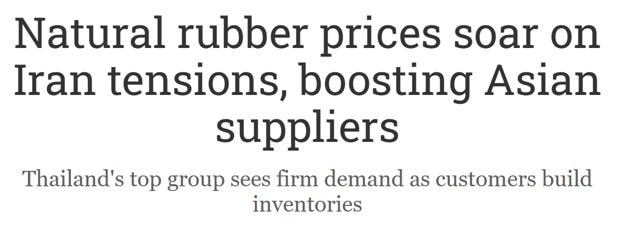
This headline was mystifying to us; it made no sense at all. Rubber prices are shooting higher because of the war on Iran, which is “boosting Asian suppliers.”
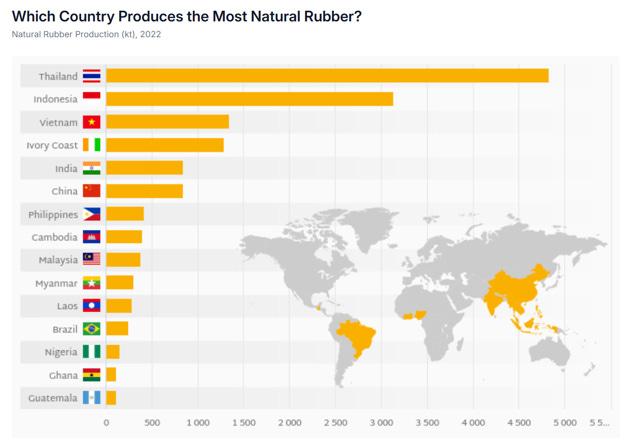
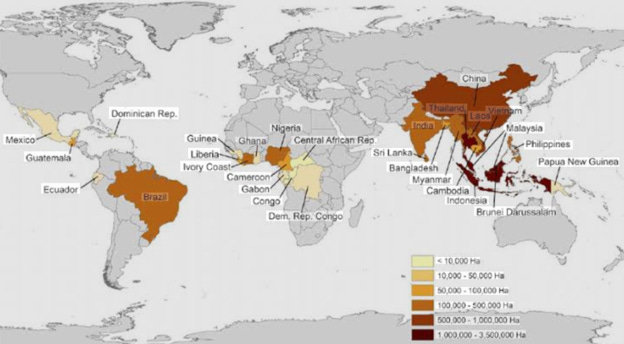
This is a map of rubber-producing countries, and there’s no supply coming out of the Persian Gulf in the first place. By volume, almost all the rubber in the world comes from here, in Southeast Asia.
These 10 countries are 90% of total rubber exports—and there is only one country in the top 7—the Ivory Coast—that isn’t in this part of the world:
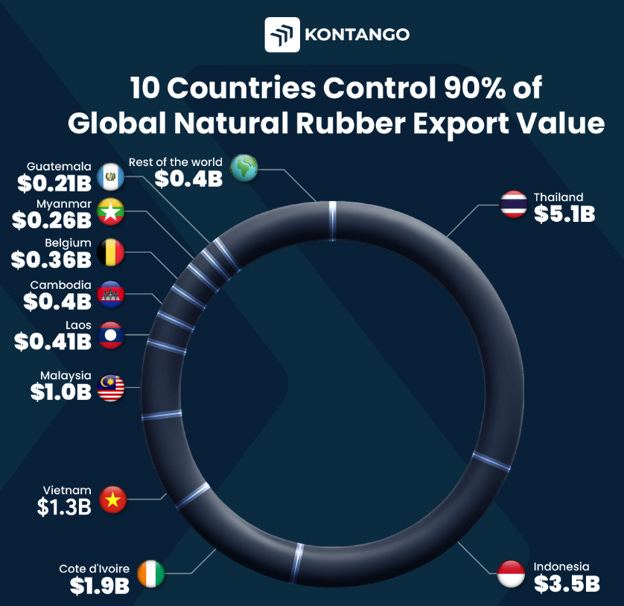
But the war in the Persian Gulf is blowing up oil prices, which in turn is pushing up the cost to make synthetic rubber. Tire manufacturers are also building inventories, in case they can’t get supplied at all.
And since natural rubber can replace synthetic rubber, prices are going up. The natural rubber industry is very labor- and land-intensive, and we can tell from the long-term price chart that there is little motivation to clear hundreds of thousands of new hectares of land to build out new natural rubber capacity, considering oil-based synthetics are widely available:
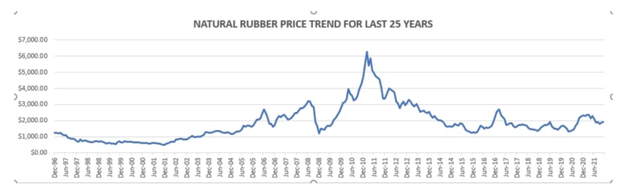
But now the prices are rising, and China in particular is exposed here. China accounts for 45% of global natural rubber demand, and is the world’s largest buyer, because China is now the world’s largest automobile market, and largest car manufacturer. Foreign tire manufacturers have set up here, and the industry is growing fast.
The boom in China’s electric vehicle industry is also putting pressure on natural rubber supplies. Battery packs are heavy, and EV’s accelerate faster, so the tires for these cars need to be stronger, with a higher proportion of top-grade natural rubber.
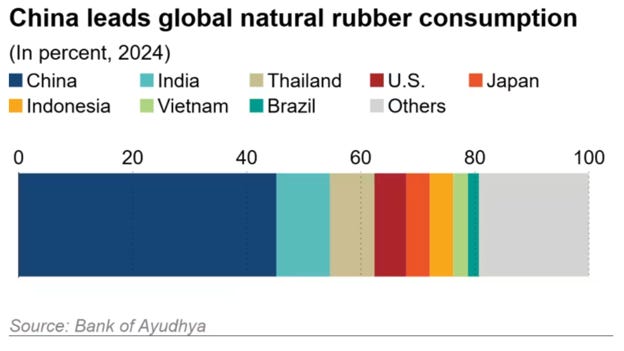
So on first glance, this chart doesn’t seem like a big problem. China, India, Thailand, Indonesia, and Vietnam are about 80% of global natural rubber demand, and most of the world’s natural rubber does actually come from these countries, who happen to be generally friendly.
But the strikes on Iran, and the closure of the Strait of Hormuz has pushed oil prices sharply higher, which means higher costs for synthetic rubber, and thus higher demand for natural rubber. The Singapore exchange is the benchmark for rubber in Asian markets, and prices are up over 37% since the start of the year. In China, the price has not moved as much—up about 14% year to date—but even here that is the highest level in over two years.
China does have a strong recycling industry for tires; in terms of volume, China recycles more than any other country. But demand for new rubber in China is outstripping what is coming off the roads. And here is another challenge for China, in developing new domestic sources of supply: most of its production comes from Hainan, and from an area just south of here in Yunnan province.
The Chinese have other, major development plans for those areas. Hainan is being transformed right now into the world’s largest free-trade zone, and will also be the world’s largest center for medical tourism:
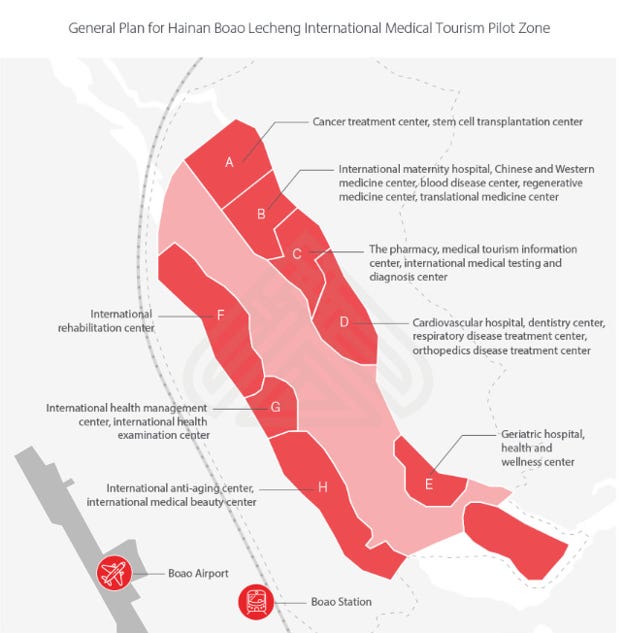
It already attracts hundreds of thousands of patients a year, who receive medical care, with treatments and therapies that are not yet approved even in Mainland China, let alone in North America or in Europe.
Xishuangbanna is in the Mekong River Delta. Natural rubber farming is an important industry there, especially at the small-village level. Again, the natural rubber industry is labor- and land-intensive. And the areas that are developed for rubber plantations aren’t good for much else. Over two decades, forest cover in Xishuangbanna dropped from over 70% to about half, which corresponded with the growth in rubber and tea plantations.
And that’s the tension: Authorities in Yunnan, and in Beijing, understand that the growth of natural rubber plantations is at odds with their plans for the tourism industries.
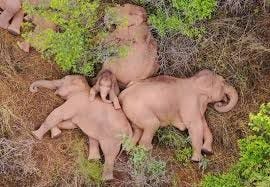
Here is a famous local example which illustrates the problem: Yunnan is a wildlife sanctuary for Asian elephants, who migrate between Xishuangbanna and Pu’er, which is the center of Yunnan’s tea industry. 70% of the protected animals in all of China are here in Yunnan, and the elephants in particular are being squeezed by the rubber plantations. Elephant populations in China are recovering, but only in the areas that are off-limits to the rubber industries. By the way, if you want to see them, best time is November-February.
All of this puts China in a strange spot. Their demands for natural rubber are higher than for any other country, and the only places they’ve got available to scale up production are slated for development of other industries that are far more lucrative. Eco-tourists fly in from all over the world to see the elephants and the other wildlife in Yunnan.
Medical tourism in Hainan will be a multi-trillion-dollar industry, which will boom long after the war ends and oil prices stabilize, at which time tire manufacturers will be comfortable with their raw materials inventories, and natural rubber prices revert to the norm.
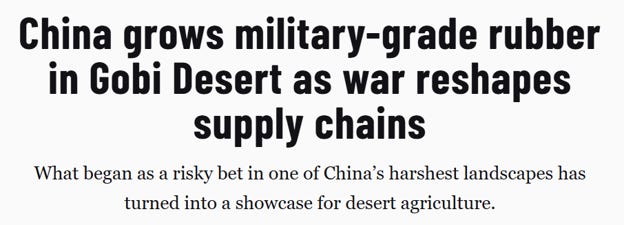
Beijing is probably somewhat relaxed about sourcing their rubber imports from friendly countries next door, and in the Ivory Coast, which is a strong trade partner. And so there’s yet another headline, that is also mystifying. These Chinese researchers are building plantations for natural rubber in the Gobi, and again we’re left to wonder right away if this is something they did on purpose, or just discovered by accident.
China consumes seven million tons per year of rubber, and imports over six million tons. Duzhong is a plant, used in Traditional Chinese Medicine. It is also a key source of natural rubber, and is China’s only source of natural rubber. Rubber derived from Duzhong has applications in the defense sector.
China strongly prefers to not rely on supply chains running through foreign countries—friendly or not. And given that China’s import dependency in rubber is 85%, rubber is a poster child for a raw material that they’ve got their scientists nationwide hard at work on.
The Northwest Agricultural and Forestry University is one of the top unis in the world. It’s in Shaanxi, and this group headed out to Xinjiang to see if Duzhong could grow in the desert. First, they had to solve the genetics problem, then had to figure out how to scale up production in the desert, and to do so economically.
They discovered a new extraction process for the rubber that dramatically improves the yield, while doing so more cleanly than before. Fast-forward ten years to now, and today there is a Dezhong forest of 300,000 hectares, in the Gobi Desert, which will grow eleven times larger in the next five years.
At 3.3 million hectares, China by 2030 will be the world’s top producer of natural rubber.
Be Good.
Resources and links:
China’s Hainan free trade port: what the world’s largest FTZ means for global trade
https://www.mic-cust.com/mic-blog/posts/detail/ad/chinas-hainan-free-trade-port-what-the-worlds-largest-ftz-means-for-global-trade/
China grows military-grade rubber in Gobi Desert as war reshapes supply chains
https://interestingengineering.com/military/china-gobi-desert-military-grade-rubber
Mapping China’s rubber metabolism: tires and beyond
https://www.tsinghua.edu.cn/en/info/1245/14737.htm
It is ‘flourishing’: China’s man-made forest in Gobi produces good rubber for military use
https://www.scmp.com/news/china/science/article/3341641/it-flourishing-chinas-man-made-forest-gobi-produces-good-rubber-military-use
10 Countries Control 90% of Natural Rubber Export Value
https://www.kontango.com/blog/10-countries-control-90-of-natural-rubber-export-value
Tire Recycling Industry Statistics: Global Market Data
https://gradeall.com/tire-recycling-industry-statistics-global-market/
After the rubber boom: good news and bad news for biodiversity in Xishuangbanna, Yunnan, China
https://link.springer.com/article/10.1007/s10113-019-01509-4
Improving sustainable livelihoods for smallholder rubber farmers in Xishuangbanna
https://www.preferredbynature.org/projects/improving-sustainable-livelihoods-smallholder-rubber-farmers-xishuangbanna
Rubber Boom, Land Use Change and the Implications for Carbon Balances in Xishuangbanna, Southwest China
https://www.sciencedirect.com/science/article/abs/pii/S0921800918301289
Navigating between Tea and Rubber in Xishuangbanna, China: When New Crops Fail and Old Ones Work
https://www.mdpi.com/2073-445X/9/1/22
SunSirs: Natural Rubber Prices Continue to Rise; Supply-Demand Gap Sustains High-Level Performance
https://www.anrpc.org/news/sunsirs%3A-natural-rubber-prices-continue-to-rise%3B-supply-demand-gap-sustains-high-level-performance
Natural rubber prices soar on Iran tensions, boosting Asian suppliers
https://asia.nikkei.com/business/markets/trading-asia/natural-rubber-prices-soar-on-iran-tensions-boosting-asian-suppliers
25-year natural rubber prices
https://jmkintl.com/rubber-price-trend
Which Country Produces the Most Natural Rubber?
https://www.helgilibrary.com/charts/which-country-produces-the-most-natural-rubber/
In Search of Giants: Tracking Rare Wild Elephants in China
https://www.fabionodariphoto.com/en/where-see-elephants-china-yunnan/
Inside China / Business is a reader-supported publication. To receive new posts and support my work, consider becoming a free or paid subscriber.
From Inside China / Business via This RSS Feed.