

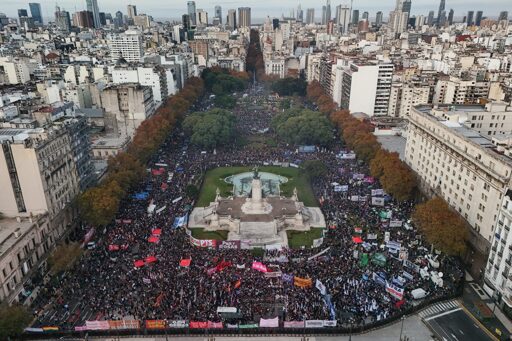
On Wednesday, June 3, tens of thousands of people flooded the streets across Argentina under the banner of Ni Una Menos — “Not One Woman Less” — in one of the most charged mobilizations the feminist movement has seen in years. From Buenos Aires to Córdoba, Rosario to Neuquén, Tucumán to Río Gallegos, the country erupted in grief, rage, and collective defiance.
#NiUnaMenos: una multitud se movilizó contra la violencia machista en el Congreso y en todo el país pic.twitter.com/CmeVhCoNcc
— La Izquierda Diario (@izquierdadiario) June 3, 2026
The immediate spark was the brutal femicide of Agostina Vega, a 14-year-old girl from Córdoba who went missing on May 23 and was found murdered a week later — sexually assaulted, hanged, and dismembered. Days later, two more cases shook the country: Dulce Candia, 17, found dead in Misiones after disappearing for weeks; and Noelia Romero, 30, murdered in Temperley by her boyfriend. Three girls and women were killed in a matter of days. Three families were destroyed. Three more names added to a list that, according to the Adriana Marisel Zambrano Femicide Observatory, now stands at 3,424 victims of gender-based violence since Ni Una Menos first took to the streets in 2015 — one every 30 hours.
In front of Argentina’s Congress in Buenos Aires, the central rally drew a massive crowd. Singer Cazzu and actress Thelma Fardín read the movement’s document from the stage. “June 3 is our cry,” Cazzu told the crowd, “the cry of rage that took to the streets eleven years ago in Argentina and spread across the world. Today, confronting Milei’s government — which denies patriarchal violence — we say: our lives are not disposable. The lives of our girls matter.”
“El 3 de junio es nuestro grito” @cazzuoficial en la lectura del documento por #NiUnaMenos, ¡vivas nos queremos! pic.twitter.com/DMy2DjOLNZ
— La Izquierda Diario (@izquierdadiario) June 3, 2026
That indictment of Milei was not incidental. Since taking office, his administration has systematically dismantled the institutional architecture built to combat gender-based violence: the Ministry of Women and Diversities was dissolved, funding for victim support programs was slashed, and his former Justice Minister openly floated removing femicide as a legal category from the penal code. On the day of Agostina’s murder, Security Minister Alejandra Monteoliva refused to call it a femicide, describing it instead as a generic “homicide.” Advocates were swift to respond: without naming this specific form of violence, they argued, the state cannot prosecute it effectively or build the policies needed to prevent it.
As Laura Vilches, former congresswoman from the PTS-FITU and journalist from Córdoba said in an interview this morning:
When impunity is allowed to take root, it paves the way for these events — for these femicides, for these crimes — to continue to happen. I believe this is at the heart of what we have been denouncing for years: the judicial system is responsible for gender-based violence. Not only because it revictimizes families, not only because it ignores complaints when they could be addressed in a timely manner, but because it creates mechanisms that guarantee impunity for femicides and their accomplices, and continues to uphold a system of values that devalues the lives of women and children.
Agostina’s grandmother was present at the protest in Córdoba and did not mince words: “They only started looking for her seriously on Tuesday,” she said. “They keep killing my granddaughter.”
Referencing the administration’s threat to revoke the category of femicide from the penal code, congresswoman Myriam Bregman from the PTS-FITU — who has topped polls as the political figure with the most positive image nationally — spoke at the rally in the country’s capital on Wednesday:
It’s terrible to deny that femicide is a crime, because if you believe femicide is possible, you act differently — and even more so in a province like Córdoba, which has major problems with human trafficking networks. Acting quickly and acting effectively are not the same thing. Today at 5 p.m. in Plaza Congreso, I think there will be thousands of us because we’re going to stand up against the impunity that extends to femicide. We have to go out and fight now because we have no reason to put up with this.
The streets of the country’s major cities were filled with working women, students, young people, and mothers accompanied by their families and children, refuting the government’s official narrative that Argentina is undergoing an ideological shift to the Right. Everywhere, there is widespread condemnation of the misogyny that has become a matter of state policy under Javier Milei’s administration, which has embraced hateful rhetoric against women, the LGBTQ+ community, and feminism.
En Córdoba, la provincia de Agostina Vega, se moviliza una multitud. ¡Vivas nos queremos! pic.twitter.com/wf3iifyjBv
— La Izquierda Diario (@izquierdadiario) June 3, 2026
Bread and Roses, the biggest feminist socialist organization in Argentina that has been part of the “Ni Una Menos” protests since 2015, took to the streets as well with an impressive column. Andrea D’Atri, congresswoman from the PTS-FITU and founder of the socialist feminist organization Pan y Rosas (Bread and Roses) called on “all women to remain organized following this day of mobilization and struggle.” She also pointed out that “Just as the Right has launched an offensive against us on an international level — an offensive they are carrying out here through the very machinery of the state — we must prepare ourselves, from the ground up, in our communities, workplaces, schools, universities, and neighborhoods, to put sexism back on the defensive.” She also highlighted the way forward for the feminist movement, embodied in the way that
[R]esilient Palestinian women, our Bolivian sisters, the immigrants and Indigenous women of Minneapolis, the Chilean students, and we ourselves have shown that we are capable of fighting with all our strength, of leading the resistance against authoritarian governments, the cruelest right-wing forces, and the most atrocious dictatorships, and of spearheading the most profound transformations.
Today’s mobilization — national, encompassing many different sectors of society and the workforce, and furious — is a reminder that the feminist movement in Argentina remains one of the most powerful forces of popular resistance in Latin America. Under a government that wages daily war on the rights of women, trans people, and the oppressed, the streets answered: Vivas y libres nos queremos — We want to be alive and free.
The post In Argentina “Ni Una Menos” Fills the Streets to Demand Justice for Agostina Vega appeared first on Left Voice.
From Left Voice via This RSS Feed.