

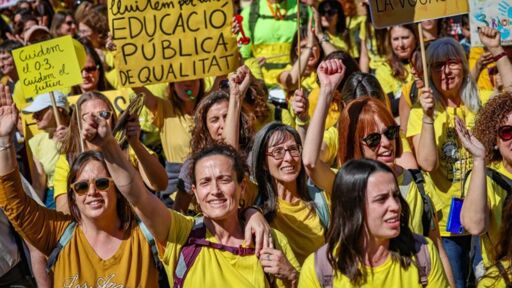
On Wednesday, the yellow shirts of hundreds of teachers shone in the scorching Catalan sun as they flooded onto the AP7, a key highway that connects Barcelona to France and the rest of Europe. As far as the eye could see, trucks slowed to a halt: the Catalan general education sector strike had successfully blocked the movement of goods along the highway.
The strike extended to every part of the education sector: even private summer camps were shut down by the strike. Mobilizations burst onto the streets — across the region, tens of thousands of teachers and allies rallied and blocked main roads. According to the combative unions (USTEC-STEs, CGT Ensenyament, Profesores de Secundaria, and Intersindical) who called for the strike, 60 percent of teachers in Catalonia participated. From Catalonia to Valencia to Aragon to Madrid, teachers are leading the way in a new moment of class struggle.
Historic Education Strikes with Rank-and-File Unity
This day-long general strike was only one of several in this historic cycle of education strikes in which teachers are fighting for quality public education: better resources and working conditions, smaller teacher-to-student ratios, police out of schools, and classes taught in Catalan. A previous strike on March 20 saw 90 percent participation rates with 100,000 teachers taking to the streets.
These mobilizations are an especially important example because they speak from below with the defiant and unified voice of the rank and file. Early this year, the teachers suffered a major betrayal by the leaderships of their main unions, the Comisiones Obreras (CCOO) and Unión General de Trabajadoras y Trabajadores (UGT) when they signed a terrible agreement with the Catalan government, the Socialists’ Party of Catalonia (PSC). Though the pact was decisively rejected by the democratic assemblies of the workers, the union leaders continue to defend it. But in an impressive demonstration of working class power, the education workers have continued to organize from below, defying the betrayal of the union bureaucracy and demanding a new agreement, under the slogan “No agreement without consultation!”
At the highway blockade on Wednesday, the mood was jubilant and the morale strong. The action was amazingly well-organized. Enormous tarps and tents, to block the protesters from the sun, were set up. Wood pallets separated the protesters from the trucks, and no cars were let through besides the occasional ambulance. Gallons upon gallons of water were wheeled in. Giant pans of Fideuà, a Catalan-style paella, were cooked and distributed, and kids played soccer. A giant cardboard coffin that read “EDUCATION – RIP” was passed around.

A stage was set up underneath the bridge, and speakers and musicians spoke and sang about Catalan and Spanish history, the cause of the teachers, and the need to unite our struggles. Many supporters spoke, including a participant of the Global Sumud Flotilla and a representative from the Balearic Islands Teachers’ Assembly, which voted to send 100,000 euros to support the teachers strikes in Valencia and Catalonia in a massive act of solidarity. Our comrades Pablo Castilla, from the student group Contracorrent, and Jorge Calderón, a member of the Revolutionary Workers’ Current (CRT) and one of the Zaragoza teachers who is being attacked by the Far Right, spoke in solidarity with the strike, denouncing the so-called progressive Catalan government of Salvador Illa Roca and calling for the unity of the student movement with the education sector.
But to understand why teachers took to the highway in yellow shirts, we need to go back to the betrayal that set this movement in motion.
As the speakers uplifted, while the government says that there is no money for public education, there is plenty for the police, rearmament, and imperialism. While the PSC and the Spanish government of Pedro Sanchez is rhetorically pro-Palestine, Spanish arms trade with Israel continues. At the same time, rearmament policies across Europe have seen the Spanish State commit 10.5 billion euros to its Defense Industrial Plan. Illa and the PSC warmongers plan to funnel 2.1 billion euros of that public money into Catalan rearmament. Teachers are connecting the dots, understanding that their fight for investment in the public sector and better working conditions is also a fight against the imperialist arms race.
Further, undercover police have infiltrated the teachers’ assemblies and while the PSC refuses to fund public education, they have approved a 4,000 euro annual raise for the Catalan police. On top of this, the government announced a plan to deploy plainclothes officers in educational centers. All of this results in the demand from the education strikes: police out of education!
Democratic Self-Organization
But how are these historic education strikes being organized? In the face of a union bureaucracy that is more loyal to the bourgeois Catalan government than to its membership, workers have been demanding accountability of the unions to their democratically organized assemblies. Teachers met in school-based assemblies to discuss and debate their struggle and the next steps of the movement. They voted representatives to participate in regional assemblies, which vote and organize the strike days and actions. These assemblies, bodies of worker democracy in the teacher struggle, have organized the fiery discontent of the educational sector into a formidable force.
As our comrade Cynthia Lub, a Catalan teacher and member of the CRT that has been part of the struggle has written, “the most valuable lesson of this cycle of protests is that self-organization from below is the only real guarantee against backroom deals and betrayals, placing decision-making power directly in the hands of the workers.”
On Friday, May 29, the Department of Education signed a “pre-agreement” with the major unions, an agreement denounced by both the CGT and COS unions as well as the student organization Contracorrent. From the rank and file, the CGT, COS, and Contracorrent are calling for a “no” vote. According to the CGT, this agreement would favor “social peace” without winning significant improvements or meeting the teachers’ demands (including staffing ratios, democracy in the education centers, police out of schools, and air conditioning). So, despite efforts to coopt and wind down the movement, the struggle continues.
The next general education sector strike will be on June 5, and both Contracorrent and the CGT union are calling for the strike to be extended to Catalan universities. This would be the first strike across every layer of education, from preschool teachers to university students, and would unite the revolutionary momentum of the student movement and the youth with the strategic power of the workers’ movement.
From the United States, we have a lot to learn from this struggle. It calls to mind the courageous organizing and leading role of teachers in the 2018 Red State teacher strikes, and the organizing of teachers in Minneapolis against ICE this year. Our own struggles can be strengthened by taking notes from the self-organization from below of the Spanish State teachers. Their struggle has catalyzed a democratic movement powerful enough to reject anything less than the education system and working conditions that students and teachers demand.
The post Education Strikes Across the Spanish State Demonstrate the Power of Self-Organization appeared first on Left Voice.
From Left Voice via This RSS Feed.