

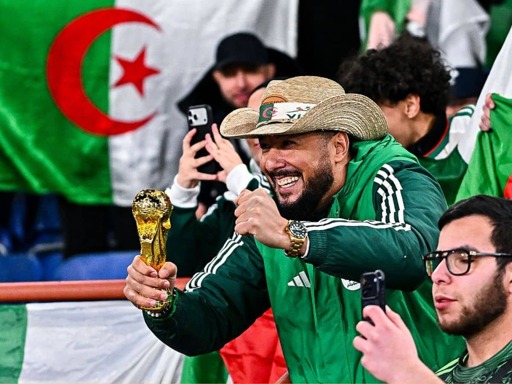

Algeria — After years of ups and downs, marked by both successes and failures, the Algerian national team returns to the 2026 World Cup with a twofold ambition: to restore its standing amongst the African elite on the one hand, and to prove that the current generation is capable of writing a new chapter to match what the Desert Warriors achieved at the 2014 World Cup in Brazil on the other.
Algeria, which dazzled the world over a decade ago when it reached the quarter-finals and played a historic match against Germany, has since experienced contrasting phases. From winning the 2019 Africa Cup of Nations to the painful absence from the 2022 World Cup, and finally returning to the world stage for the 2026 edition.
Today, the Algerian national team enters the tournament knowing that mere qualification is no longer enough for fans accustomed to dreaming big, and that the real challenge lies in transforming immense individual potential into a collective achievement on the world’s biggest football stage.
A blend of European experience and Algerian identity
The Algerian national team boasts one of the most talent-rich squads in Africa. The core of the team consists of players competing at the highest levels in Europe, giving them considerable experience in handling big matches and high-pressure situations.
Riyad Mahrez leads the attack with his wealth of experience, whilst Amine Gouiri is one of the team’s key attacking weapons thanks to his ability to play in multiple positions. Nabil Bentaleb also provides the team with crucial balance in midfield, whilst Rayan Aït-Nouri stands out as one of the key players capable of making a difference on the flanks thanks to his attacking and defensive abilities.
However, Algeria’s strength lies not only in the names, but in the variety of options. The national team boasts a large number of players capable of playing in more than one position, which gives the coaching staff great flexibility in dealing with various scenarios throughout the tournament.
From individual skills to tactical balance
In recent years, the Algerian national team has evolved from a side that relied primarily on individual skills to a more tactically balanced unit. It has become capable of combining possession and build-up play on the one hand, with quick transitions and direct attacks on the other.
One of the team’s key strengths lies in its ability to exploit the flanks, whether through Mahrez, Aït Nouri or the attacking full-backs, which provides Algeria with a variety of attacking options. Furthermore, the presence of players with excellent passing ability and movement between the lines allows the team to dictate the tempo against opponents who prefer to sit back defensively.
Conversely, the main challenge remains maintaining focus and discipline during big matches, an issue that has cost the team dearly in some previous tournaments despite their clear technical superiority.
Algeria — From progressing past the group stage to the bigger dream
While Algeria’s realistic goal is to reach the knockout stages, the ambition within the squad appears to be greater than that. The current squad believes it can go far if it manages to progress from the group stage with confidence.
The Desert Warriors possess the qualities to compete against teams of varying styles, whether those relying on physical strength or those favouring possession. Moreover, the breadth of talent provides the coaching staff with important options for managing the long matches throughout the tournament.
However, the path to a new achievement will not be easy, as the differences between teams at the World Cup are often decided by small details, not just the quality of the players.
A chance to redefine the current generation in Algeria
The 2026 edition represents an exceptional opportunity for a number of Algerian stars to leave a historic mark on the nation’s footballing record. The 2014 generation remains firmly etched in the fans’ memories, whilst the 2019 Africa Cup of Nations title remains one of the most significant milestones in modern Algerian football.
As for the current generation, it has a rare opportunity to forge its own story, free from comparisons. If it succeeds in reaching the later stages, it will not only restore Algeria’s prestige on the world stage, but may also pave the way for one of the finest African performances in World Cup history.
Ultimately, the Algerian national team is not entering the 2026 World Cup as a guest or an underdog, but as a side possessing the talent, experience and ambition to make it one of the leading contenders to steal the limelight, and perhaps to rewrite a new chapter in the history that began in Brazil twelve years ago.
Featured image via Simone Arveda/Getty Images
By Alaa Shamali
From Canary via This RSS Feed.