

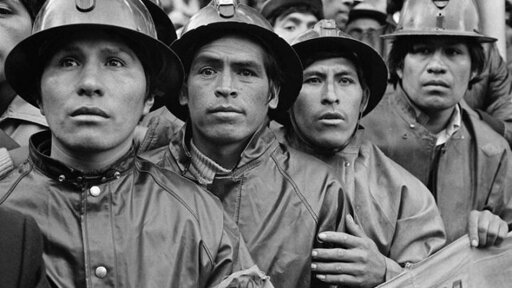
Bolivia’s deep crisis is putting President Rodrigo Paz Pereira’s austerity government in a tight spot. There have been barricades, protests, and clashes with police forces, while workers, peasants, and students are gaining strength and taking center stage. This militancy is not new. It is a product of Bolivia’s labor and popular history.
Seventy-four years ago, workers and miners took up arms and defeated an entire national army in the largest revolution ever to take place in South America.
What was happening in Bolivia during those years? In the early 1950s, a military government defended the interests of mining magnates, known as the “tin barons.” It was an oligarchic, sexist, and racist regime in which only literate men were allowed to vote — just 10 percent of the population of 2 million.
Workers and ordinary people had been confronting the military and resisting repression through strikes and street demonstrations. Leading the way were the miners, a powerful force thanks both to their numbers and their influence in an economy where mining was a key sector. They also had access to dynamite.
We cannot fail to mention the influence of the Pulacayo Theses, a highly significant document from 1946 written by Guillermo Lora, a Trotskyist leader of the Revolutionary Workers’ Party (POR). The document was approved by a vote at a congress of mineworkers. It stated that workers had to be politically independent — that is, not rely on traditional political parties — to fight for the nationalization of the mines. The mines had to be put under the control of the miners, who had to arm themselves to confront repression.
In 1951, elections were held, and the Revolutionary Nationalist Movement (MNR) — a bourgeois nationalist party — won. The military refused to hand over power and staged a “self-coup,” forming a military junta headed by General Ballivián.
By 1952, the political and social crisis was severe. Feelings of resentment and anger had already spread after Bolivia’s defeat in the Chaco War. All this led to a conspiracy to stage another coup. Officials of the dictatorship, police and military chiefs, and leaders of the MNR worked behind the scenes to stage the coup. The plan was to carry out the coup quickly and efficiently in the early morning of April 9, but opposition from the military high command caused the attempt to fail.
The Bolivian labor movement not only repelled the coup but went on the offensive to defeat the entire oligarchic regime. On April 9, armed groups emerged from mines and factories, forming makeshift militias that clashed with the regular army.
Fighting broke out in the capital city of La Paz. There, weapons were seized and soldiers were arrested. Many workers had experience handling weapons because they were veterans of the Chaco War; some became natural leaders of the uprising. The women worked behind the lines, organizing supplies for the troops and serving as nurses.
The army suffered defeats in various battles. It barricaded itself inside the El Alto Air Base and bombed Villa Victoria in an attempt to advance on La Paz. Meanwhile, miners from Milluni held an assembly and voted to march in two large groups: one headed down toward Villa Victoria, and the other went to El Alto to join the people there.
On April 11, the miners seized a train carrying ammunition and weapons. Having obtained heavy weaponry, they launched their attack. These victories served to boost the people’s morale. In the Battle of El Alto, the revolutionaries, armed with dynamite, rifles, and pistols, advanced up to the area where the military was stationed and defeated them. More miners joined the fight. Further clashes broke out in other cities. In Oruro, the last “loyalist” regiments were defeated under a barrage of dynamite. The revolution wasn’t confined to the cities: it quickly spread to the countryside. Indigenous peoples confronted the landowners, who had long exploited and oppressed them.
In just two days, Bolivia’s oligarchic regime ceased to exist, and the masses took center stage in the political and social arena, becoming practically the only force left with any power.
So, what happened? The Bolivian workers staged a revolution but did not take control of the government. The MNR remained in power, with Paz Estenssoro as president after his return from exile. The masses who had risen up placed great hopes in him. At the same time, on April 17, the Bolivian Workers’ Confederation (COB) was founded. It was the COB that organized the unions and the workers’ militias that had formed in the heat of the revolution.
The COB harbored a trap. It was very powerful and large, and even gave rise to situations of “dual power” in the sense that, by having defeated the army with its own militias, it was in a certain way beginning to assume the functions of a state. But because it was led by the union bureaucracy affiliated with the MNR — that is, with the new government — it ended up becoming integrated as a sort of advisory body of “worker ministers.” This contained rather than expanded the revolutionary process. The agreement between the MNR and the COB ultimately expressed class collaboration, very different from what the Pulacayo Theses had stated. That is why the process ended up being diverted within legal boundaries.
The MNR government succeeded in rebuilding the army and reached agreements with the United States. Significant concessions were made, which were necessary to quell the insurgency. For example, the mines were nationalized, though their owners were compensated.
Agrarian reform was also implemented, though on a limited scale. It was carried out primarily because it was necessary to legalize a series of measures that were fait accompli, such as the thousands of peasants who had seized land, particularly in the Cochabamba area.
In addition, universal suffrage, including women’s suffrage, had to be enacted. The MNR regime used this to legitimize its hold on power. It also appointed workers to individual public offices, seeking to dismantle a historic demand for workers’ control — that is, for workers to control production.
The MNR revealed its true colors a few years after the revolution. In 1956, it agreed to austerity measures with the IMF. Years later, and not without significant resistance from the working class, the defeat was finally cemented by General Barrientos’s military coup in 1964.
Unfortunately, the POR, which was supposed to be the left-wing alternative, merely acted as the “left-wing adviser” to the union bureaucracy and the MNR. It never seriously attempted to win the leadership of the working-class and peasant masses, starting with the miners, among whom it had significant influence at the outset of the revolution.
Unlike what happened during the Russian Revolution, when dual power began to emerge and the slogan “All power to the soviets” was raised, in Bolivia, the slogan “All power to the COB!” was not raised. No path was put forward toward political independence by establishing a workers’ and peasants’ republic, expropriating the big capitalists, and breaking free from imperialism — thereby winning the sympathy and solidarity of many other oppressed peoples.
The Bolivian Revolution was marked by a spirit of sacrifice, courage, and fighting spirit. It also involved armed struggle and workers’ militias. Yet it lacked a revolutionary party to organize all these forces, rather than handing power over to the government of the business elite.
The Bolivian Revolution was truly monumental; it erupted in the heart of South America, and its lessons remain as relevant as ever in a world where the capitalist system has nothing left to offer, as is demonstrated by the deep and severe crisis that the country is now facing.
This article was originally published in Spanish on La Izquierda Diario on May, 19th.
Translated by Otto
The post The Bolivian Revolution of 1952: When Workers and Miners Defeated a National Army appeared first on Left Voice.
From Left Voice via This RSS Feed.