

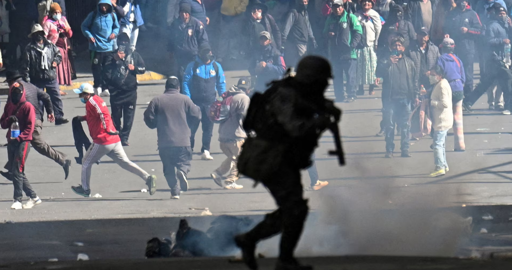
Bolivia is witnessing a genuine rebellion of the working class, peasants, and other popular sectors. They are fighting their second major battle against the austerity government of right-wing president Rodrigo Paz in just six months of his administration.
This is no coincidence. Last December, Paz issued Supreme Decree 5503, whose first measure was to eliminate fuel subsidies, effectively doubling fuel prices in what became known as the gasolinazo. The decree also came packaged with a broad set of austerity and extractive measures targeting the Bolivian masses.
From December onward, an enormous wave of opposition began to build. The Bolivian Workers’ Central (COB), the country’s largest trade union federation, called a series of mobilizations against the austerity package. This grew into a broader movement, eventually reaching half a million people in the streets.
Yet faced with a situation that threatened to spiral beyond their control, the COB leadership, headed by Mario Argollo, chose to negotiate with the Paz government in January. The result was a decree co-signed by the labor leadership that effectively accepted the gasolinazo as a baseline, gutting the incomes of families in both rural and urban areas. Meanwhile, the leadership secured only a postponement of other measures, such as the privatization of natural resources.
It was a genuine betrayal of the growing movement.
Taking advantage of the resulting demobilization, Paz proceeded to issue a string of executive decrees that not only resumed the austerity agenda but also cracked down on social protest, including an outright ban on road blockades. Meanwhile, the fuel price hikes rippled through the cost of basic goods, eroding living standards. Adding insult to injury, a major scandal erupted over the sale of adulterated imported fuel (“junk gasoline”) that was sold at exorbitant prices while damaging both personal vehicles and those of transport workers.
Rodrigo Paz’s Deception and Austerity Agenda
Just over a month ago, the government issued Decree 1720, benefiting agribusiness interests and large landholdings, overriding the Bolivian Constitution which protected small properties from potential seizures. This new attack, a form of privatization, ignited fury in the communities, who organized a long march from Pando and Beni to La Paz, converging there with the assembly on May 1 called by the COB.
That assembly had been convened under intense grassroots pressure from sectors demanding that union leadership take a stand against the privatization of state enterprises, cuts to healthcare and education, and the dismantling of workers’ pensions. These accumulated grievances were channeled into a formal list of demands to present to the Paz government. All of this culminated in the COB leadership being forced at this assembly to call for an indefinite general strike, even as it was, for the time being, not being implemented as an actual work stoppage.
It’s worth noting that although Decree 1720 was subsequently repealed, the government only kicked the problem down the road: the issue will return, in conditions even less favorable to the communities, with an eye toward advancing agribusiness and corporate interests.
As these attacks continued, the demand for Paz’s resignation (¡Fuera Paz!) gained increasing traction, driven by the conviction that negotiation is futile and that the government’s repeated failure to honor its commitments has made compromise impossible. The demand has been taken up by broad sectors, particularly in La Paz and Oruro — regions where many had voted for Paz (drawn largely by the profile of his vice president, Edman Lara) as a supposed lesser evil against right-winger Tuto Quiroga.
They have since felt clearly deceived, as Paz has pursued an austerity agenda that rivals any in the region, including that of Argentina’s Javier Milei, making plain that he governs in the interests of imperialism and big business.
Organizing from Below Against the Betrayal
As these demands intensified and the calls for Paz’s resignation grew louder, it became clear that the leaderships of neighborhood associations, the FEJUVE (El Alto’s federation of neighborhood councils), and especially the COB were not delivering on the commitments made in the May 1 petition, starting with the indefinite general strike.
So workers and communities began taking matters into their own hands, working to repudiating these co-opted leaderships. Paz, sensing the discontent, attempted to divide and negotiate separately with each sector: rural teachers, urban teachers, health workers, regional federations in Potosí and other departments, the FEJUVE, and indigenous lowland organizations like CIDOB. This tactic only deepened anger at the base, since such negotiations serve only the leaderships and fail to address the demands of those most harmed by the austerity measures.
In response, people from different districts of the city of El Alto began to gather at the roadblocks, feeling called to action and expressing the need to organize. As one woman at a blockade put it: “We have to do something — we can’t just stay home, we don’t have enough to eat.” Another added: “We’ve put up with a lot. Bread prices went up and we said nothing. But now it’s unbearable as, on top of everything else, the gasoline is garbage, it costs twice as much, and you wait in endless lines just to get it.”
Rebellion and Self-Organization
Out of this situation, in various districts, particularly in Senkata, groups of people began self-organizing from below. As they sought to join the blockades, they found their own leaders pushing dialogue and accommodation with the government instead. So, they began to reject them. In one case, a leader of the southern FEJUVE in El Alto accepted a vehicle as a gift from the Paz government. The base repudiated him and demanded he return it. He eventually did, announcing, “I’ve done by part,” but that wasn’t enough. The community subjected him to chicoteo, the traditional form of communal justice, citing not just the gift, but also the fact that he had sat down to negotiate with Paz while actively working to demobilize the very residents who want him gone.
This pattern is being repeated across the city. A standout example is the emergence of a self-organized blockade committee in District 8 of El Alto, near Puente Vela-Ventilla. Seeing their leaders unwilling to mobilize, residents called their own blockade, playing a pivotal role in paralyzing the flow of goods into La Paz.
These committees have also begun convening cabildos, or open assemblies where neighbors, workers, mothers with children, students, informal vendors, and small traders gather to debate next steps and coordinate blockade strategy. A recent assembly in Ventilla, for instance, resolved that the assembly itself would call on other blockades and mobilizations to strengthen.
Participating in the District 8 coordinating committee are miners from centers like Colquiri and elsewhere, who have also called for deepening and radicalizing the struggle, pressing the COB leadership to make the general strike real. This anger is sharpened by the government’s threats to privatize the mining centers.
These experiences are crucial: the committees are beginning to coordinate across districts and zones, and are calling on other workers and peasants to join these democratic organizing bodies and to take the implementation of the indefinite general strike into their own hands until Rodrigo Paz is gone.
Another example comes from the community of Guarinaca, in the Río Abajo valley in the municipality of Mecapaca, also in the La Paz department. A leader from this community attended a dialogue convened by President Paz, which generated enormous discontent there, since no one trusts the government — a situation compounded by anger over the government’s racist rhetoric that labels them vandals, savage Indians, and terrorists. The community, who no longer want to be deceived, are finding new leaders and representatives.
The scope of this rebellion against the bureaucracy was on full display at an emergency assembly convened by the COB on Saturday, May 23, open to both affiliated and non-affiliated sectors, including the self-organized committees. Representatives of the District 8 blockade stood before the COB Central Committee and demanded the leadership move immediately toward a real general strike, insisting that the union could not abandon them. They spoke from their own experience: they had set an example by confronting the repression and maintained their blockades even through the heavy snowfall that blanketed El Alto in recent weeks. Their intervention challenged the COB’s willingness to engage in dialogue with the Paz government and prompted delegates from blockades across the country to raise their own voices for escalation.
These early steps in grassroots self-organization point toward a necessary horizon: those fighting at the dozens of roadblock points across the country and participating in mobilizations must be able to democratically debate their next moves at every moment, without placing any trust in Paz or in any other representative of big business and imperialism.
The government’s threats to declare a state of emergency and intensify repression, alongside the attacks of the Far Right, must serve as a warning to deepen coordination across sectors and escalate the struggle. As one delegate from the Senkata blockade committee put it, that begins by demanding the COB make the general strike real in every workplace, while fighting to impose it from below.
The post Rebellion in Bolivia: Grassroots Organizing in the Face of Union Leadership Betrayal appeared first on Left Voice.
From Left Voice via This RSS Feed.