

With many votes still to be counted in California and little certainty in most of Tuesday’s closest-watched primary elections, one early pattern is taking shape: Progressive candidates for Congress across the state are failing to top their more moderate Democratic opponents.
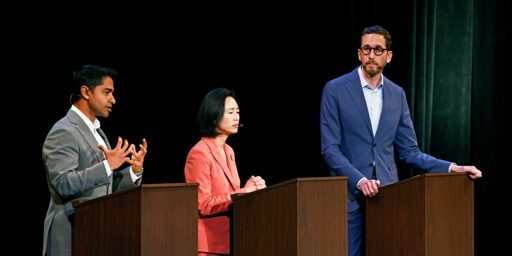
In the race for Rep. Nancy Pelosi’s seat in San Francisco, the YIMBY State Senator Scott Wiener secured a comfortable victory with more than 40% of the vote, according to the Associated Press, which made the early call. Local politician Connie Chan earned the second spot, according to the AP, leaving Saikat Chakrabarti, a prominent figure in national progressive politics, off the general election ballot in November.
In Los Angeles, AIPAC-backed incumbent Rep. Jimmy Gomez easily won a spot on the November ballot, according to a call from the AP. Despite the election day revelation of a House Ethics Committee investigation into allegations of sexual misconduct against him, Gomez fended off a challenge from the progressive insurgent Angela Gonzales-Torres by a wide margin. Results are still coming in, but Gonzales-Torres appears likely to face off against Gomez again in the general election thanks to California’s “jungle primary” system, in which the top two candidates move on to a runoff.
Meanwhile in Sacramento, longtime establishment Democrat Rep. Doris Matsui is currently leading progressive city council member Mai Vang, though that race remains too close to call.
In these three solidly blue districts, each race has been viewed as part of a wider battle for control between a Democratic establishment seen as faltering in the face of the second Trump administration and a progressive wing that has grown in influence in the decade since the 2016 presidential campaign of Sen. Bernie Sanders, I-Vt. — and argues the establishment strategy gave rise to Trump in the first place.
Chakrabarti, Gonzales-Torres and Vang all had the backing of Justice Democrats, a group that supports progressive challengers in primary elections and helped elect members of the Squad in Congress. Earlier in the evening, Justice Democrats notched a victory when Dr. Adam Hamawy, a former combat surgeon who volunteered in Gaza and faced a barrage of attacks that often peddled in Islamophobic tropes, comfortably beat a crowded field of Democrats in New Jersey.
Justice Democrats had hoped to elevate Chakrabarti, one of its co-founders, to Congress. After earning his fortune at the tech firm Stripe, the centimillionaire worked on Bernie Sanders’s 2016 presidential campaign, co-founded Justice Democrats, and became chief of staff to Rep. Alexandria Ocasio-Cortez.
Chakrabarti grew to become an influential activist in progressive politics, but he was often a divisive figure, known for riling Democrats online and antagonizing Rep. Nancy Pelosi, D-Calif., who he hoped to succeed. Pelosi, who won her last reelection with 82 percent of the vote in her district, ultimately endorsed Chan, a San Francisco Board of Supervisors member. When the AP called the race for Chan, she held a lead of 13% over Chakrabarti.
Chakrabarti, Chan and Wiener all jockeyed to be seen as the progressive in the race: All three campaigns call for Medicare for All, the overturning of Citizens United, and abolishing or defunding of Immigration and Customs Enforcement. Yet differing views on Israel’s genocide of Palestinians and wealth taxes on billionaires, which Wiener and some of his richest tech-and-development-friendly backers oppose, became notable wedge issues.
While Wiener and Chan have come to embrace placing conditions on offensive weapons to Israel, Chakrabarti advocated for a total arms embargo on the country. Wiener’s previous support for pro-Israel bills in the state legislature and his earlier opposition to a ceasefire in Gaza drew intense scrutiny during the race, and anti-genocide and anti-Zionist protesters at times disrupted his events on the campaign trail.
[
Related
This California Congressional Hopeful Opposes a Billionaire Tax. So Do His Tech CEO Backers.](https://theintercept.com/2026/05/14/scott-wiener-billionaire-tax-california-house-race/)
The weekend before the primary election, the race was jolted with final-hour reporting from Drop Site News that revealed the pro-Israel lobby giant, American Israel Public Affairs Committee, and its offshoot, Democratic Majority for Israel, DMFI, had been funneling money into a super PAC supporting Chan. Chakrabarti used the revelation to claim that AIPAC had attempted to keep him out of the general election because of his support for Palestinian human rights, suggesting a degree of collusion between Chan and AIPAC.
Chan, in turn, rejected Chakrabarti’s claims as “absurd and laughable.” She restated her campaign pledge against accepting AIPAC donations and her advocacy for Palestinian rights.
In Los Angeles, Gonzales-Torres, a community organizer, also made her opposition to the pro-Israel lobby and Israel’s genocide in Gaza a major part of her platform against Gomez. Despite the incumbent’s earlier vows that he would try to rid his fundraising of corporate backers in favor of grassroots support, Gomez’ previous two reelection bids have been fueled by special interest groups, such as the cryptocurrency industry and AIPAC and DMFI.
AIPAC has continued to support Gomez in the current election cycle, pouring nearly $150,000 into his 2026 run, according to FEC filings. Gomez has consistently voted to send military aid to Israel.
[
Related
Who’s Spending in Your Congressional Election? We Tracked the Front Groups Fueling the 2026 Midterms.](https://theintercept.com/2026/05/18/super-pac-election-spending-midterms-aipac-ai-crypto/)
The race was rocked after CNN reported Tuesday that Gomez was under investigation by the House Ethics Committee over allegations of sexual misconduct against Gomez. The news came months after the New York Post alleged Gomez, who is married, was spotted kissing the staffer of another member of Congress in 2023 at a party hosted by former Rep. Eric Swalwell, D-Calif. Swalwell resigned from Congress and ended a California gubernatorial campaign earlier this spring after reporters unearthed allegations of sexual assault former staffers leveled against him, which he denies.
Gonzales-Torres had previously called into question Gomez’s close relationship to Swalwell and asked whether Gomez, who backed Swalwell’s campaign for governor, had knowledge of the incidents at the time. On Tuesday, she wrote on X that if Gomez “has nothing to hide, he should have no concern. But if there was any criminal behavior that he witnessed, participated in, or helped conceal, we will find out and we will help ensure accountability and justice.”
Gomez, in a statement to CNN, admitted to “personal mistakes outside my marriage that have caused real pain to my wife and family,” but insisted he did not break the law or House ethics rules.
Gomez has thrice fended off another progressive challenger, attorney David Kim, who in 2020 trailed by 6 percentage points in the November general election and came only 3 points from winning in the 2022 general election. Gonzales-Torres, who had previously volunteered for Kim’s campaign, believes her campaign can build on that success and defeat Gomez.
In Sacramento, Vang is facing off against one of California’s most powerful Democratic families. Matsui has held her House seat since 2005, winning after the death of her husband, Bob Matsui, who had represented Sacramento in Congress since 1979.
Vang’s campaign criticized Matsui’s acceptance of corporate donations and painted Matsui as out-of-touch with a transforming Democratic voter base. Vang championed policies that have animated the left, such as Medicare for All, abolishing Immigration and Customs Enforcement, and the Green New Deal. At the time of publication, Vang is in a tight battle with a pro-Trump Republican candidate, Zachariah Wooden, a student at California State University, Sacramento.
Many primaries across the state, such as the Matsui-Vang contest, remain too close to call, with huge numbers of votes left to count and final positions far from settled. That includes the race for California governor, where moderate Democrat Xavier Becerra and Republican commentator Steve Hilton are neck-and-neck, with billionaire Tom Steyer, around whom progressives had coalesced, trailing in third at the time of publication. In the Los Angeles Mayor’s race, incumbent Mayor Karen Bass secured her spot in a November runoff, with reality TV personality Spencer Pratt leading Nithya Raman, a progressive councilmember.
Other progressive candidates led their races on Tuesday, including Jane Kim, who is running for the state’s insurance commissioner with the endorsement of Sen. Sanders. In Los Angeles, city attorney candidate Marissa Roy, who drew support from the city’s progressive base, is ahead of the incumbent, Hydee Feldstein Soto, who caught heat for defending LAPD’s brutal tactics against protesters and for deciding not to charge members of a Zionist mob that attacked UCLA’s pro-Palestine encampment.
The post Establishment Dems Stave Off the Left in Key California Congressional Primaries appeared first on The Intercept.
From The Intercept via This RSS Feed.