


In May 2019, I sat down with my mum in her living room and watched the first episode of Years and Years. This is a dystopian BBC drama created by screenwriter Russell T Davies. He is the same man who brought back Doctor Who in the mid-noughties. Since watching it in 2019, the six-part series has become an oracle. This is because almost every fictional prediction Davies makes in the series has terrifyingly come true.
Please note this article contains spoilers.
Predictions in Years and Years that came true
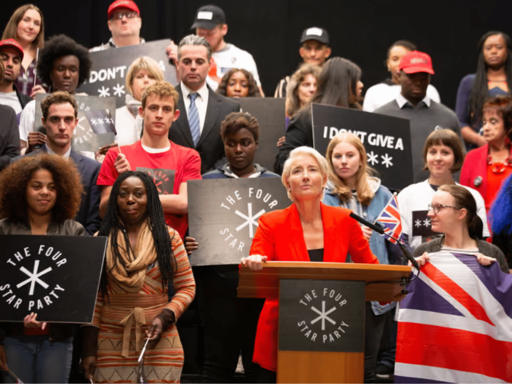
Years and Years follows Mancunian family the Lyons, who gather one night in 2019 to celebrate the latest addition to their family, baby Lincoln. The drama then quickly moves into the future and spans fifteen years of political turmoil, economic instability, environmental destruction and technological advances. Meanwhile, a far-right party, headed by celebrity-turned-politician Vivienne Rook (played by the brilliant Emma Thompson), rises to power in Britain.
In the first episode alone, which covers the period of 2019 to 2024, Queen Elizabeth II dies. President Trump is re-elected for a second term. Also, a Russian-backed military government takes control of Ukraine. Then, in 2025, character Celeste loses her job to artificial intelligence. Later in the series, Rook’s far-right, anti-immigration ‘Four Star Party’ secures a majority in the next general elections. Sounds scarily familiar, right?
It’s uncanny that, when interviewed by BBC shortly after the series aired, Davies said the idea for Years and Years was hatched a decade earlier. You might argue that Queen Elizabeth II was in her 90s and would have had to die at some point. Although the year 2022 is scarily spot-on. You might also argue that he may have been inspired by the rise of far-right parties in Europe. It is true that Russia had already begun its invasion of the Ukraine in 2014. But in October 2018, when the series was being filmed, no one could have foreseen Trump getting re-elected. Likewise, no one could have predicted a far-right party actually rising to power in Britain. Back then, Nigel Farage’s Reform Party was still called the Brexit Party. No one really took Farage and his outlandish politics seriously back then.
Certainly, when I first watched the series, the idea that you could lose your job to artificial intelligence or that a far-right party would one day win a general election in the UK was far-fetched. In 2019, AI was still an emerging topic and not a mainstream conversation. Many of us still believed that our government would forever be dominated by Labour and the Conservatives. However, as Davies’s predictions have continued to come true (the latest being Reform’s local elections success in May), Years and Years has become as accurate in its prophecy-telling as The Simpsons.
Other dystopian works that have come true
Years and Years is not the first dystopian TV series, film or novel to fulfil its prophecies.
The most often-used example is George Orwell’s 1984, in which a totalitarian party implements mass surveillance of citizens via two-way screens called telescreens containing hidden cameras and microphones.
It has been over seven decades since 1984 was published and mass surveillance is part-and-parcel of our everyday lives. For example, the CCTV cameras are everywhere, and our smartphones ‘listen’ to us.
According to Liberty, Britain has the most intrusive mass surveillance system of any democratic country. This is thanks to the Snoopers’ Charter or Investigatory Powers Act. This act grants the state the power to collect and store information on what we do and say online.
Why dystopian fiction is not fantasy
Dystopian fiction, as a genre, is less sci-fi and fantasy than the TV, film and publishing industries would have us believe.
What the three genres have in common is the aspect of world-building, in which the writer constructs an imaginary world that is believable. However, this is the only common denominator. Dystopian fiction is really a commentary on the social conditions we are already living in. What writers do is build upon both past and current political, social, economic and environmental conditions.
Indeed, author Margaret Atwood has often said that The Handmaid’s Tale was inspired by things that have already happened to women as opposed to being complete figments of her imagination. The Christian evangelism dominating American society in her book has long been a shaping force in American politics. It continues to be, as we see so evidently in Trump’s America.
An inevitable return to totalitarianism?
Most dystopian TV, film and literature imagine a totalitarian world order, but we have lived through totalitarianism before and we continue to live through authoritarianism. The level of restriction on freedom of expression, freedom of press, the right to gather and the right to protest here in the UK is living proof of that.
Back in January of this year, Home Secretary Shabana Mahmood proposed a new AI-powered mass surveillance system where:
the eyes of the state can be on you at all times.
And that’s under a supposedly ‘centre-left’ Labour government!
Thanks to Years and Years, I now watch dystopian TV and read dystopian books with a less sceptical lens. Who knows, maybe the next thing to come true from Davies’s predictions will be the ability to project phone filters onto our actual faces.
Featured image via the BBC / the Canary
From Canary via This RSS Feed.