

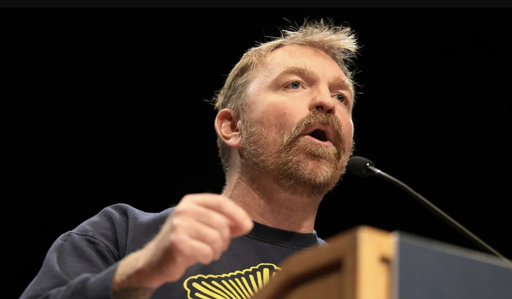
In the lead-up to the 2026 U.S. midterms, a new challenger within the Democratic Party is making waves. In August 2025, Graham Platner launched his campaign to become Maine’s Democratic nominee to unseat Senator Susan Collins, a so-called moderate Republican who has held her seat since 1997. After Chuck Schumer–backed candidate Janet Mills dropped out of the primary race on April 30, Platner emerged as the presumptive nominee, garnering widespread media coverage, including a profile in the New York Times.
Platner’s campaign gained traction by running on a populist platform. This has entailed extensive outreach to working-class Maine residents and slogans like “Tax the Rich” and “Medicare for All,” first popularized by Bernie Sanders and now championed by a new wave of neoreformists in the Democratic Party. Although Platner initially described himself as a democratic socialist, he has rebranded as a “New Deal Democrat” and distanced himself from the label “progressive” in order to appeal to a broader anti-establishment sentiment. Media outlets and politicians alike have been shocked by his rise in a purple state not typically known for its progressiveness. Yet the movement behind him is no accident.
In an era of global capitalism marked by wars, climate crises, unemployment, skyrocketing housing costs, and a fragile economy buoyed by a massive AI bubble, workers across the United States are increasingly seeking political alternatives. They are rejecting both the “business as usual” politics of establishment Democrats and the increasingly authoritarian Trump administration. Maine is no exception. The state’s workers are grappling with rising healthcare costs, a declining job market, and high-profile immigration raids carried out by ICE. In response to these issues, workers and oppressed people in the state are rightfully rejecting the Democratic establishment and billionaire candidates.
Platner thus emerges as a contradictory figure in Maine politics. On one hand, he presents a progressive economic platform with ambitious goals for redistributing resources, providing universal health care, and even reforming deeply undemocratic institutions like the Senate and the Supreme Court. He has also mobilized thousands at rallies and town halls across the state, employing a small-donor strategy and vowing to remove figures like Schumer from leadership.
On the other hand, Platner seeks to achieve these goals by bringing people into and “transforming” the Democratic Party, imbuing it with “New Deal–scale ambitions.” Reviving these political aspirations would require building a movement large enough to wage class war on the ruling class — something the Democratic Party would never allow. In addition, his platform includes aspirations for “rebuilding the American military” and strengthening the U.S.-Mexico border, both of which are deeply reactionary features of U.S. imperialism. A general sense of weakness on the Left leads some to believe that any shift in Democratic Party politics is a good thing, but this vision cannot offer real solutions for the working-class people of Maine.
While Platner has successfully organized a grassroots campaign capable of defeating an entrenched primary opponent and challenging a Republican incumbent, his potential victory won’t fundamentally shift the balance of power for working-class forces. In reality, Platner represents a revival of old-school economic populism with conservative leanings toward the capitalist state and military-industrial complex. The success of his campaign thus far is less a testament to the growing radicalism of Democratic politicians — Platner remains to the right of figures like Mamdani and Bernie — and more an opportunity to capitalize on broader anti-establishment politics that flourish in the absence of serious leadership on the Left. What is certain, however, is that his arrival heralds a much deeper shift in the political aspirations of working-class people, who are no longer willing to tolerate the dead-end status quo.
Rise of the “New Democrats”
Zohran Mamdani’s victory in the election for NYC mayor marked a turning point in the progressive movement — one defined by challenging establishment candidates by portraying themselves as democratic socialists, opposing U.S. wars in the Middle East, and championing popular redistribution policies. Like Mamdani, Platner openly references the FDR administration in his vision for changing the Democratic Party. His platform includes big policies like Medicare for All, a “Billionaire Minimum Tax,” opposition to the genocide in Gaza, and advocacy for a constitutional ban on “buying elections” and for the breaking up of monopolies.
These policies are certainly progressive relative to the politics of mainstream and established Democrats, who for years have served as the political servants of finance capital, pharmaceutical companies, AIPAC, and the military-industrial complex. They appear to have learned no lessons from Kamala Harris’s defeat to Trump in 2024 and continue to punish primary challengers who address working-class issues. Maine governor Janet Mills, at Schumer’s urging, ran a pathetic primary campaign against Platner, offering little more than “standing up to Trump.” At 78, she would’ve been the oldest first-time congressional representative in U.S. history.
Of all the “progressive” politicians who have made an impact since Sanders first ran for president in 2016, Platner presents himself as the most directly confrontational upstart against the Democratic Party establishment. He has opposed supporting Schumer as the party’s leader in the Senate, as well as Hakeem Jeffries as a potential House Speaker in 2027, placing him to the left of Mamdani on this issue. Additionally, his platform advocates eliminating the filibuster in Congress and imposing term limits on federal officials, structural changes that the Democratic Party has historically opposed.
These stances have been particularly important to the left flank of the Democratic Party, who are politically traumatized by the betrayals and right-wing pivot of current Senator John Fetterman on one hand, and the co-optation of figures like Alexandria Ocasio-Cortez on the other. Although Platner rhetorically presents himself in this way, in reality, there are no mechanisms for him to be held accountable to his base. Moreover, he offers no concrete strategy to achieve the policies he advocates, beyond electing more members of the Democratic Party — a party owned and controlled by the corporate elite.
As with Mamdani, volunteers in Maine who support or organize for Platner are likely to be politically sidelined and dismissed if he wins, given that this strategy is fundamentally anchored in political maneuvering rather than building working-class power. In his interview with the New York Times, Platner entertained the idea of packing the Supreme Court while claiming to have “spent a lot of time developing relationships with sitting Senators. [I] want to be a functioning part of the Senate.” One has to wonder how Platner expects to fight for reforms without being “a pain in everyone’s ass.”
Mobilizing or Organizing?
To his credit, Platner has spoken at length about the necessity of organizing the working class and addressed the deteriorating conditions that working people have faced in recent decades. Advocating directly for a “political revolution against the billionaire class,” he correctly points out that the working class forms a greater portion of society today but holds much less power, a direct result of extreme wealth inequality, the deterioration of workers’ rights since the 1980s, and increasing precarity from “forever wars” waged by the U.S., such as the one he was sent to in Iraq. In his view, reclaiming working-class power means wresting it away from the wealthy elite that started fixing elections and privatizing public services decades ago.
There are, however, several features of his political strategy and messaging that obscure the true nature of working-class power and its origins. As we’ve noted in previous articles, the FDR administration and New Deal policies were not the result of a suddenly benevolent Democratic Party working on behalf of ordinary people; rather, they were concessions granted in the face of rising working-class militancy and struggle, aimed at preserving a long-term future for the capitalist system. Winning large-scale reforms from the capitalist state would therefore require massive upheavals and a national movement engaging in large-scale mobilizations and strikes, especially in the context of a more repressive government.
Platner and his colleagues frequently describe themselves as “democratic socialists” and have repopularized the term “socialist,” but they refuse to challenge capitalism as the core feature that creates the crises his campaign seeks to address. Ironically, Platner used to consider himself a communist and took much stronger stances against U.S. imperialism after being radicalized by his experience in the army. Now that he is seeking political office at the federal level, he has to temper those views and limit the horizon of working-class strategy within electoral campaigns, which can champion popular policies if only more of his colleagues can be elected.
This doesn’t translate to movements that fundamentally threaten the system; instead, it offers a vision in which workers are left jumping from campaign to campaign, waiting for someone else to demand their rights for them. In the final analysis, class struggle and the greater self-organization of the working class are the only way forward for us to win not just policies that would make our lives slightly better but power over the people who exploit us.
The post Graham Platner’s Strategy of Transforming the Democratic Party Won’t Work appeared first on Left Voice.
From Left Voice via This RSS Feed.
In the final analysis, class struggle and the greater self-organization of the working class are the only way forward for us to win not just policies that would make our lives slightly better but power over the people who exploit us.
But…the answer is still not to have people in power who are aligned with that struggle? Wouldn’t electing more people to office, be a part of that “greater self-organization”? What exactly are you planning on doing with those efforts, if you refuse to put people in charge who will legislate those gains? These things need to be codified into law, if we are ever going to see lasting progress. That means having lawmakers on our side.
Or are you just suggesting that class struggle should go on forever, without any long-term achievements being made? Or that we should simply be satisfied to accept whatever scraps that “leadership” tosses us, in an effort to appease our rage?
Because unless we replace that leadership with our own, that’s all we will ever get.
