

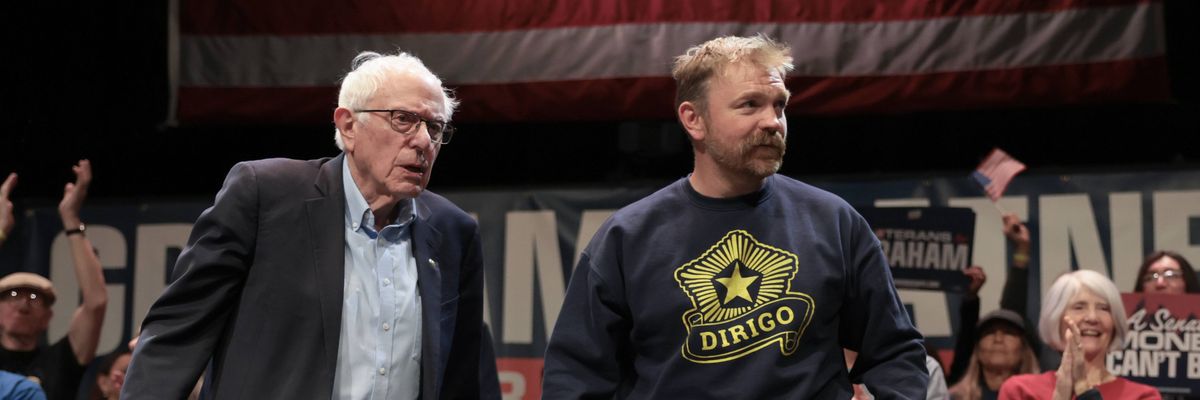
The super PACs pouring money into the US Senate race in Maine are doing a great job of proving Graham Platner’s point.
As new reporting on Monday detailed the flood of dark money targeting his campaign, the Democratic hopeful in recent days has put a spotlight on the super PACs, which he says have created a political system dominated by corporations and wealthy donors who want to distract from the serious issues and struggles faced by everyday voters and working families.
“I think it’s very telling that a political system that has become controlled by money, controlled by the power of organized money, is also a political system that is trying to convince all of us down here that policy and discussions around what government can or cannot do is not what they want to talk about,” Platner said during a conversation with Sen. Bernie Sanders (I-Vt.), a longtime critic of super PACs, posted to social media.
“It’s fascinating that the more money that goes into our political system,” he continued, “the less we talk about actual politics.”
“I agree with Senator Sanders: Super PACs should be outlawed,” said Platner.
On Monday, Sludge reported that a pair of shadowy nonprofits “with no public presence and no disclosed staff” have dumped at least $750,000 into a super PAC supporting Platner’s opponent, the five-term incumbent Republican Sen. Susan Collins, according to Federal Election Commission (FEC) filings.
Condorcet Initiative Corp. has given $500,000 to Pine Tree Results PAC across two separate donations, including $250,000 on May 1 that was disclosed in a filing reported to the Federal Election Commission last week. Ardleigh Impact Corporation contributed an additional $250,000 in April.
The PAC has spent nearly $4 million on attack ads against Sen. Susan Collins’ Democratic challenger Graham Platner, according to FEC data.
The two nonprofits are both described as shell-like entities linked to the same address in Springfield, Virginia, belonging to Republican political consultant Staci Goede.
The groups are part of a much larger network and have poured a combined $9 million into GOP-aligned PACs since 2024, including in four competitive Senate races in this coming cycle.
Goede, meanwhile, is the treasurer or officer for at least nine different nonprofits “that span Republican Senate campaigns, pro-Israel donor pass-throughs, and issue advocacy groups,” according to the report.
The Campaign Legal Center has filed a complaint against Ardleigh, arguing that the nonprofit, which contributed an astonishing $2.575 million across six federal committees in its first three months of existence, was being used as a straw donor to conceal the identities of one or more rich benefactors.
The source of the $750,000 aimed at Platner remains unknown. But the Pine Tree Results PAC is already known to have a slate of wealthy backers from the commanding heights of finance and tech, including Blackstone CEO Stephen Schwarzman, hedge fund founder Paul Singer, and Palantir CEO Alex Karp. The fund has also taken in contributions from an affiliate of the tobacco giant Altria and from the far-right news company Newsmax.
According to a FEC data, it has raised more than $16 million to help Collins ward off a challenger in 2026, which will almost certainly be Platner.
While the potential use of straw donors may present legal issues, the use of super PACs by wealthy backers to dump unlimited sums behind their preferred candidates is unquestionably legal under federal campaign finance law.
As of March, super PACs funded by crypto, artificial intelligence, pro-Israel donors, and outside groups had already spent more than $225 million trying to influence the 2026 election cycle, according to the Washington Post.
Platner has argued on the campaign trail that the unchecked ability of the wealthy to influence elections is a genesis point for the growing wealth gap between the rich and poor.
“The inequality we’re experiencing, it didn’t happen organically,” he said at a recent campaign event. “We live in the outcome of policy written by establishment politicians who for 40 years have been doing the bidding of those who donate the most money to them.”
The Pine Tree Results PAC had already spent nearly $4 million on ads attacking Platner as of May 20, according to FEC data. As Sludge’s reporting notes, “Rather than engaging with policy, the ads are exclusively focused on personal attacks against Platner, digging up comments the candidate made online going back as far as 2013.”
So far, attempts to mire Platner in personal scandal have done little to blunt the momentum of his populist campaign. A poll from the University of New Hampshire in late May showed him leading the incumbent by a nine-point margin among likely voters and other polls show similar advantages.
It can be expected that the PACs attacking Platner will make a meal out of recent reports from The Wall Street Journal and The New York Times that probe into the private details of his marriage.
But noting the failure of past attempts to drown Platner in controversy, Lever News founder David Sirota questioned in a piece on Monday if these sorts of “character” attacks even work in an age of politics defined by rapacious corporate greed and corruption.
He noted how Sen. Chris Murphy (D-Ct.) and Rep. Ro Khanna (D-Calif.) responded to recent questions from news outlets about whether Platner’s controversies mean he’s failed to “pass the character test.” Murphy responded that “character involves standing up to people who are bankrupting and corrupting this country,” while Khanna lauded Platner for “having the character to stand up against the war in Iran, against genocide, and against an unfair and lopsided economy.”
This response, Sirota said, hinted that the country could be entering a new political paradigm—“a reality in which many voters are so economically pulverized and politically disillusioned that they now define ‘character’ in a politician solely as whether or not they are single-mindedly focused on destroying oligarchy and ending corruption.”
“It is, potentially, a new era in which voters who can’t afford anything and who feel totally ignored by their government have reimagined their entire definition of political ‘character’ on economic/anti-corruption terms—rather than on old definitions of personal moral rectitude,” he wrote. “In this potential new reality, the personal shortcomings of individual politicians—which often have little effect on voters’ actual lives—are less important and electorally salient than the policies those politicians support and oppose."
“And such a shift,” he added, "would make sense in the current moment.”
From Common Dreams via This RSS Feed.