

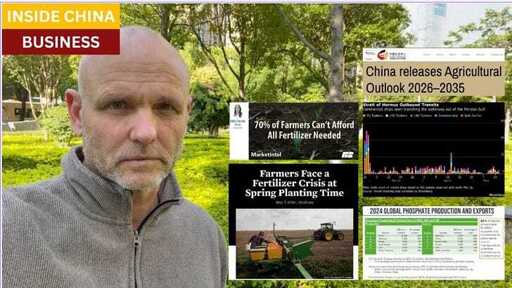
Bullets:
The War on Iran has left hundreds of thousands of tons of fertilizers stranded in the Persian Gulf, and destroyed years of forward natural gas production.
Fertilizer supplies are collapsing, with billions of dollars’ worth of contracts to farmers voided.
China enacted export curbs on fertilizers and upstream products in the opening days of the war, to ensure domestic farm production was not impacted.
Inside China / Business is a reader-supported publication. To receive new posts and support my work, consider becoming a free or paid subscriber.
Report:
Good morning.
Inflation in the United States is hitting multi-year highs again, with particularly big jumps in energy and food prices. The Consumer Price Index rose 3.8% since the same time last year. Gas prices are up sharply, along with food, coming either from restaurants or supermarkets.
There won’t be any relief on household spending for food anytime soon, and farmers – almost everywhere – are making painful decisions about how much to plant this Spring, based on those rising prices for fuel, and now for fertilizers. Both of those problems come from the War on Iran, and the closure of the Strait of Hormuz.
Fertilizer prices for American farms are ripping higher. Urea costs are up 47%, with DAP and other fertilizers up double-digits. In the United States, over three-fourths of the total cropland is treated with synthetic fertilizers, and most of that fertilizer is used in the Spring months, or right now.
Farmers signed supply contracts last year and earlier this year, but those contracts are not being honored by global suppliers. We covered that problem before; Middle East suppliers declared Force Majeure on billions of dollars of natural gas contracts, and there isn’t nearly enough coming from anywhere else, at any price.
In the United States, the situation is more severe in the South and Northeast, but farmers everywhere have a problem. 70% of farmers can’t afford all the fertilizer they need to plant their crops for this year.
Diesel fuel prices are also much higher, which means higher operating costs for farm tractors and transport, as well as for the heavy equipment used in irrigation. And fuel and fertilizer costs won’t come down, much, for later this Fall, or in time for next year’s planting season. Small- and medium-sized farms are under a lot of pressure, and bankruptcies are likely to also rise because crop prices aren’t going up nearly fast enough to cover the increases in cost.
This crisis was obvious, even in the early days of the war, when 21 ships carrying about a million tons of fertilizers were stuck in the Persian Gulf. About half of that was urea, and another eight ships with over 300,000 tons of sulfur. Sulfur sourced from the Middle East is primarily used as fertilizer. Half of those ships were intended for Asia, and urea heading to the United States was also stuck.
China, however, is getting some of their ships through the Strait. And China’s position in the fertilizer industry has ironically become much stronger, at least relative to other markets. Chinese farmers are planting their Spring crops, same as normal. The supply of fertilizer in China is sufficient, and prices are far lower than anywhere else.
Governments across the world are focused on finding energy and petrochemicals from wherever they can get them, while China is largely unaffected by those problems. It’s the same here, for fertilizers. The war on Iran has scrambled all these markets, and China enjoys supply-chain advantages on everything that goes into making chemical fertilizers.
China produces a third of all the fertilizer in the world, while also producing 70% of the raw materials used in the industry worldwide. That math, right there, makes China a major exporter of those upstream chemicals used to manufacture synthetic fertilizers, which we’ll come back to. All that production means that China has more latitude and flexibility, as they are far less reliant on the trade through the Strait of Hormuz.
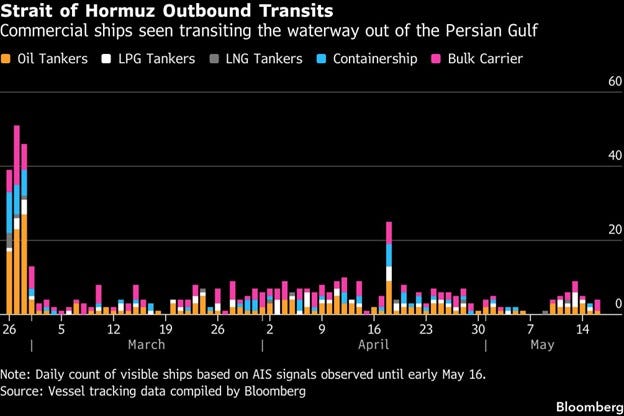
Traffic through the Strait has collapsed, to just a handful of vessels per day, from over 50 before the war, and we’ve already seen that a bunch of those ships are coming to China anyway. There is some good news on this chart: fertilizers are usually shipped via dry bulk carrier; 85% of fertilizers go that way. Bulk transport are the pink bars on that chart, and some of those are getting through. Two caveats though—we don’t know how much of that is fertilizer, compared to other dry bulk, and those levels are still far, far below historical averages for this time of year.
China, though, is well supplied with fertilizers and is making them available to farmers. Beijing also put export restrictions on key raw materials for fertilizers, in the opening days of the war. That helped ensure domestic farmers would have uninterrupted access, and at lower prices than anyone else is paying. And price caps were put in place for urea.
Exports of sulfur were sharply restricted, with the exception of some sulfuric acid volumes for industrial users. That is pushing up prices across the world; up 44% in Chile, for example. 54% of sulfuric acid demand is for phosphate fertilizers; prices are shooting up for farmers.
A major reason for China’s “expanding dominance” over the fertilizer and petrochemical markets is low-cost energy. The Chinese energy mix is diversified, with costs that are the lowest in the world for a large economy.
China also has a lot of coal, and plants that produce Chinese fertilizers are mostly powered by coal, which doesn’t cost much. So in 2024, China led the world in the production of fertilizers, and ranked #2 in exports.
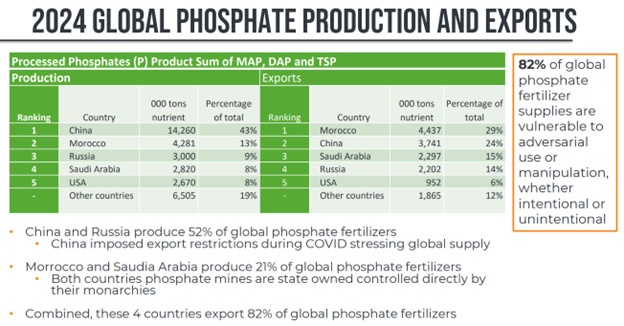
China and Russia together produce over half the world’s supply of phosphates, and add Morocco and Saudi and it’s over four fifths of the world supply. 82% of global phosphates are vulnerable to adversarial use or manipulation—that’s the conclusion there from the Department of the Interior, because such high levels of these fertilizers need to be imported to the United States from potentially unfriendly sources.
Farmers in North America, however, are saying their problems come from our own companies. Nutrien makes potash fertilizers, and their profits went up over 16 times in just three years. Mosaic’s profits jumped more than five times, and CF Industries increased by over 10 times:
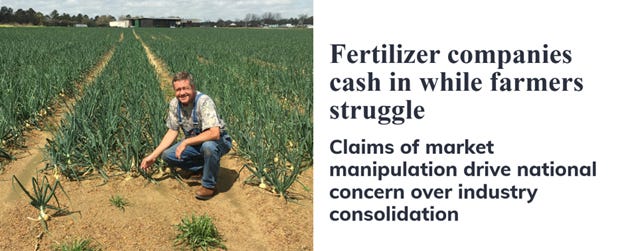
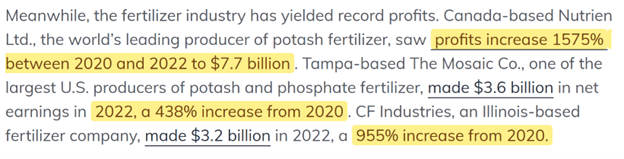
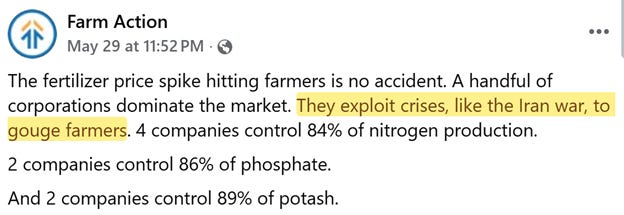
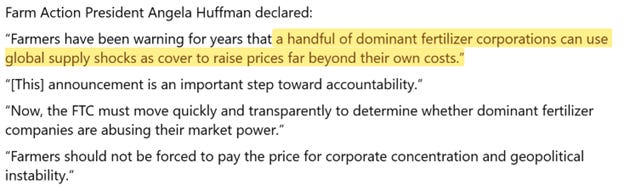
This is yet another story of industry consolidation that deliberately reduces competition, and supply. The number of fertilizer companies went from 46 to 13, and by 2019 just four companies made up 75% of total production in the United States. That allows them to exploit crises and jack up prices for farmers. Dominant fertilizer corporations can use wars, or other supply disruptions to increase prices much faster than their increases in cost.
Farm advocates are calling for the government to do something about it. But they pretended to care about the problem last year. This is the Senate Judiciary Committee—not the farm committee, but they’re looking here for crimes—and the hearing is on competition in the seed and fertilizer industries. Lawmakers are asking here, why fertilizer and seed prices keep rising, while competition keeps shrinking.
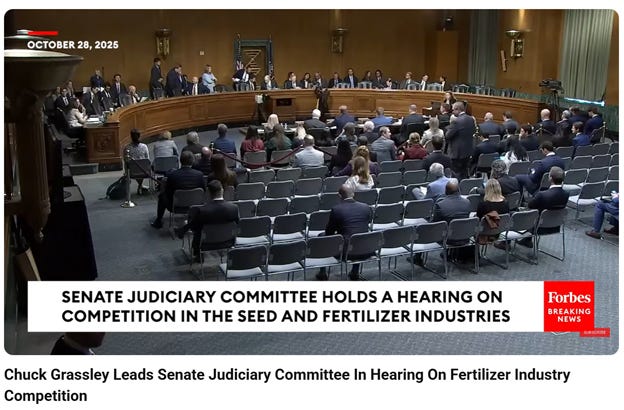
Democrats and Republicans, from Blue States and Red ones, are hearing complaints from farmers that their prices are shooting up, while the number of vendors in the market is going the other way.
This didn’t help much either, at the time. The Trump Administration proposed big tariffs on fertilizers imported into the United States, with new rates that would apply beginning last August on 84% of the American ammonium phosphate supply chain. Most of those eventually were exempted, except for the tariffs on ammonia, sulfur, and sulfuric acid—those tariff schedules stay, and now that the Hormuz is closed and China has shut off export, that’s not making it over to American farmers anyway.
And here’s another twist. Farm Action, remember, pointed out that fertilizer suppliers in the US take advantage of global crises to gouge farmers by raising prices. But when Mosaic’s costs went up, they responded by just shutting down production. From 12 May: Mosaic is reducing phosphate fertilizer production, cutting it in half from their plants in Louisiana and Florida.
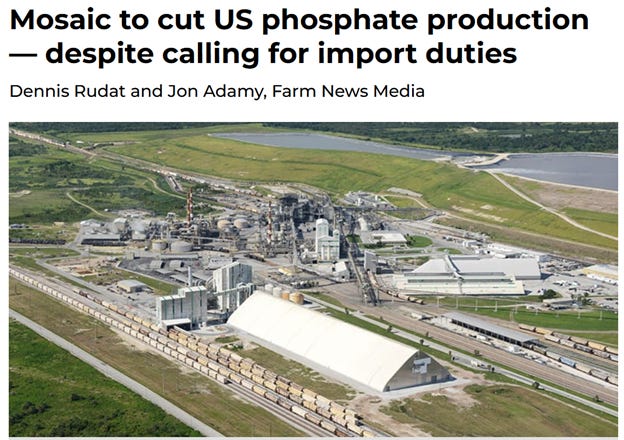
In April—just the month before—Mosaic publicly supported high tariffs on imports from Morocco and Russia to remain in place. Those tariffs were enacted in 2021, and are up for the five-year review. Mosaic is insisting here that if those tariffs on Morocco and Russia go away, it would threaten American suppliers like Mosaic who cannot compete on price. But they shut down production anyway, despite record prices. And that was because Mosaic cannot get sulfur either.
So the Fertilizer Institute was prophetic, in ways they surely didn’t intend, at all. What that industry group was doing there was asking for Congress to classify their products as critical minerals, and get a lot of federal money heading their way in the same way rare earth metals miners are getting big contracts now from the Pentagon.
Mosaic was even one of the panelists for the group who was warning that “fertilizer markets were vulnerable to manipulation”, whether deliberate or unintentional. That was last May, just one year ago.
Fast forward to now, the War on Iran has blown up energy markets in the Middle East, and so China now is the only country that can make cheap fertilizer. And China is also now the only country where its farmers will have surplus crops to sell in the fall.
Just one year.
Be good.
Resources and links:
How the Middle East crisis is expanding China’s agrochemical influence
https://www.scmp.com/economy/china-economy/article/3352366/how-middle-east-crisis-expanding-chinas-agrochemical-influence
China rushes to stabilise fertiliser market as Iran war chokes off imports
https://www.scmp.com/economy/china-economy/article/3347964/china-rushes-stabilise-fertiliser-market-iran-war-chokes-imports
Hormuz Blockade Propels China’s Fertilizer Dominance, Threatening Global Food Security
https://finance.biggo.com/news/Yqmx-50BDXrLZJaAEa1v
Suezmax tanker with Iraqi crude reaches India after Hormuz transit
https://economictimes.indiatimes.com/industry/energy/oil-gas/suezmax-tanker-with-iraqi-crude-reaches-india-after-hormuz-transit/articleshow/131140680.cms
Strait of Hormuz shutdown leaves 1m tons of fertilizer stuck in Gulf
https://asia.nikkei.com/business/markets/commodities/strait-of-hormuz-shutdown-leaves-1m-tons-of-fertilizer-stuck-in-gulf
Farmers demand fertilizer ‘monopoly’ probe
https://www.aol.com/news/farmers-demand-fertilizer-monopoly-probe-125650048.html
Fertilizer Prices Under Fire: Monopoly or Markets to Blame?
https://www.agweb.com/news/policy/ag-economy/fertilizer-price-fire-monopoly-or-markets-blame
China Suspends Sulfuric Acid Exports, Global Copper and Fertilizer Supply Under Strain
https://www.echemi.com/cms/2963199.html
Fertilizer companies cash in while farmers struggle
https://projects.wuft.org/priceofplenty/profit/the-cost-of-growth-fertilizer-companies-cash-in-while-farmers-and-communities-struggle/
Fertilizers ARE Critical Minerals
https://www.tfi.org/wp-content/uploads/2025/05/DOI-CM-Briefing-briefing-5-08-25.pdf
Key suppliers of phosphate fertilizer to US face 10%-25% tariffs from Aug. 7
https://www.spglobal.com/energy/en/news-research/latest-news/fertilizers/080125-key-suppliers-of-phosphate-fertilizer-to-us-face-10-25-tariffs-from-aug-7
Beef, Most Fertilizers Exempt from New Trump Tariffs
https://farmpolicynews.illinois.edu/2026/02/beef-most-fertilizers-exempt-from-new-trump-tariffs/
Most US ferts cleared under new import policy
https://www.argusmedia.com/en/news-and-insights/latest-market-news/2791825-most-us-ferts-cleared-under-new-import-policy
Mosaic to cut US phosphate production — despite calling for import duties
https://www.michiganfarmnews.com/mosaic-to-cut-us-phosphate-production-despite-calling-for-import-duties
Mosaic Pulls Guidance, Cuts Spending as Fertilizer Costs Surge
https://www.wsj.com/business/earnings/mosaic-swings-to-loss-on-surging-sulfuric-acid-prices-fec74551
Chuck Grassley Leads Senate Judiciary Committee In Hearing On Fertilizer Industry Competition
Farmers Face a Fertilizer Crisis at Spring Planting Time
https://blog.ucs.org/omanjana-goswami/farmers-face-a-fertilizer-crisis-at-spring-planting-time/
Food Price Outlook - Summary Findings
https://www.ers.usda.gov/data-products/food-price-outlook/summary-findings
China’s grain production trends upward
https://www.world-grain.com/articles/22559-chinas-grain-production-trends-upward
China releases Agricultural Outlook 2026–2035
https://www.dcz-china.org/2026/04/29/china-releases-agricultural-outlook-20262035/
Iran War fallout: Russia and China quietly take over natural gas markets in Asia, with Qatar gone
Mosaic to cut US phosphate production — despite calling for import duties
https://www.michiganfarmnews.com/mosaic-to-cut-us-phosphate-production-despite-calling-for-import-duties
Mosaic Pulls Guidance, Cuts Spending as Fertilizer Costs Surge
https://www.wsj.com/business/earnings/mosaic-swings-to-loss-on-surging-sulfuric-acid-prices-fec74551
Chuck Grassley Leads Senate Judiciary Committee In Hearing On Fertilizer Industry Competition
Farmers Face a Fertilizer Crisis at Spring Planting Time
https://blog.ucs.org/omanjana-goswami/farmers-face-a-fertilizer-crisis-at-spring-planting-time/
Food Price Outlook - Summary Findings
https://www.ers.usda.gov/data-products/food-price-outlook/summary-findings
China’s grain production trends upward
https://www.world-grain.com/articles/22559-chinas-grain-production-trends-upward
China releases Agricultural Outlook 2026–2035
https://www.dcz-china.org/2026/04/29/china-releases-agricultural-outlook-20262035/
Iran War fallout: Russia and China quietly take over natural gas markets in Asia, with Qatar gone
Inside China / Business is a reader-supported publication. To receive new posts and support my work, consider becoming a free or paid subscriber.
From Inside China / Business via This RSS Feed.