

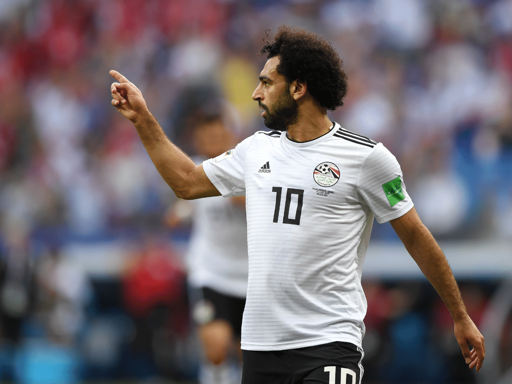

After its absence from the 2022 World Cup, Egypt returns to the 2026 World Cup loaded with huge ambitions and bigger questions – particularly for captain Mo Salah. The Pharaohs, who have one of the oldest teams in Africa and the most crowned on the continent, have not succeeded throughout their history in passing the group stage of the World Cup, despite their previous participation in the 1934, 1990 and 2018 editions.
Now, after years of continental and international failures, the Egyptian national team finds itself facing an opportunity that may not be repeated for an entire generation of players, led by Salah. Will the United States, Canada and Mexico witness Egypt’s best achievement in the World Cup, or will the dream be postponed again?
Between Salah’s experience and the ambition of the new generation
The Egyptian team enters the tournament with a combination of experience and ambition. Mohamed Salah remains the beating heart of the Egyptian project, not only as one of the best players in the history of the African continent, but also as the leader who carries the hopes of millions to achieve a long-awaited global achievement.
But the 2026 team does not rely on Salah alone as was the case in previous years. The team includes a group of players capable of making a difference in various lines, such as Omar Marmoush, who has become one of the most prominent Arab strikers in Europe, along with Ibrahim Adel, Ahmed Sayed “Zizou”, Hamdi Fathi, and Marwan Attia, names that gave the team a greater balance compared to the 2018 World Cup.
It seems that Egypt’s biggest gains in recent years have been the gradual elimination of the idea of complete reliance on one star, and the shift towards a more diverse collective system in offensive and defensive solutions.
A historic opportunity to break the knot
Despite the long history of the Egyptian national team, the World Cup has always been the tournament that has eluded it. In its previous three participations, the Pharaohs did not succeed in passing the first round, which makes the 2026 World Cup a historic opportunity to change this picture.
The new tournament system, with the participation of 48 teams, gives Egypt a greater opportunity to compete to qualify for the knockout rounds, especially if the team succeeds in investing in the experience of its senior players and reducing individual mistakes that cost it a lot in previous tournaments.
But the real challenge will not only be to qualify, but to prove the ability to compete with the major teams when the pace of competition increases. The world no longer views Egypt only as a team looking to participate, but as an African power that has the capabilities to offer something different.
A World Cup that may determine the legacy of an entire generation
For Mohamed Salah and a number of the current national team stars, this tournament may be the last chance to leave an immortal mark in the World Cup. History always remembers the players who succeeded in leading their national teams to exceptional achievements, not just those who shined with their clubs.
That is why Egypt’s mission in the 2026 World Cup seems to be bigger than just passing the group stage. It is an attempt to redefine the national team’s position on the global stage, and prove that Egyptian football is capable of translating its ancient continental history into a long-awaited global success.
If qualifying for the World Cup marks the end of the qualifying journey, the real challenge begins now. Between the dreams of the fans and the ambitions of the players, the Pharaohs stand before a rare opportunity to write the most important chapter in their World Cup history.
Tactical flexibility… The real weapon of the Pharaohs
If Mohamed Salah represents the most prominent face of the Egyptian national team, the most important strength appears in the tactical flexibility that the team has gained during the recent period. Analytical reports that followed Egypt’s progress under the leadership of Hossam Hassan indicated that the team no longer relies on a fixed method, but rather changes its method according to the nature of the competitor, with the ability to switch between the two forms 4-3-3 and 5-3-2 during the same match. This trend was clearly evident during the last African Cup of Nations, where the technical staff relied on defensive discipline against the major teams, while granting offensive freedom to Mohamed Salah and Omar Marmoush in quick transitions.
Featured image via Getty/Sean Botterill
By Alaa Shamali
From Canary via This RSS Feed.