

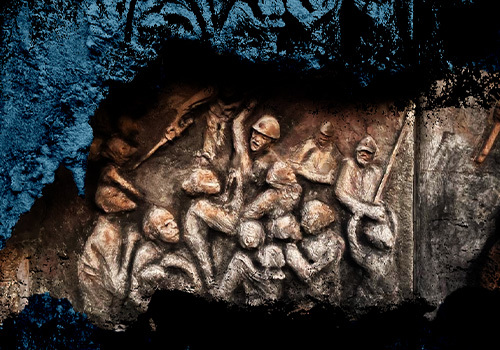
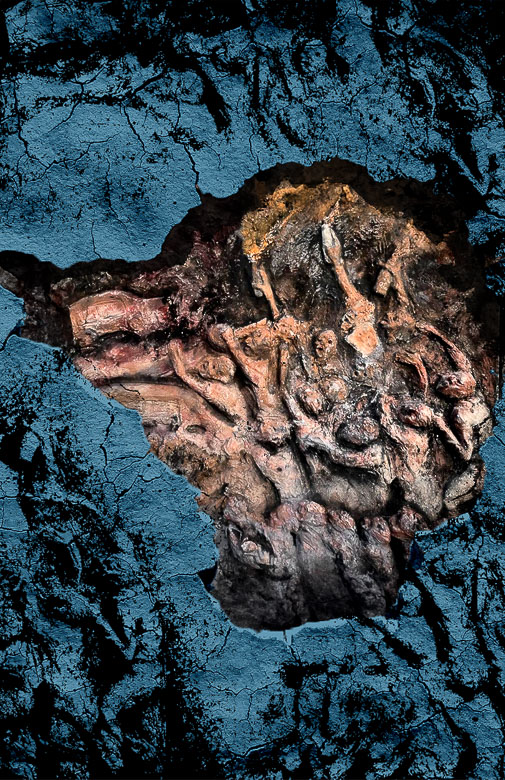
The images in this dossier, edited by Tricontinental’s art department, highlight the work of Kinjo Minoru, an Okinawan sculptor who honours the generations that have resisted war and occupation. For decades, Kinjo has carved the atrocities committed during and after the World Anti-Fascist War (widely known as the Second World War) era. Kinjo works in concrete, plaster, and metal – the same materials now being poured into Okinawa to build yet another US military base. In Okinawa – today a frontline in the New Cold War – Kinjo’s sculptures stand as memory and material refutation: a rough, heavy history that refuses to be smoothed over. 1



No Cold War, International Strategy Center, and the International Peoples’ Assembly
When the United States and Israel began their illegal war of aggression against Iran on 28 February 2026, it was inevitable that Iran would retaliate by restricting transit through the Strait of Hormuz. While Iran has never closed or restricted movement through the strait before, the government in Tehran had made it clear that the geography of the strait would become part of its defensive strategy if provoked. For the countries of Asia, the Strait of Hormuz and the Strait of Malacca are vital pathways – chokepoints – for the flow of goods, especially energy. Around 90% of Japan’s oil and 75% of South Korea’s passes through the strait. Any slowdown at the strait dramatically impacts the energy-hungry industrial economies of East Asia. From an economic perspective, the US-Israeli war on Iran is also a war against the interests of Japan and South Korea – and indeed every Asian country that relies on oil from the Persian Gulf. Despite this fact, many Asian countries have either maintained diplomatic silence or, as in the case of Japan and South Korea, openly backed the United States.
Countries like Japan and South Korea align with the United States against their own economic self-interest because they were absorbed into the US military architecture after the end of the World Anti-Fascist War (widely known as the Second World War).2 The continued presence of massive US military bases in these countries inexorably draws them into the US’s forever wars. These countries cannot break with the US on the war on Iran as long as they are militarily subordinated to it.
The US’s principal military target in Asia is not Iran but China, which is a leading trade partner of Japan, South Korea, the Philippines, Taiwan, and most other Asian countries. Given China’s centrality in the region’s industrial chains, any aggression against it would disrupt the entire development paradigm of East Asia. On the other hand, the US remains the principal military patron of Japan, South Korea, the Philippines, and Taiwan, as well as a major export market for several of them. This places these economies in a double bind: they can neither break easily from their military and economic dependence on the US nor can they break from their vital economic relationship with China – the new factory of the world.
In East Asia’s Double Bind: Contradictions and Possibilities in the New Cold War, we look at how Japan, South Korea, the Philippines, and Taiwan are caught in an intractable contradiction that persists regardless of changes in government. Although our focus is on East Asia, we also briefly analyse the role of states like Australia and India in this conjuncture. The contradictions explored in this dossier are primarily economic and geopolitical, yet they pose possibilities to advance the class struggle in these societies by exposing the need to break from subordinate alliances with imperialism.
East Asia and the Role of China
Over the past thirty years, Japan, South Korea, the Philippines, and Taiwan have seen a dramatic shift in their trade patterns and development trajectories.3 During the Cold War, the United States was the principal anchor of the region’s economic order, followed by Japan during the late twentieth century.4 Today, the new centre of gravity is China, which plays a central – though uneven – role across these economies. While each has its own development model and political relationship with Beijing, all four are deeply integrated into a production network in which China functions as a manufacturing hub, supply chain anchor, and primary market.
Studies by the World Bank and the Asian Development Bank have clearly demonstrated China’s economic significance in East Asia.5 China is the single largest trading partner for Japan and South Korea, accounting for roughly 20–25% of each country’s exports. Taiwan’s relationship is even stronger, with 30–40% of its exports going to China. The Philippines is less integrated, but China still ranks among its top trading partners, absorbing roughly 15–20% of exports. These figures indicate that a significant share of East Asian economic activity is directly tied to demand from China’s industries.6
When viewed in relation to overall economic output, the importance of China becomes even clearer. Trade with China, namely total exports, accounts for a tenth of South Korea’s Gross Domestic Product (GDP). A quarter of Taiwan’s GDP is tied to trade with mainland China. Japan, with a much more domestic-oriented economy, nonetheless has 5% of its GDP tied to exports to China (roughly the same percentage of its GDP is tied to the US, which includes the economic impact of the 120 US military facilities in Japan). The Philippines, while less export intensive, has around 6% of its GDP tied to exports to China.7 The vitality of the Chinese economy is therefore directly tied to the levels of output, employment, and investment in all of East Asia.
At the 2011 Association of Southeast Asian Nations (ASEAN) summit in Bali, Indonesia, member states discussed the necessity of creating a regional framework for economic integration. These discussions eventually led to the Regional Comprehensive Economic Partnership (RCEP), a trade agreement signed in 2020 and brought into force in January 2022. The RCEP accounts for roughly 30% of the world’s population and 30% of global GDP. Spanning economies from New Zealand to Japan, it brings together a range of industries, from mining to high technology, and a market of 2.2 billion consumers. Signatories have agreed to reduce or eliminate tariffs by 92% over twenty years. Japan, South Korea, and the Philippines are part of the RCEP, which reinforces trade flows and formalises the interconnected economic space in which China is the largest economy.8
Beneath aggregate trade figures, the structure of production further reinforces this integration. China is not only a final market but also a central node in regional and global industrial chains as a major consumer and producer of intermediate goods. Japanese and South Korean firms export high-value components – such as machinery and automobile parts, petrochemicals, and semiconductors – that are often assembled or processed in China before being re-exported globally. Taiwan’s semiconductor industry is deeply intertwined with Chinese manufacturing, as chips produced in Taiwan are often sent to China for integration into finished electronics.9 These integrated production structures have created sectoral interdependencies. South Korea’s semiconductor industry – led by firms such as Samsung Electronics and SK Hynix – relies on demand from Chinese electronics manufacturing. Japan’s automotive and machinery sectors – led by firms such as Toyota, Honda, Nissan, Mazda, Komatsu, Hitachi, and Mitsubishi – rely on Chinese consumers and production networks.
Taken together, these trade and production links show that all four economies are structurally linked to China, even though the degree of integration varies (it is the highest in Taiwan and South Korea and more moderate in Japan and the Philippines). This creates both opportunities for growth and vulnerabilities as US pressure on China reverberates across the region.
The Garland of US Military Bases
Over the past decade, the United States has consolidated a coherent military strategy aimed at encircling China. This ‘strategy of denial’ was formalised in successive US National Defense Strategy documents and articulated prominently in Elbridge A. Colby’s 2021 book The Strategy of Denial: American Defense in an Age of Great Power Conflict. Colby led the development of the 2018 National Defense Strategy as deputy assistant secretary of defence for strategy and force development during Trump’s first term and is now the US under-secretary of war for policy as well as a leading strategist behind the Trump administration’s approach to China.10 At the core of the strategy of denial is the idea that the Indo-Pacific – stretching from East Africa to the west coast of the United States and encompassing the Indian and Pacific oceans – is the most economically significant region in the world. US strategic interests depend on preventing China from displacing US primacy in the Indo-Pacific region. The strategy rests on deterrence through military superiority and alliance coordination, which has been institutionalised through the Quadrilateral Security Dialogue or Quad, which brings together Australia, India, Japan, and the United States (2017); AUKUS, the trilateral security partnership between Australia, the United Kingdom, and the United States (2021); the Pacific Deterrence Initiative, a US military funding and force-posture framework for the Indo-Pacific (2021); and the US-Japan-South Korea Trilateral Agreement (2023).11
Rather than direct confrontation, as with Iran, the US seeks to raise China’s cost of defence to an unacceptable level by strengthening the US-based alliance system and the forward positioning of US military bases. There are currently about 270 US military facilities stretching from Diego Garcia in the Chagos Archipelago to Guam. Central to this strategy is Washington’s belief that a credible US military capability can constrain China’s strategic choices while preserving a US-led regional order and continuing to draw on China’s role as an economic engine for the region.
Taiwan occupies a critical place in this US framework.12 On 1 January 1979, the United States formally recognised the People’s Republic of China and acknowledged Beijing’s position that there is ‘One China’, of which Taiwan is a part. However, on 10 April 1979, the US Congress passed the Taiwan Relations Act, which provided the legal basis for Washington to maintain an unofficial relationship with Taiwan. This allowed the US to play a double game, formally acknowledging the One China framework while provoking Beijing through arms sales to Taiwan and maintaining direct economic and cultural ties with Taipei. Since 1950, the United States has sold Taiwan nearly $50 billion in defence equipment and services.13 For the US, Taiwan’s status is not only political but strategic because Taiwan’s reunification with the mainland would give China significantly greater access to the Pacific Ocean. For Washington, Taiwan is an instrument to pressure Beijing and constrain China.
The US containment strategy is geographically organised through a system of encirclement that begins with the first island chain (an arc of islands that stretches from Japan to the Philippines and acts as a barrier to China’s access to the Pacific Ocean). This extends into the wider ‘encirclement depth’ of Diego Garcia, Sri Lanka, and the US bases in the Persian Gulf region.14 The US has developed a network of bases and access agreements along this chain to control key nodes and shipping routes and to constrain Chinese military mobility. This encirclement strategy includes not only large, permanent military installations (such as those in Japan and South Korea) but increasingly a dispersed network of smaller, more flexible sites across the Pacific and Indian oceans designed to enhance military resilience. The bases are integrated with surveillance, intelligence, and missile systems that enable monitoring and rapid response. Together, this military network constitutes a structured system of containment. While US national security documents frame this as defensive deterrence, the effective positioning of US forces along China’s border creates tensions rather than resolving them.
The US strategic framework of containment and encirclement has been operationalised through a sustained expansion of US military capabilities and infrastructure in East Asia, particularly over the past two decades and with increasing intensity since 2020. The US has also been funding large-scale military exercises such as Exercise Balikatan (with the Philippines), Exercise Malabar (with Australia, India, and Japan), and Exercise Talisman Sabre (with Australia). These efforts are designed to improve military interoperability and turn US allies from regional partners into frontline participants in the containment of China.
One of the more recent frameworks advanced by the US is the Pacific Deterrence Initiative (PDI), which was established by the 2021 US National Defence Authorisation Act.15 The PDI ensures dedicated funding for force deployment, base infrastructure, missile defence, and joint exercises with US allies such as Japan, South Korea, and the Philippines. In Japan, the PDI has ensured upgrades to missile defence and rapid deployment forces. In South Korea, it has enabled joint exercises, while in the Philippines it has upgraded US bases and surveillance systems. The PDI also underpins the integration and deployment of long-range precision missile systems across the Indo-Pacific. This includes the expanded air and missile defence capacities that have been built up at US military bases in places such as Guam and the Mariana Islands as well as Basa Air Base in the Philippines (for which the US government allocated around $66 million in 2023).16 The PDI ensures intelligence, surveillance, and reconnaissance systems that enhance the tracking of regional military activity and enables what is known as ‘precision targeting’ – the rapid identification and accurate striking of military targets.
These developments have transformed countries like Japan, South Korea, and the Philippines into forward operating platforms for US aggression.
Sowing Conflict: Class Contradictions and the Limits of Democracy
The US strategy of denial depends not only on military integration but also on the alignment of the ruling classes across the first island chain into a coordinated anti-China posture – particularly in Japan, Taiwan, and the Philippines, and more broadly in neighbouring South Korea. This alignment reflects the interests of the domestic industrial, military, and political elites tied to US power. Across Japan, South Korea, the Philippines, and Taiwan, the deepening of US military integration sharpens existing class contradictions and exposes the narrowness of electoral systems. While this generates resistance from below, these political systems are designed to prevent the growth of any force that is inimical to US intervention. Additionally, each of these societies bears the scars of the World Anti-Fascist War and the postwar US military presence, including military bases that are now seemingly permanent – an experience that has continued to define the political outlook of these ‘client states’.17
Japan
Japan’s postwar political system has been dominated by the Liberal Democratic Party (LDP), a right- to far-right political formation with intimate ties to the US state and capital. While formally democratic, Japan’s political system is effectively dominated by a single party, with the LDP in office for all but four years since its formation in 1955. Though article 9 of Japan’s 1947 Constitution, sometimes called the ‘pacifist clause’, forbids a military build-up going beyond minimal defence, the political right has called for its removal since the premiership of Nobusuke Kishi (1957–1960). In 2014, during the premiership of Kishi’s grandson, Shinzō Abe (2012–2020), article 9 was reinterpreted to allow for ‘collective self-defence’, enabling the expansion of Japanese military spending – which has risen particularly since 2022 under prime ministers Fumio Kishida, Shigeru Ishiba, and Sanae Takaichi. Between 2023 and 2024, Japanese military spending rose by 21%, accounting for 1.4% of the country’s GDP.18 In April 2026, under Takaichi, Japan lifted a ban on the export of lethal weapons, which had been put in place based on the logic that a pacifist country should not profit from wars.
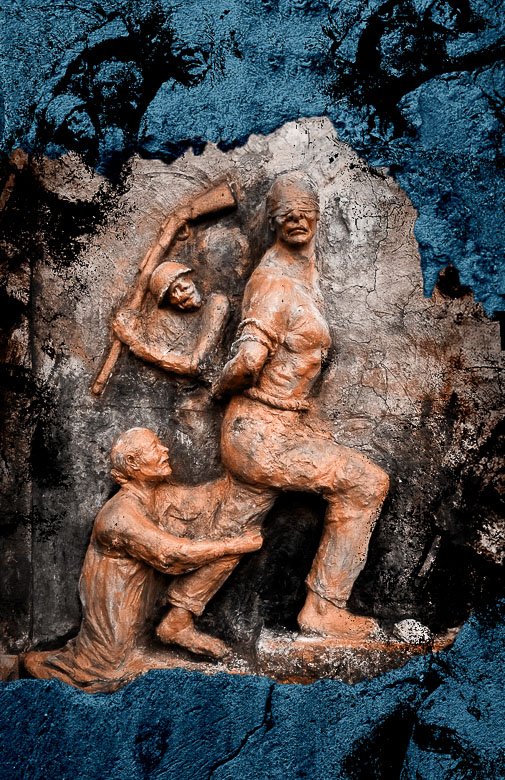
The contradiction between military spending and democratic demands that Japan’s wealth be invested on social needs – exemplified by anti-base protests in poorer regions like Okinawa – reveals the limitations of Japan’s formal democracy. Japanese society remains subordinated to military priorities defined by a permanent Japanese elite aligned with the US.
The construction of a new Marine Corps base in the Henoko-Oura Bay area of Okinawa, intended to replace Futenma Air Station – long criticised for its location in the middle of densely populated Ginowan – has faced continuous opposition since 1996. In 2018, Denny Tamaki was elected governor of Okinawa on an anti-base platform; in a prefectural referendum held in 2019, 70% of respondents opposed the construction of the base. Despite such democratic mandates and decades of legal challenges, Japan’s central government proceeds with landfill operations that are destroying Oura Bay’s coral ecosystems on behalf of the US military.19 Organisations including the All Okinawa Council Against Construction of New Base in Henoko, the Okinawa Peace Movement Center, the Okinawa Environmental Justice Project, and the Henoko sit-in protesters – who have maintained daily resistance for over two decades – embody a politics that connects local struggle to broader questions of imperialism and self-determination.20
South Korea
South Korea’s political history is marked by intense class struggles. Born amid the Korean War, which began in 1950 and remains formally unresolved since the 1953 armistice did not produce a peace treaty, South Korea has been treated by the United States as a military base and economic bulwark against communism. Though it has been under pro-US administrations, including a military dictatorship from 1967 to 1988, South Korea’s political system has appeared more fluid than Japan’s: no single party has ruled continuously. Nonetheless, elected governments, both conservative and liberal, have remained structurally dependent on the US. For example, this was the case under both Yoon Suk-yeol, a conservative strongly aligned with the United States and the chaebols (South Korean conglomerates), and Moon Jae-in, a liberal who sought limited autonomy but remained tied to export-oriented capital and the chaebols. In fact, in 2018, during Moon Jae-in’s liberal presidency, South Korea’s military spending rose to 2.5% of GDP, establishing a level that subsequent annual budgets have continued to pursue (it rose to 2.6 % in 2022).21
Since the mid-2010s, South Korea has seen a wave of democratic struggles, from the Candlelight Revolution or Chot*–bul Hyuk-myung (2016–2017), which removed President Park Geun-hye from office, to the Revolution of Lights or *Bit-eh Hyuk*–myu**ng* (2024–2025), which sought to defend South Korean democracy against the martial law imposed by President Yoon Suk-yeol in December 2024. Despite repeated working-class and civil society mobilisation against inequality and calls for greater foreign policy independence, South Korea’s subordination to the US has prevented such transformation. Furthermore, South Korea’s economic and military dependence on the US means that it must adopt deeply unpopular measures such as dispatching Korean troops to Iraq or installing the Terminal High Altitude Area Defense (THAAD) anti-ballistic missile system. Since its inception, South Korea has deferred its foreign policy to the US. One result of this is that the failed 2019 North Korea-United States Hanoi Summit resulted in a freeze in inter-Korean relations.22 Meanwhile, the Democratic People’s Republic of Korea’s (DPRK) deepening ties with Russia have expanded Pyongyang’s room for manoeuvre.
In June 2025, Lee Jae-myung won the presidency after playing a role in preventing President Yoon from imposing martial law some months earlier. A human rights and labour lawyer, President Lee has nonetheless continued to entangle South Korea’s military-industrial complex with the US. Even as Lee attempts to regain wartime operational control of the Korean military, his economic concessions to US President Donald Trump have embedded South Korea even deeper in the US war machine. Not only has Lee agreed to US calls for allies to spend 3.5% of GDP on defence, but South Korea will also invest $350 billion over the next ten years to increase US semiconductor fabrication (with their dual use enabling the expansion of military AI) and expand US naval shipbuilding, helping to relieve chronic bottlenecks in the US maritime industrial base, a push captured in the sycophantic Korean slogan MASGA: Make American Shipbuilding Great Again. More specifically, the South Korean Hanwha Group’s acquisition of the Philadelphia Shipyard in 2024 allows it to serve as a potential solution to the backlog of nuclear-powered submarines in the US Navy and contribute to the production of US Navy warships. Furthermore, South Korea hosts a US Space Force presence that cooperates with the US in creating a network of interoperable satellites for Trump’s Golden Dome.23 All these actions have allowed South Korea to join Israel in the US club of ‘model allies’.24
The Philippines
The Philippines has struggled to assert its sovereignty since it was seized by the United States in 1898. Political power in the country has been dominated by a few elite families (for instance, the current president, Bongbong Marcos, is the son of Ferdinand Marcos, who was president from 1965 to 1986). The country relied entirely on the US for its security plans until 1991, and in 1995 launched the Armed Forces of the Philippines Modernisation Program, which allowed for the expansion of the Philippine navy and air force, largely through the purchase of US military equipment. The Philippines’ military became integrated with that of the US through procurement and joint exercises.
The structure of US power over the Philippines is best illustrated by the Enhanced Defense Cooperation Agreement (EDCA), first signed in 2014 and then expanded in 2022. EDCA allows US military forces rotational access to Philippine military bases, enabling the pre-positioning of equipment, joint training, and the construction of US military infrastructure on the bases, with minimal oversight from the Philippine government.
In 2023, early in the Marcos Jr. administration, designated sites under EDCA were nearly doubled (increasing from five to nine). The Camilo Osias Naval Base and Lal-lo Airport are located at the northern tip of the Philippines, allowing ‘rapid response’ to conflicts in the Taiwan Strait.25 These two bases are supported by the Camp Melchor F. Dela Cruz in the mountainous Cagayan Valley, which acts as a logistical rear. The US presence at these bases helps Washington project force across the Luzon Strait, which the Philippines shares with Taiwan. The fourth newly designated site has not been publicly disclosed, but its location makes clear its role in US projection in the South China Sea. Through EDCA, US forces conduct Exercise Balikatan, which has reached unprecedented scale under the Marcos Jr. administration, with Japan even joining in 2025. Civil society organisations and peace activists continue to debate the implications of the Marcos Jr. administration’s close alignment with the US. This alignment has unfolded alongside intensified repression of activists and rural organisers, including the killing of nineteen people by Philippine troops in Toboso, Negros Occidental, in April 2026 – an incident that human rights groups have called to be independently investigated.
Taiwan
After the nationalist Kuomintang (KMT) was defeated in the Chinese Revolution, it fled to the island of Taiwan under the leadership of Chiang Kai-shek and constructed its government there. The KMT ruled Taiwan under martial law for thirty-eight years, until 1987, and then continued to rule in a one-party dominated electoral system until 2000. Since then, the Democratic Progressive Party (DPP) has largely been in power, moving Taiwanese politics further towards separatism from mainland China and towards integrating the island more deeply into US strategic plans. The DPP reflects a coalition of techno-capitalists, separatist elites, and military institutions, while the KMT draws its support from businesses with interests in cross-strait trade with China. Both, however, operate within a framework shaped by US strategic priorities. Since 2022, Taiwan’s military spending and US military support have shown a pattern of steady, coordinated strengthening rather than sudden rearmament. Taiwan’s military budget has exploded, reaching approximately $30 billion in 2026. Military spending has risen from 2% of GDP in the 2010s to 3.3% in 2026, with plans to increase to 5% by 2030. This massive diversion of resources falls on a society already confronting stagnant wages and rising living costs.
The military budget finances arms purchases and enriches US defence contractors. US military sales to Taiwan have become more regular, with frequent arms packages focused on missiles, air defence, and drones. Between 2019 and 2024, the United States approved over $32 billion in weapons sales to Taiwan, including F-16V fighters ($8 billion), M1A2 Abrams tanks ($2 billion), HIMARS rocket systems ($436 million), and Harpoon coastal defence missiles, with massive new packages worth more than $11 billion announced in 2025.26 But arms sales are no longer the limit of US military involvement. Since 2024, US Army Special Forces, commonly known as Green Berets, have been stationed on the Kinmen and Penghu islands, the first enduring US military presence on Taiwanese territory in over forty years. The military escalation is unmistakably driven by the US, creating the conditions for a self-fulfilling crisis through militarisation while framing Chinese responses as ‘provocations’.
The political fragility of this path to militarisation warrants emphasis. Lai Ching-te of the DPP took office on 20 May 2024 after winning only 40.1% of the vote, with the KMT securing 33.5% and the Taiwan People’s Party (TPP) 26.5%. Crucially, the KMT and TPP opposition controls the Legislative Yuan – Taiwan’s highest legislative organ – for the first time since 2016. Out of 113 seats, 52 are held by the KMT, 8 by the TPP, and 51 by the DPP. This political opening was underscored in April 2026, when KMT chairwoman Cheng Li-wun visited Beijing and met Xi Jinping – the first such visit by a KMT chair in a decade – signalling that part of the opposition is attempting to reopen cross-strait engagement rather than follow the DPP’s path of military escalation. The legislature did not vote for the military escalation that the DPP pursues.
Public opinion polling by National Chengchi University’s Election Study Centre reveals that only 3.8% of the population, the lowest since 2002, support ‘immediate independence’, with 1.2% supporting immediate unification. Meanwhile, 83–88% prefer the status quo, with a record high of 33.2% wanting the ‘status quo indefinitely’.27 The DPP’s confrontational posture with the mainland, intensified with the 2019 Anti-Infiltration Act, aimed at curbing China’s alleged political influence in Taiwan, now lacks both a legislative and a popular mandate.
Left-unificationist organisations like the Labour Party of Taiwan have argued that the social basis for the DPP’s separatism is rooted in colonial-era Japanese collaborators and that the Taiwan question is a legacy of US intervention in the Chinese Civil War. The US does not need to formally expand its presence in Taiwan in the way it does in Japan or the Philippines, as the DPP wholeheartedly supports the US strategy of containment. These trends indicate deepened US-Taiwan military integration, approaching a quasi-alliance in practice since a formal treaty would trigger a response from Beijing. Since 2022, there has been a durable militarisation of Taiwan punctuated by moments of callous disregard for Taiwan’s own development – the US has even suggested blowing up Taiwan’s semiconductor factories to protect US interests on the island.28
Beyond the First Island Chain
The US strategy to contain China extends beyond the first island chain through groupings such as AUKUS and the Quad. These arrangements create overlapping layers of military cooperation that constrain China’s mobility in nearby waters and across the Indo-Pacific. They also reveal tensions between economic interdependence with China and military alliances oriented toward confrontation. The resulting contradictions raise questions about the durability of these formations. Two major actors stand out as pivotal players in this broader architecture: Australia and India.
Australia
Australia is a member of the Five-Eyes – an intelligence-sharing network led by the US – and is one of six ‘Enhanced Opportunities Partners’ of NATO. As such, Australia has always played a key role in US strategy in Asia. The most significant recent development in the US-Australia alliance is the 2021 AUKUS agreement, which, under its first pillar, would give Australia nuclear-powered attack submarines. The programme began with increased visits by US submarines to Australian ports, followed by rotational deployments at Australian bases, and is expected to culminate in the Royal Australian Navy’s acquisition of at least eight nuclear-powered submarines beginning in the 2030s (with a portion constructed domestically through joint cooperation in the 2040s). With a total estimated cost of more than $264 billion, these nuclear-powered submarines are strategic because they enable long-range operations across the Indian and Pacific oceans. While not explicitly stated, the interoperability and deep operational dependence on the US would make Australia part of the US posture against China, including in efforts to control sea lanes and to support US operations in the Taiwan Strait or the South China Sea.
Though Australia has already paid Washington more than $1 billion under AUKUS, the Trump administration, facing its own submarine bottleneck, is reviewing whether to provide Australia with the promised submarines.29 A congressional report has even considered keeping the submarines under US control and operating them out of Australian bases given Australia’s reluctance to promise military intervention in a potential war between the US and China, as the latter is Australia’s largest trading partner.30 This is indicative of the contradictions and tensions between national interests and alliance commitments.
India
India’s position in the containment architecture differs from that of Japan or Taiwan. India has no formal alliance with the US, maintains membership in BRICS and the Shanghai Cooperation Organisation (SCO), and inherits a powerful tradition of non-alignment. Yet India’s foreign policy trajectory over the past decade reveals a trend of compliance with US strategic preferences, often disguised by the rhetoric of strategic autonomy. India has signed defence framework agreements with the US that integrate Indian forces into US command, control, and intelligence architectures. India’s drift towards Washington is most instructive when viewed in the context of its weakening relationship with Iran, a traditional friend and ally. When the Trump administration reimposed sanctions on Iran in 2018 and demanded the cessation of Iranian oil purchases, India complied by reducing imports from 500,000 barrels per day to near zero by May 2019. India’s compliance meant forgoing cheaper Iranian oil and jeopardising its investments in Iran’s Chabahar Port, a strategically important project for India because it guarantees access to Central Asia while bypassing Pakistan.31 On 12 March 2025, global 25% tariffs on steel and aluminium took effect, raising tariffs on Indian steel and aluminium to 26%. On 6 August, Trump imposed an additional 25% tariff on Indian goods over India’s purchase of discounted Russian oil, bringing the cumulative rate to 50%. India eventually agreed to halt purchases of Russian oil but stopped short of signing a decisive trade agreement with the US after the US Supreme Court overruled Trump’s tariffs.
Despite these agreements with the US, India remains a member of the BRICS process and maintains important economic relations with both China and Russia. India-China bilateral trade grew 12% year-on-year in 2025, reaching $155.6 billion. India’s participation in the SCO has deepened, especially following Indian Prime Minister Narendra Modi’s visit to the 2025 SCO summit in Tianjin. In 2018, India signed a $5.4 billion deal to purchase the S-400 air defence system from Russia despite threats of US sanctions. Trade between India and Russia has surged significantly in recent years, driven particularly by discounted Russian crude oil purchases that increased from negligible levels before 2022 to a peak of two million barrels per day by 2025, making Russia the largest oil supplier to India. India’s continued trade with Russia and China sits uneasily alongside its participation in the Quad and US partnership agreements, revealing a contradiction at the heart of India’s positioning. India illustrates a pattern of graduated coercion by the US. Even as a strategic partner, India has no protection from imperial coercion.32
Alliance Fragility and Economic Contradictions
The strategy of denial assumes that the US can commit its allies to containing China – an assumption that erodes upon scrutiny. The material prosperity of US allies increasingly depends on economic integration with China, even as military alignments commit them to potential conflict. Every region examined in this dossier faces the same fundamental contradiction: between economic integration with China and military alignment against China. In 2025, these countries’ trade with China – South Korea’s $331 billion, Japan’s $322 billion, the Philippines $73 billion, and Australia’s $207 billion – dwarfed their trade with the US –$241.2 billion with South Korea, $228 billion with Japan, $27 billion with the Philippines, and $89.6 billion with Australia. Even India’s trade with China ($156 billion) is larger than its trade with the US ($149 billion). These flows represent wealth, employment, and government revenue that would be devastated by war or sustained confrontation with China. When actual conflict looms, these economic interests may prove more decisive than abstract military commitments.
During the US war on Iraq, significant US allies refused to participate despite enormous US pressure and invocation of alliance commitments. In Asia, Japan and South Korea refused to provide combat forces, even though they did provide logistical assistance and reconstruction funds. More recently, no US allies (including Japan and South Korea) have stepped up to Trump’s demands that they send ships to open the Strait of Hormuz. If allies proved unreliable for a war against a weaker adversary, how likely is their participation in a war against China, an industrial and nuclear power? Would Australia send combat forces to fight China, risking retaliation against Australian cities and the loss of its largest trading partner? Would South Korea participate, when a regional war might trigger intervention by the DPRK? Would Japan’s people, traumatised by the US nuclear bombing, accept casualties in combat? Would India commit forces when Taiwan’s status has no direct relevance to Indian security and participation would jeopardise relationships with China and Russia? Would the Philippines fight if it meant risking Chinese retaliation?
Alliances function smoothly when costs remain hypothetical and abstract: joint exercises, intelligence sharing, arms purchases, and diplomatic coordination. They face severe tests when actual war requires sacrificing lives, accepting economic devastation, and risking national existence for another power’s interests, especially when that power is the aggressor. The strategy of denial’s reliance on allied participation may be its fatal flaw if conflict breaks out, especially when alliances rest on subordination and coercion rather than genuine shared interests.
Resisting the War Machine and Building Multilateralism
The emerging New Cold War, centred in East Asia, is a strategic US response to the shifting centre of gravity of the world economy. As China’s economic and technological capabilities expand, US policy is increasingly reliant on military force and alliance structures to maintain strategic influence in the Indo-Pacific.33 This strategy of denial seeks to contain China through militarisation, alliance coordination, and defence modernisation. Washington is building a provocative military architecture in the region through a network of initiatives and partnerships.
Across East Asia and the Indo-Pacific, the implications of intensifying militarisation are profound. Japan, South Korea, the Philippines, Taiwan, Australia, and India either host significant military infrastructure or participate in military cooperation that could place them at the centre of a major confrontation. For many societies in the region, the prospect of heightened militarisation raises concerns about opportunity costs as resources directed toward defence spending compete with investments in social welfare, infrastructure, climate resilience, and economic development.
Foreign policy analysts and progressive policymakers in the region have proposed several reforms for peace and de-escalation. These include confidence-building measures in flashpoint areas such as the Taiwan Strait, renewed arms-control initiatives, and multilateral mechanisms for managing maritime disputes in the South China Sea. Regional organisations, particularly ASEAN, are often cited as potential platforms for dialogue and conflict management.
While these proposals are welcome, any transformation must inevitably come from the organised people of the region themselves. Diverse social movements across the region continue to advocate for diplomacy, regional cooperation, and demilitarisation. In Okinawa, organisations such as the Okinawa Environmental Justice Project and No More Battle of Okinawa protest the expansion of US bases. In the Philippines, organisations such as Bagong Alyansang Makabayan (Bayan) oppose expanded military access agreements and call for greater national sovereignty. In South Korea, political parties and social movements, such as the People’s International Action Denouncing Trump, support renewed diplomatic engagement to reduce tensions on the Korean Peninsula. Similar debates occur in Taiwan, Australia, India, and other regions navigating US militarism.
The International Peoples’ Assembly (IPA) – a network of around 200 social movements, political parties, and trade unions founded in 2015 – has worked closely with grassroots organisations in the region, building solidarity and consensus on key issues. At this crucial conjuncture, when militarisation threatens peace and development in Asia and indeed the entire world, the IPA has launched the Hands-Off Asia campaign. That campaign is centred around four demands to de-escalate from this New Cold War in Asia:
- Remove all foreign military bases and democratise security. The hundreds of foreign military bases that litter the Asian region should be removed so that regional policy can be democratised and peace can be more than just preparation for the next war. States should avoid forming rigid military blocs, limit forward deployments, and commit to preventing an arms race. Military policy should be accountable to the public – there should be parliamentary, local government, and civil society oversight over military agreements, defence budgets, and foreign troop deployments.
- Increase people-to-people contact. Support cooperation among labour unions, student groups, peace organisations, and social movements across Asia to oppose arms races, foreign bases, and escalating confrontation. Encourage people-to-people exchanges, cultural ties, and grassroots diplomacy across borders – especially between societies in conflict or under heightened tension – to build a shared regional culture of peace.
- Institutionalise sustained dialogue. Establish regular, high-level political and military-to-military communication channels to manage crises, reduce miscalculation, and build trust. Promote practical confidence-building mechanisms such as hotlines and incident-prevention agreements.
- Prioritise cooperative security and shared challenges. Shift focus from zero-sum competition to collaboration on key issues such as climate change, public health, economic stability, and development, reinforcing interdependence as a foundation for peace. Campaign for reductions in military spending and the reallocation of resources toward healthcare, climate action, education, and the reduction of inequality by linking peace to social justice.
Underlying these struggles is a broader structural shift in the global economy. China’s growth as the major industrial power has reshaped global production networks and altered the distribution of economic influence. These changes have given a new impulse to sovereign-seeking movements across the Global South. Whether this transition leads to stable and peaceful multilateralism or intensified competition remains uncertain. Much depends on whether the class struggle can be advanced so as to push the agenda towards peace and development rather than war and austerity.
Notes
1Though Okinawa makes up just 0.6% of Japan’s landmass, it hosts roughly 70% of all US military facilities in the country. Read more about Kinjo and Okinawa’s history in our twenty-sixth art bulletin (April 2026), ‘You Cannot Swallow a Needle, However Small: Okinawa’s Sculptor of Resistance’, https://thetricontinental.org/art-bulletin-okinawas-sculptor-of-resistance/.
2 Tricontinental: Institute for Social Research, The 80th Anniversary of the Victory in the World Anti-Fascist War, Understanding Who Saved Humanity: A Restorationist History, Contemporary Dilemmas no. 5, 12 November 2025, https://thetricontinental.org/the-80th-anniversary-of-the-victory-in-the-world-anti-fascist-war/.
3 Linda Glawe and Helmut Wagner, The Economic Rise of East Asia. Development Paths of Japan, South Korea, and China (Cham: Springer, 2021); and Asian Development Bank, Asian Economic Integration Report 2025: Harnessing the Benefits of Regional Cooperation and Integration (Asian Development Bank, 2025).
4 Chalmers Johnson, MITI and the Japanese Miracle: The Growth of Industrial Policy, 1925–1975 (Stanford University Press, 1982); and Masahiko Aoki, Hikaku Seido Bunseki ni Mukete (Toyo Keizai Shinposa, 1995).
5 Asian Economic Integration Reports, Asian Development Bank, https://www.adb.org/publications/series/asian-economic-integration-report.
6 Lin Yifu, Jiedu Zhongguo Jingji [Demystifying the Chinese Economy] (Beijing Daxue Chubanshe, 2012).
7 This data is available at the UN Comtrade Database website, https://comtradeplus.un.org/.
8 Cheng Yawen, ‘Building the New “Three Rings”: Reconfiguring China’s Foreign Relations in the Face of Decoupling’, Wenhua Zongheng, vol. 1, no. 1, March 2023, https://thetricontinental.org/wenhua-zongheng-1-building-the-new-three-rings/.
9 Honghong Tinn, Island Tinkerers: Innovation and Transformation in the Making of Taiwan’s Computing Industry (MIT Press, 2025); and Bappa Sinha, Breaking the Stranglehold: How China is Shattering US Technological Hegemony, Tricontinental Interventions: Conjunctural Analysis from Asia no. 10, 27 March 2026, https://thetricontinental.org/asia/breaking-the-stranglehold-how-china-is-shattering-us-technological-hegemony/.
10 Elbridge A. Colby, The Strategy of Denial: American Defense in an Age of Great Power Conflict (Yale University Press, 2021).
11 Clinton Fernandes, Sub-Imperial Power: Australia in the International Arena (Melbourne University Press, 2022); Andrew Fowler, Nuked: The Submarine Fiasco that Sank Australia’s Sovereignty (Melbourne University Press, 2024); Jeffrey Wagner and Dae-Han Song, ‘Trilateral missile defense system a step towards Asian NATO’, Peoples Dispatch, 29 November 2023, https://peoplesdispatch.org/2023/11/29/trilateral-missile-defense-system-a-step-towards-asian-nato/.
12 Zhao Minghao and Yang Hongjia, ‘Major Power Competition and New Trends in US Interference with the Taiwan Question’, Contemporary American Review, no. 1, 2024.
13 Council on Foreign Relations, ‘U.S. Military Support for Taiwan in Five Charts’, 5 October 2023, https://www.cfr.org/articles/us-military-support-taiwan-five-charts.
14 On Sri Lanka’s role at the epicenter of the US Indo-Pacific strategy, see Shiran Illanperuma, Sri Lanka’s New Government, the Indo-Pacific Debt Trap, and the Struggle for the 21st Century, Tricontinental Interventions: Conjunctural Analysis from Asia no. 4, 30 December 2024, https://thetricontinental.org/asia/ticaa4-sri-lanka-s-new-government-the-indo-pacific-debt-trap/. On Diego Garcia, see Philippe Sands, The Last Colony: A Tale of Exile, Justice, and Britain’s Colonial Legacy (W&N, 2022).
15 Vijay Prashad, John Bellamy Foster, John Ross, and Deborah Veneziale, Washington’s New Cold War: A Socialist Perspective (Monthly Review Press, 2022).
16 Richard Javad Heydarian, ‘Philippines becoming a military hub for checking China’, Asia Times, 16 November 2023.
17 We are following the narrative laid out by Gavan McCormack in Client State: Japan in the American Embrace (Verso, 2007).
18 Stockholm International Peace Research Institute, ‘Unprecedented Rise in Global Military Expenditure as European and Middle East Spending Surges’, 28 April 2025, https://www.sipri.org/media/press-release/2025/unprecedented-rise-global-military-expenditure-european-and-middle-east-spending-surges.
19 Jon Mitchell, Why Are We in Okinawa? A History of Violence (Bloomsbury, 2026).
20 Gavan McCormack and Satoko Oka Norimatsu, Resistant Islands: Okinawa Confronts Japan and the United States (Bloomsbury, 2018).
21 World Bank, ‘Military expenditure (% of GDP) – Korea, Rep.’, based on SIPRI Military Expenditure Database, https://data.worldbank.org/indicator/MS.MIL.XPND.GD.ZS?locations=KR.
22 Dae-Han Song, ‘Power Concedes Nothing Without a Demand: Peace in Korea and Northeast Asia Now!’, Monthly Review 76, no. 3, July-August 2024, https://monthlyreview.org/articles/power-concedes-nothing-without-a-demand-peace-in-korea-and-northeast-asia-now/.
23 Dae-Han Song, ‘US Recruits South Korea to Help Colonise and Militarise Space’, Peoples Dispatch, 13 November 2024, https://peoplesdispatch.org/2024/11/13/us-recruits-south-korea-to-help-colonize-and-militarize-space/.
24 ‘Remarks by Under Secretary of War for Policy Elbridge Colby at the Sejong Institute in South Korea (As Delivered)’, US Department of War, 26 January 2026, https://www.war.gov/News/Speeches/Speech/Article/4389207/remarks-by-under-secretary-of-war-for-policy-elbridge-colby-at-the-sejong-insti/.
25 Chad de Guzman, ‘US and Philippines Announce New Sites for Military Cooperation: What to Know’, Time, 4 April 2023, https://time.com/6268379/philippines-us-military-bases-china/.
26 No Cold War*, Taiwan Is a Red Line Issue*, briefing no. 6, 9 February 2023, <https://nocoldwar.org/news/br