

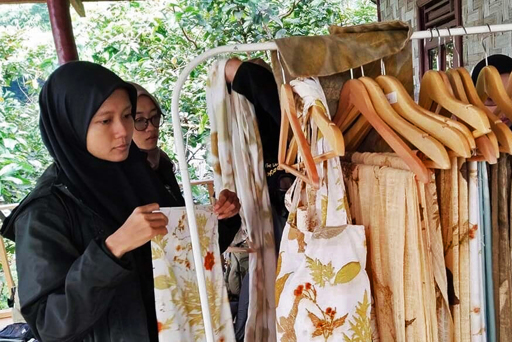
BOGOR, Indonesia — In a village bordering Gunung Halimun-Salak National Park on the Indonesian island of Java, local people browse a row of fabrics carrying impressions of plants and the silhouette of the forest’s silvery gibbon. They are made by the women-led Ambu Halimun collective, whose name translates to “mothers of Halimun” in the local dialect. The project focused on boiling and pressing distinctive local plants into motifs on fabric, which drew women like Mirna Maharani into closer observation of the vegetation surrounding the village of Citalahab. Species once overlooked, even dismissed as weeds, have since acquired new value as sources of color, pattern and identity, Mirna explained. “Now, we are preserving them,” said Mirna, 30, a mother of two. Formed in 2020 during the challenges of the coronavirus pandemic, the goal of Ambu Halimun was to engage women in conservation while providing an arena to uplift economic agency and professional development. Ambu Halimun is a women’s empowerment group that produces eco-friendly textiles in Bogor, West Java. Image by Falahi Mubarok/Mongabay Indonesia. Primatologist Rahayu Oktaviani, co-founder of the Kiara Foundation, which came up with the Ambu Halimun initiative, said she wanted to seed an original approach to conservation that would benefit women in Citalahab. “The forest isn’t something that is separate to them,” Rahayu told Mongabay Indonesia. “That’s why we’re building a sense of ownership.” Last year, Rahayu received the Whitley Award in recognition of her organization’s grassroots conservation work with Java’s silvery gibbon (Hylobates moloch), which included the work…This article was originally published on Mongabay
From Conservation news via This RSS Feed.