

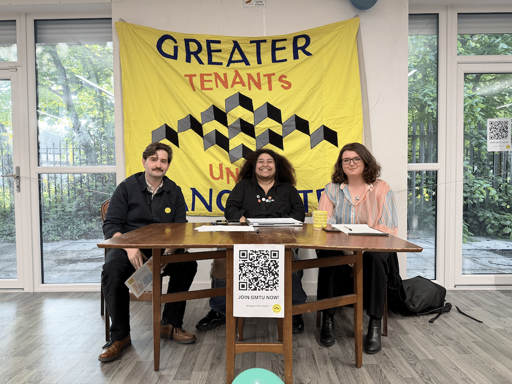

Housing expert lawyers Nick Bano and Kate Bradley told a packed GMTU audience in Manchester that the recent Renters’ Rights Act (RRA) is a great foothold, but not the finish line. They balanced joy in the wake of the monumental Act with cautious pessimism about our collective next steps.
Greater Manchester Tenants’ Union was buzzing on a recent evening as campaigners, tenants and housing lawyers packed the GMTU offices for the Manchester area launch of the national Resist Rent Rises campaign.
Two of the sharpest minds in housing law — Garden Court barrister and Against Landlords author Nick Bano, and Greater Manchester Law Centre lawyer Kate Bradley — set out exactly why tenants now have more power than they realise, and why they must use it. Turns out that GMTU and GMLC are in fact joint office tenants!
From reform to rent controls
Nick Bano gleefully clarified that the RRA converted every private tenancy into a lifetime tenancy overnight on 1 May. But this was never the movement’s final destination, in his telling — it’s our launch pad.
He told the room:
We don’t stop. … The Renters’ Rights Act is what’s going to give us the stability to move on to the next thing, which is rent controls.
The shift on 1 May was seismic. As Bano put it:
Overnight, every single tenancy got magically converted into a housing association-style lifetime tenancy where you cannot be evicted unless the landlord can find a legal pretext.
He was candid about the risks. Landlords will lie, cheat, and push every loophole. It’s in their interests, as a class, to do so. But Bano insisted the narrative must change, and that it is:
A home is for life. Taking someone’s home away is unbelievably draconian.
And now landlords, he argued, are already on the back foot:
Landlords are losing. They’ve been at the centre of this debate for seven years. We’ve got used to giving them a kicking in the policy realm, on the streets, and in the activist scene.
Now is a brilliant time to use that momentum.
What the RRA gets right and wrong
Kate Bradley offered a forensic read of the legislation, welcoming the removal of dreaded Section 21 evictions from what Bano calls the “ratchet mechanism.” It’s the landlord’s longstanding power to serve a rent increase and an eviction notice simultaneously, thereby forcing tenants to either pay up or get out.
Tenants everywhere can sigh in deep relief now that it’s gone. Bradley and Bano are certain of that much.
But Bradley was unflinching about the gaps left behind by the RRA:
- Landlords can now cite intention to sell or move in as grounds for eviction, with a potentially cripplingly low evidential bar — and enforcement on the ground hasn’t kicked in yet.
- Defences that previously blocked Section 21 evictions (gas safety certificates, energy performance certificates, the How to Rent guide) are now gone. She said, worryingly:
I really predict we’re going to see an increase in carbon monoxide deaths and house fires as a result.”
- Anti-discrimination rules for benefits claimants and families with children exist on paper, but local authorities lack the funding and duty — not just the power — to enforce them.
- Key protections are enforceable only by local authorities, not tenants themselves — and most councils aren’t yet resourced to act.
“Paper rights are worth almost nothing,” Bradley warned:
Getting something that’s on paper but never being able to do anything about it is the problem.
The Tribunal, your new best weapon
That may sound grim, but there’s much to be hopeful for, too. Both speakers were clear that challenging rent increases through the First-Tier Tribunal is now a genuinely viable and low-risk tool.
Bradley spoke about any Section 13 notices served now, after 1 May. She articulated the removal of two of the previous gravest deterrents that tenants faced in challenging a rent rise:
- If a tenant refers a rent increase to the First-Tier Tribunal, the Tribunal cannot raise the rent above what the landlord originally asked for;
- Furthermore, any increase will only take effect from the date of the Tribunal’s determination, rather than being backdated.
Bano set out the positive case plainly for where we find ourselves now, regarding Tribunals:
- There are no disincentives to raising a tribunal challenge, because rents will be stuck at the old rate while the dispute is pending;
- The tribunal cannot increase the rent beyond what the landlord asked for, so the risks are low;
- When tenants negotiate lower increases — perhaps under threat of a tribunal challenge — those agreements are used by the tribunal to assess rents in other cases.
Hence, Bano says on this last point that these can be strategically leveraged by the tenant movement:
You’re doing your neighbours a service by reducing the general rate of rent increases.
Bano’s vision is where everyone picks a fight against annual rent increases. This is entirely new.
If everyone is fighting every single rent increase, that’s an incredibly empowering thing. If it’s just standard practice that every year we help each other fight our rent increases, that’s a way to build a movement.
The road to rent controls
The political weather is shifting. Bano noted that think tanks including the Joseph Rowntree Foundation and IPPR had recently backed rent controls, and that Rachel Reeves, however briefly, publicly floated the idea.
The dial has moved enormously in the past 12 months alone. That’s a testament to this movement.
He was pithy in dismissing the landlord lobby’s counter-argument:
They say rent controls push rents up. That’s utterly nonsense on its face. The fact they’re having to argue that — yes, rents going up is bad, but if you did this rents will go up — that’s them admitting rents going up is bad. That’s how badly they’re losing that argument.
Andy Burnham twice won Greater Manchester on a (supposed) rent control platform, and now eyes up PM. These campaigners are clear — local pressure, tribunal challenges, and collective organising are not just ends in themselves. These must now become the engine of all future fights.
The Resist Rent Rises campaign is just getting started. Follow it on social media and get involved through GMTU branches, the London Renters’ Union or your local renters’ organisation.
Featured image via Cameron Baillie / the Canary
From Canary via This RSS Feed.