

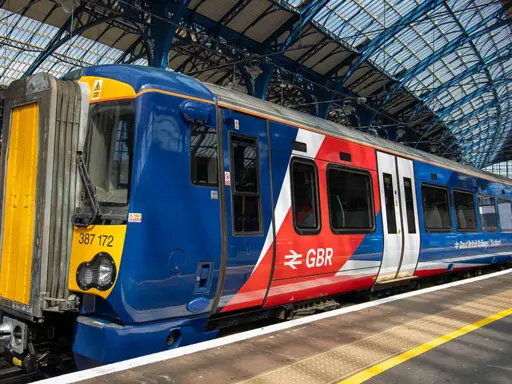

The Trades Union Congress (TUC) and the Rail, Maritime and Transport (RMT) union have highlighted the creation of a “two-tier workforce” as Govia Thameslink Railway enters public ownership.
Govia Thameslink Railway is the UK’s largest train operator, encompassing Southern, Thameslink, Great Northern and Gatwick Express.
Labour has begun the public ownership process as part of its manifesto commitment to nationalise the majority of train companies after their contracts expire.
The Department for Transport Operator Limited already manages West Midlands Trains, Greater Anglia, c2c, South Western, Northern, TransPennine Express, Southeastern and LNER under the same commitment. Chiltern Railways and Great Western Railways will follow in September and December, respectively.
Govia Thameslink Railway nationalised on 31 May
Transport secretary, Heidi Alexander, said:
Bringing Britain’s largest train operator into public ownership is a defining moment in our reform of the railway. It gives us an opportunity to tackle the bread and butter issues people want, like driving down cancellations and improving the frequency of services to Gatwick Airport.
Those “bread and butter issues” are a real grab-bag, from the genuinely important to the painfully mundane. Nevertheless, Labour crammed the whole lot into its press release.
The plans include:
- Doubling services for Gatwick Express services and increasing Saturday and Monday morning trains from December onwards. They’ll also additional Great Northern services around the same time.
- Continuing Govia Thameslink Railway’s recruitment of 75 more drives between Thameslink and Great Northern, and 40 drivers at Southern and Gatwick Express this year.
- Training 110 ‘Travel Safe Officers’ to “support revenue protection” (i.e. check more tickets) and increase security.
- Upgrading secondary signalling between Farringdon and Blackfriars. The government expects this to prevent as many as 1,000 cancellations per year.
- Providing more online payment options and a customer support channel on WhatsApp.
- Cleaning the graffiti in the Thameslink train toilets and resurfacing the toilet interiors. (Did we really need government intervention for that one?)
‘Two-tier workforce’ risk
Whilst at least half of those plans sound very worthy, the unions have been less than enamoured with one aspect of the endeavour.
TUC general secretary, Paul Nowak, explained:
This could be one of the great success stories of the Labour government.
But it is undermining its own efforts to deliver nationalised rail by leaving contracts in the hands of third-party providers who line their own pockets at the expense of the workforce and passengers.
We need a fully integrated national rail service which works for passengers and the rail workforce.
That means tackling outsourcing in the sector and ensuring all rail workers enjoy decent terms and conditions.
Govia Thameslink Railway contracts its cleaning services to private provider, Churchill. TUC analysis highlighted that Churchill makes £2.53 million gross profit annually from this tender alone. That’s the equivalent of 160,000 additional hours of cleaning or 83 extra cleaners.
This outsourcing diverts money from the public, workers and services into the pockets of private shareholders. The unions are urging that the cleaning services should instead be brought in-house.
Eddie Dempsey, general secretary of the RMT, explained:
We want to see all our members on the railway receive the same benefits of public ownership and this includes outsourced workers.
The Labour government needs to follow through on its commitment to undertake a mass wave of insourcing.
Nationalisation — in spirit or in name?
It’s not like Labour’s nationalisation doesn’t have form for continuing to enrich private interests, either.
The Canary previously reported that energy secretary Ed Milliband handed lucrative contracts to London-based firms, Deloitte and Baringa Partners. Now, the two companies will handle day-to-day operations of GB Energy, nominally Labour’s flagship publicly-owned energy corporation.
The National revealed that these contracts promise the firms up to £10 million each to be responsible for “organisational set up support”, “operational design and delivery”, market strategy and “technical support”.
Likewise, GB Energy was also supposed to create 1,000 jobs, mostly in the north of England. However, GB Energy only employes 30 staff on permanent contracts. The rest are on temporary or contingent, i.e. far less secure, government-sponsored contracts.
Don’t get us wrong, the Canary advocates for the nationalisation of public services. However, that process needs to be more than public ownership in name only. This, in turn, means spending public money on the public good, not further enriching private shareholders.
As the unions pointed out, Labour isn’t set to achieve that aim with Govia Thameslink Railway — and if its performance with GB Energy is anything to go by, that fact is a feature, not a bug.
Featured image via Charlotte Coney/ Getty Images
From Canary via This RSS Feed.