

By Damian Fossi – May 29, 2026
There is a sentimental fantasy called “Latin America.” A comfortable idea, repeated for decades in political discourses, cultural festivals, and continental unity songs. The notion that Latin Americans share a historical brotherhood based on language, colonization, miscegenation, and a common experience in the face of foreign powers. Yet, a migration crisis, an economic recession, or a wave of crime is enough to discover that this fraternity is usually much more fragile than we imagine.
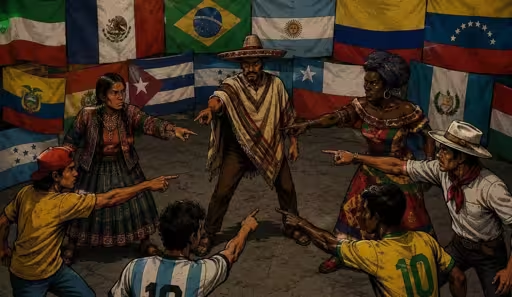
Xenophobia among Latin Americans is one of the most uncomfortable issues on the continent because it destroys a narrative that we like to tell about ourselves. We find it easy to condemn European racism or US contempt for Latino migrants. The difficult thing is to admit the fierce rejection that exists between our own countries. Chileans against Venezuelans, Mexicans against Central Americans, Argentinians against Bolivians or Paraguayans, Costa Ricans against Nicaraguans, and Dominicans against Haitians. The list is long and too constant to keep pretending that they are isolated exceptions.
The romantic idea of a unified Latin American identity crumbles precisely where poverty, labor competition, and the fear of social decline appear. That is where the real hierarchies emerge. Some countries are beginning to imagine themselves as more modern, white, European, civilized, or successful than others. Then the classical mechanism of every insecure society appears: the building of an inferior foreigner.
The problem is not just national. It is also racial and economic. In Latin America, xenophobia often functions as classism in disguise.
It is no coincidence that the most rejected migrant groups are, almost always, the poorest, the darkest, the most vulnerable, or the most visible in the informal economy. Hostility is rarely directed toward the foreign executive, the European investor, or the US retiree living by the sea. It is heading towards those who sell food on the street, work in construction, clean houses, or share precarious neighborhoods with the local popular classes.
Frantz Fanon wrote in “Black Skin, White Masks” that colonialism does not disappear when the political occupation ends. It survives within the mind, in the perception of human hierarchies, and in the need to resemble the dominator. Latin America never completely resolved that heritage. Political independence did not remove the colony’s symbolic structures. Many Latin American societies still organize their imagination around proximity to Europe and distance from the indigenous, the Black, or the poor.
Aníbal Quijano called this “the coloniality of power.” A mental and cultural structure in which racial hierarchies created during the colonial period survive within modern republics. They did not disappear. They just changed language. What was once called “caste” today is now usually presented as culture, education, security, or merit.
That is why Latin American xenophobia has something profoundly contradictory. Often, the rejected alien physically resembles the national who rejects them. They share language, religion, music, food, and even similar family stories. Yet, there is the obsessive need to mark distance. “We are not like them.” This phrase is heard in almost every country on the continent.
In the end, the rejection of the migrant is often also a fear of one’s own reflection in society.
However, reducing all this to “irrational hatred” would be intellectually mediocre. There are also real material stresses. Mass migration can put pressure on informal wages, utilities, housing, and health systems. It can alter entire neighborhoods in a very short time. It can increase urban conflicts and, in some cases, may coincide with actual increases in certain crimes. Denying that does not eliminate the problem. Only the less credible analysis is back.
The error begins when complex problems are transformed into simplistic stories in which an entire nationality is associated with crime, dirt, or disorder. That is where the media, politics, and now the algorithms come in.
Modern societies live on emotional narratives. Fear sells. Outrage generates an audience. The crime committed by a foreigner has much more media value because it activates a primitive sense of invasion. The visible alien becomes a perfect symbol for displacing the accumulated frustrations that are actually born from decades of inequality, state corruption, and economic precarization.
It is easier to blame the poor migrant than to discuss why millions of people live permanently on the verge of financial collapse even while working full-time.
This is to avoid an opposite simplification. There is not necessarily a centralized conspiracy where “media elites create xenophobia” from an ideological laboratory. The dynamics are usually more chaotic and more structural. Opportunistic politicians exploit real fears. Some sensationalist media magnify certain crimes. Social media rewards emotionally extreme content. Audiences consume what confirms their previous anxieties.
The end result, however, does often benefit those who need to divert attention from structural deterioration. The public conversation ends up focusing on the visible foreign rather than the economic mechanisms that produce chronic poverty, informality, or state neglect.
René Girard wrote that societies usually stabilize their internal tensions by creating scapegoats. When a community goes into crisis, it needs to identify an external body in which to deposit anxiety, frustration, and symbolic violence. The migrant perfectly fulfills that function because he is visible, vulnerable, and politically replaceable.
However, there is something even more uncomfortable about Latin American xenophobia. It reveals that we never finished building truly inclusive national projects. Our countries remain deeply fragmented by class, race, and region. The arrival of foreigners simply makes fractures that already existed visible.
Xenophobia reveals unresolved historical fractures.
It reveals societies where millions of people already felt abandoned before the first migrant arrived. It reveals weak states unable to integrate large population flows. It reveals underground classes terrified of losing stability. It reveals elites who stopped thinking about social cohesion decades ago. It also reveals the partial failure of the Latin American dream as a real political identity.
Abstract solidarity usually lasts until real competition shows up.
Perhaps that is the most uncomfortable truth of all. Latin America does exist as a cultural emotion. It exists in music, in certain shared codes, in humor, in language, and in a common historical memory. Yet, in the face of economic fear, that identity often breaks down, and old colonial hierarchies that never completely disappeared reappear.
Venezuela Condemns Perú’s Mistreatment & Xenophobia Against National Soccer Team
The problem is not just that there is xenophobia. The problem is how quickly it emerges when material conditions worsen. That indicates that beneath the integrative discourse, there was always a latent tension waiting for an excuse to manifest.
Perhaps that is why this issue is so uncomfortable. It forces us to recognize that Latin America has not just been a historical victim of external discrimination but that it has also learned to reproduce it internally.
(Substack)
Translation: Orinoco Tribune
OT/JRE/SF
From Orinoco Tribune via This RSS Feed.