

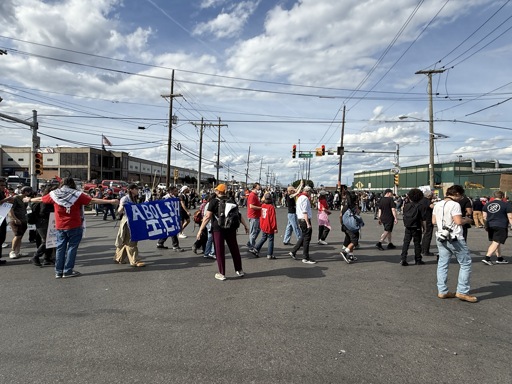
I and my two dear friends have been on the ground at Delaney Hall nearly every single night to support those on hunger and labor strike.
That first Sunday, May 24, GEO Group — who privately runs Delaney Hall — tried to move Martín Soto, a key organizer of both strikes, presumably to break the bonds of solidarity that facilitate such inspiring resistance. But when the van pulled out of the north gate to relocate him, something happened: protestors stopped it.
That same Sunday night a crowd grew in support of Gabriela Soto, Martín’s wife, as she stood up against the fence that surrounds Delaney Hall. We made so much noise with our demands that people stuck inside went up to the windows of their cages and flickered their lights on and off. As we witnessed their presence, we cheered in awe of the incredible struggle they sustain toward their own freedoms.
Following the strikers’ consistent demand to meet with Governor Mikie Sherill — who, four months ago, said ICE agents need to be held accountable for their illegal actions, and who, two months ago, made it illegal for ICE agents to wear masks only after pressure from the movement — we joined their call at the gates for her to show up and meet with them as they invoke their rights for medical care, nourishing food free of worms, and basic accountability for the innumerable human rights abuses inside.
Sherrill took four days to show up. She asked to go in. Staff apparently told her no. She got in front of cameras near the sidewalk to say she’d ask again (at some other time in an unspecified future). And then she left.
Monday night, after Martín was relocated to the Elizabeth Detention Center, more demonstrators arrived and visitation hours for families were closed, citing the demonstrations as a risk — not, of course, their coerced labor or their shameful provisions. (As of the time of this writing, visitation hours have still not been restored.)
Tuesday evening, after teaching all day, a coworker and I went straight to Delaney Hall and joined the line of people who locked arms opposite ICE agents, the majority of whom covered their faces with masks. We chanted and held a line at the south gate to keep vans from leaving with more people. That evening, we were chased across the street — away from Delaney Hall — and attacked. Some of us were singled out.
One person pinned against the concrete curb of Doremus Avenue by an agent who dug his knee into their spine, leaving them breathless before more agents joined in, dragging them into Delaney Hall. Another was chased north up the train tracks by agents who had to regroup in cars after being too slow for a foot chase, who then used their cars to close the distance to taser a man who fell face first into rocks, adding him to what has become a growing roster of resistors shoveled into the detention center.
That evening, I almost vomited from inhaling pepper spray sent at our line while we tried to keep a van from leaving. I had my eyes irrigated by kind and knowledgeable medics who knew how to handle the stinging that made my face bright pink. I irrigated other people’s eyes. Later, agents rushed across the street to swarm, tackle, and bring one of those medics inside Delaney Hall where nobody on the ground had the slightest clue of what awaited them, or if and when they might be released. (Fortunately, they and others were eventually let go.)
And we continued to hold the line. For a while, we kept ICE vehicles from leaving, forcing them to reverse back into their flanks. We drove counter protestors out in shame.
We all saw Wednesday night how the line prepared for ICE’s escalating violence. Normal, everyday people arrived with useful respirators, shatterproof goggles — even homemade shields — to better hold the line, insisting that not another van leave with anyone as the hunger and labor strikers heroically persisted.
And then ICE pushed one of us into an oncoming eighteen-wheeler, seriously maiming them.
Thursday night, after teaching again all day, I returned and had to navigate a blockade set up by state police. We were sprayed again. I yanked an elderly man off the ground and rushed him to a medic while he stumbled, shaken and soaked in an orange liquid that has made grown adults weep like children. I watched the infamous agent mentioned above grab a man, pull his respirator down to spray him point blank in the eyes with mace while two other agents beat his body and legs with batons. He stood stock still with his hands up, palms open the entire time. A medic helped him refresh, and he joined the line again.
I watched more people shoved to the asphalt of Doremus Avenue, dragged, and zip-tied while they were swallowed by a ballooning line of masked agents, some of whom brandished their tasers in our direction. On the line, there was talk of recent flights into Newark Airport that might transfer people to different detention centers where they may never be seen again. Flood lights were set up to make it harder for us to see their line, to record their actions, and to disorient us. It was an ongoing push-and-pull that one organizer called a “meatgrinder.”
Friday night, after Governor Sherill’s press conference insisted on a peaceful protest zone, state police declared an unlawful assembly and gave everyone almost no time to clear out.
Everyone was taken off guard, and a formation of state riot police, backed by cavalry, shot tear gas at the crowd as they retreated up Doremus Avenue, leaving the protestors once again in front of the line of ICE agents at the south gate. This time, those agents pointed their weapons at protestors and swiftly moved in to take the barricade from the peaceful protest zone.
As of halfway through Saturday afternoon, while I write this, medic tents are being reestablished. Conservative counter protestors come in and out of Doremus Avenue, screaming about Black Lives Matter. State troopers huddle for strategy, and ICE agents still hold their line.
We hold our line.
And Mikie Sherill’s phone number is still not taking phone calls.
But here’s the bigger point: it is actually extremely possible to continue to support those on strike inside Delaney Hall. As I have mentioned, I am a public school teacher. What’s more, my partner and I have an infant at home.
As do many of those detained inside.
And so do the families whose breadwinners, or even their own children, were kidnapped and now forced to work for a dollar a day, if that. We are no more entitled to our bodies, our relationships, or our freedoms than they are.
And it is possible to resist this systemic violence without simply waiting on the very same local institutions that block our road access, gas us, and arrest us. It is possible to resist what is happening in our neighborhoods by depending on one another.
If you go to Delaney Hall, you will witness something powerful. On the top floor of a privately-run detention center on a street called the “Chemical Corridor” of an over-polluted neighborhood, a dark window pane will light up in response to your solidarity. In it, you will see a human being. You will see that person — someone criminalized for daring to survive in a land separated from their own by the invisible lines we call borders — in a stark, black silhouette made from the dismal lighting of their paltry cell. You may see that silhouette come and go.
And the crowd, standing before the ranks making up one of the largest armed forces on this planet, will all cheer for them. And from the crowd on the dark streets of the third largest port in the nation, you will see that person, more bravely than anyone you now know, raise their fist in solidarity from inside their cage because they know we are there.
The post Dispatches from Delaney Hall: Confronting ICE and State Police appeared first on Left Voice.
From Left Voice via This RSS Feed.