

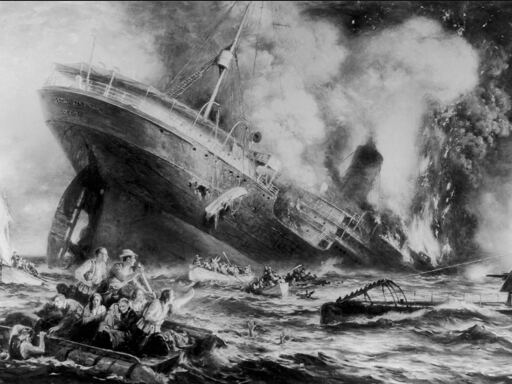

On 7 May 1915, the pristine waters off the old head of Kinsale became a graveyard. Within just eighteen minutes of being struck by a single German torpedo, the RMS Lusitania – the world’s most celebrated luxury liner – vanished beneath the Atlantic, taking 1,198 lives with her. Historically, this tragedy is framed as a shocking turning point; a brutal act of piracy that shattered American isolationism and catalysed a moral crusade against imperial tyranny.
Yet, when we peel back the layers of standard textbook narratives, the fate of the Lusitania emerges as something far more calculated. Beneath the murky depths of this disaster lies a masterclass in crisis engineering – an intricate nexus of resource warfare, strategic maritime blockades, and the brutal leverage of financial markets.
It was an event transformed behind the scenes by architects of power, including the First Lord of the Admiralty, Winston Churchill, into a mass intelligence test. By deconstructing the chasm between the overt humanitarian narrative and covert geopolitical determinants, we can decode the hidden mechanics of more contemporary conflicts.<
War as an Engineered Industry
In classical political philosophy, war is often defined as an extension of politics by other means. However, a critical reading of political economy suggests a more chilling reality: modern total wars do not break out spontaneously; they are deliberately designed.
For any state to transition from peacetime into total war, it must first break the instinctive social contract of its citizenry. Democratic societies do not willingly sacrifice their youth, wealth, and liberties without an acute, existential provocation. This necessitates a “shock event” – or what strategic literature brands a “false flag” operation. By executing an attack or deliberately manufacturing a vulnerability, ruling elites can fabricate evidence to frame an adversary, thereby legitimising military aggression in the eyes of an outraged public.
The First World War (1914–1918) served as the premier laboratory for this brand of total mobilisation. It was not merely an escalation of armies, but a systemic restructuring. Entire civil institutions and societies were weaponised under totalitarian state control, all masked by the collective war effort. In this grand theatre, the entry of the United States in 1917 represented the ultimate geopolitical pivot.
The war dismantled three great empires – the Russian, German, and Ottoman – leaving millions dead and mutilated in its wake. Crucially, the Russian and German empires stood defiantly outside the orbit of western ‘Money Powers’ – non-elected, transnational network of central banks, Wall Street cartels, and mega asset management firms that controls the global reserve currency and uses sovereign debt to dictate international policies and conflicts to preserve its financial hegemony – whilst the Ottoman Empire occupied a Levant targeted for oil colonization and strategic British realignment.
Yet, this monumental American intervention would never have materialised without the psychological and political groundwork engineered through the wreckage of the Lusitania two years prior.
Geopolitical Background and the Ethnic Context
Prior to the disaster, President Woodrow Wilson’s administration faced a complex domestic quandary. London was desperate for American intervention; the British economy was utterly exhausted, and the Western Front was consuming human lives at an unsustainable rate. For decision-makers in Whitehall, dragging Washington into the trenches was a matter of sheer survival.
However, American public opinion leaned overwhelmingly towards isolationism, viewing the European conflagration as a distant imperialist squabble. Furthermore, Wilson faced a profound demographic dilemma: a relative majority of the American populace was of German descent, with the German language deeply embedded in local schools, press, and communities.
To shatter this domestic deadlock, British political planners recognized that they needed something louder than diplomacy. They required a direct assault on American sovereignty or dignity – an event so emotionally devastating that it would rewrite the collective consciousness and morph into an undeniable moral justification for total war.
Deconstructing the Incident: Myth versus Reality
When the German U-20 boat targeted the Lusitania, claiming 1,198 lives – including 128 American citizens – the Allied media machine instantly weaponised the tragedy. It was branded a savage German war crime against defenceless civilians. However, a century of maritime exploration and declassified documentation has exposed a truth entirely at odds with the official narrative.
1. The Auxiliary Cruiser
The Lusitania was never a purely civilian vessel. She was officially registered on the British Admiralty’s auxiliary warship rosters, designed from her very inception to specifications that allowed immediate conversion into an armed cruiser during wartime. In fact, her construction had been heavily subsidised by military loans from the British Government on the explicit condition that the Navy could claim her when required.
2. The Cargo
Despite vehement denials from British political circles, subsequent investigations and physical expeditions to the wreck proved that the ship’s holds were packed with massive shipments of military supplies destined for the British Army, including millions of rifle rounds, shrapnel shells, and fuses shipped out of New York.
Paradoxically, this lethal ammunition was loaded quite openly. This explains the mysterious, massive secondary explosion that ripped through the vessel immediately after the single German torpedo strike, causing her to sink in a mere 18 minutes. Under international maritime law at the time, the Lusitania was an entirely legitimate military target.
3. The Suppressed Warnings
Operating within strict maritime protocols, the German Chancellery saw through the British plot to use civilians as human shields for weapons transport. In an extraordinary move, the German Embassy in Washington purchased advertising space in major American newspapers – including prominent New York broadsheets – explicitly warning passengers that boarding the Lusitania was a high-risk venture, as she would pass through a designated war zone carrying military material.
Tragically, pro-British interest groups within the United States successfully suppressed the publication of these warning advertisements in several pivotal cities, leaving the civilian passengers entirely in the dark – disposable pawns in a high-stakes geopolitical chess game.
Winston Churchill and Engineered Risk Management
At the very centre of this web sits Winston Churchill, the First Lord of the Admiralty.
Declassified records reveal that Britain’s legendary naval intelligence hub, Room 40, had successfully cracked the German military wireless codes. Consequently, the Admiralty possessed precise, real-time tracking of German U-boats patrolling the Irish coast.
The profound suspicion surrounding the incident lies not just in the sudden withdrawal of a military escort for the Lusitania, but in a sequence of direct, highly irregular directives emanating from Churchill’s personal office:
Step 1: A secret, direct order is issued from the personal office of the First Lord of the Admiralty, Winston Churchill.
Step 2: The order is relayed past standard naval command straight to the Captain of the Lusitania as she approaches British waters.
Step 3: The luxury liner is commanded to reduce her speed off the Irish coast, placing her precisely within the active U-boat nexus.
This final directive flew in the face of all established naval protocols, which dictated that fast vessels must maintain maximum speed and zigzag to evade torpedoes. Internal Admiralty testimonies indicate that Churchill’s own aides confronted him, warning that slowing the ship would drastically increase the probability of an attack. His stern, unyielding reply was:
The order is mine; pass it on.
By confirming the military cargo, suppressing public warnings, intercepting the intelligence codes, and actively slowing the ship into the path of a known submarine, the incident shifts from the realm of tragic military negligence into the territory of deliberate facilitation – the engineering of a catastrophic trap.
Propaganda Mechanisms and the Dehumanisation of the Adversary
The moment the ship sank, the Allied media apparatus executed a meticulously prepared crisis management plan. Empirical military facts were instantly replaced with highly emotional, weaponised vocabulary. Overnight, headlines coalesced into a unified, thunderous battle cry: “The Barbarians Dare Again” and “The Hun Butchers Murder Mothers and Children”.
This wartime propaganda went far beyond mere reporting; it sought the total dehumanisation of the adversary – a psychological prerequisite required to prepare ordinary citizens to kill without guilt. The campaign succeeded brilliantly in shattering American isolationism. While Washington delayed its official declaration of war until 1917, the ghost of the Lusitania served as the emotional fuel and political legitimacy that President Wilson required to successfully market total war to Congress and an outraged American public.
From the Lusitania to the Twenty-First Century: Continuity of the Model
Deconstructing this history is not an exercise in mourning the ruins of the past, but an effort to extract the immutable structural rules of crisis engineering. It reveals that central planners and ruling elites treat mass casualties as mere cost variables in equations of global hegemony. This exact political blueprint has repeated itself across subsequent, well-documented historical milestones:
The Gulf of Tonkin Incident(1964): Washington claimed that an American destroyer fell victim to an unprovoked North Vietnamese assault. Declassified documents later exposed the attack as entirely fabricated and illusory, yet it served as the official pretext granted by Congress to launch full-scale military intervention in the Vietnam War.
The 9/11 Attacks (2001): Irrespective of the details heavily classified under absolute state secrecy, these attacks represented the ultimate modern “shock event.” It cleared the path for totalitarian domestic legislation like the Patriot Act and launched two decades of pre-emptive wars that redrew global energy maps and geopolitical borders at the cost of millions of lives.
The Economic Reality of Systematic Warfare
The ultimate umbilical cord linking engineered conflicts to the global order is forged in finance and credit. During the First World War, Great Britain funded its astronomical war effort by borrowing heavily from Wall Street, specifically the J.P. Morgan banking group. By 1916, British military debts to American banks had ballooned to exceed 10% of the entire United States Gross Domestic Product (GDP).
This massive financial exposure created an unyielding economic chain of events. The accumulation of military debts to the point of exceeding the 10% threshold automatically rendered an Allied victory an absolute matter of domestic national security for the United States. This was essential to protect the banking and financial system from total systemic collapse.
Consequently, America’s entry into the trenches was not a spontaneous, idealistic crusade to protect global democracy. It was an intervention emotionally brokered by the tragedy of the Lusitania to safeguard the investments of the financial elite on Wall Street and secure the ultimate repayment of British sovereign bonds.
Wars as Mass Intelligence Tests
Parroting official political narratives without subjecting them to rigorous geopolitical and critical analysis constitutes a failure of a collective intelligence test. The global financial and monetary elites who steer the international order do not view the world through the lens of sentimentality, national borders, or human cost; they view it through the prism of centralised control and the restructuring of financial systems via the controlled shocks of total war.
Reading the Lusitania incident provides the necessary lens to decipher our current global landscape. The very same archetypes that deployed print propaganda in 1915 are utilizing digital simulation models, viral pandemic narratives, climate emergency rhetoric, and modern energy blockades today to usher in a highly centralized financial and social order. As history repeatedly warns us, the capitulation of the masses to emotional propaganda is a blank cheque signed by the victims for their executioners, ensuring the repetition of the catastrophe in every age.
Featured image via Three Lions/Getty Images
From Canary via This RSS Feed.