

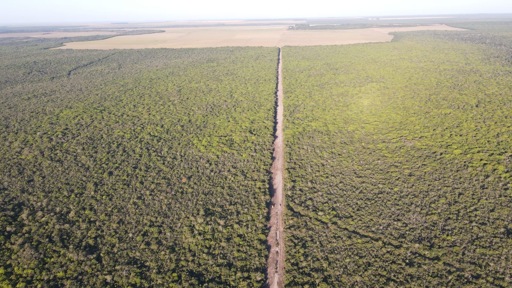
Landowner Carlos Roberto Simonetti gets three harvests per year from the corn, soy and cotton plantations on his 17,000-hectare (about 42,000 acres) farm called Fazenda Natureza Feliz, or Happy Nature, in the Brazilian state of Mato Grosso. Over the course of four years, he would also get what he calls a fourth harvest, this time from the forested areas of his property, located where the Cerrado savanna meets the Amazon Rainforest. That’s because Simonetti would receive regular payments for protecting native vegetation beyond what the law requires, as part of a pilot project for payment for ecosystem services (PES) run by the Amazon Environmental Research Institute (IPAM), an NGO, in the states of Mato Grosso and Pará. The program, called CONSERV, gives landowners financial incentives to keep the forest standing even in areas which they are legally allowed to clear. The pilot project, which initially ran between 2020 and 2024 on 23 different properties, protected 20,707 hectares (about 51,170 acres) of land in the Cerrado and Amazon biomes with funding from the governments of Norway and The Netherlands. Ongoing contracts funded by Soft Commodities Forum members – agribusiness companies committed to preserving the Cerrado – are protecting a further 7,000 hectares (about 17,300 acres) in the states of Mato Grosso and Maranhão. IPAM is now seeking to scale up the program without relying on donations. The risk of legal deforestation The idea for CONSERV goes back to 2016, when an internal IPAM report calculated that around 1.5 million hectares (3.7…This article was originally published on Mongabay
From Conservation news via This RSS Feed.