


This story is part of ICT’s series on the 250th anniversary of the United States of America, a nation built on the backs of enslaved people, genocide, and stolen land.
Amelia Schafer
ICT
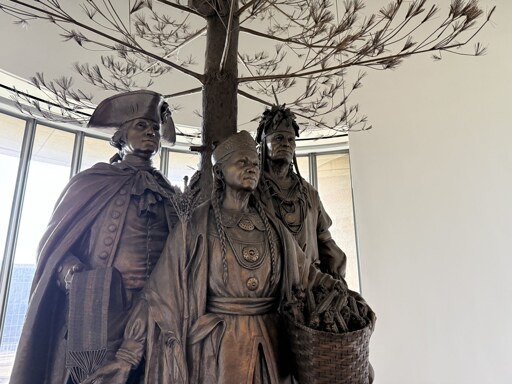
More than 270 years ago, the Haudenosaunee Confederacy showed America’s founding fathers just what they’d been looking for – an example of a thriving democracy where distinct communities could remain sovereign yet united under one government.
Benjamin Franklin, one of the core founding fathers, immersed himself in learning about how six different Indigenous nations – the Oneida, Onondaga, Mohawk, Seneca, Cayuga and Tuscarora – had sustained the oldest continuous democracy in the world.
What the Haudenosaunee showed Franklin during his years of research played a critical role in the development of the United States’s Constitution and democratic framework.
“For the Haudenosaunee, we’re really known for our democracy. We’ve been able to have peace for over a thousand years,” said Katsitsionni Fox, a Akwesasne Mohawk filmmaker and pottery maker.
The role the Haudenosaunee Confederacy played in shaping America’s democracy is no secret. Franklin wrote about this inspiration in several letters. Despite this, few Americans realize just how key his interactions with members of the Haudenosaunee Confederacy were in shaping the United States.
In 1744, diplomats from the 13 colonies met with representatives from the Haudenosaunee Confederacy, which is often mistakenly referred to as the Iroquois Confederacy. (The French gave them the name, “Iroquois,” which translates to snake, black snake, or enemy in Huron.)
Amid rising tensions between the 13 colonies and French forces, colonial diplomats decided to schedule a conference with the confederacy, seeking an alliance. The Haudenosaunee had expressed frustrations toward settler encroachment on their ancestral lands, something the meeting would aim to address.
After reading a meeting transcript, Franklin penned a March 20, 1751 letter remarking that the way in which these tribes worked together could serve as a perfect model for the future of the 13 colonies.
“Probably our greatest influence on the founding fathers came [through] peoplelike Benjamin Franklin,” said Scott Manning Stevens, the Akwesanse Mohawk scholar who is director of Native American and Indigenous Studies at Syracuse University. “He’s looking at the 13 colonies and thinking, alright, we all have different histories and regions and structures, could we all possibly ever work together? Are we just going to be 13 little countries?”
For Franklin, this observation had to be especially interesting, Stevens said. Franklin, who was of British ancestry, would have witnessed the monarchies across Europe at the time. The only other model for a confederacy he could’ve observed at that time would have come from the Swiss, Stevens said.
In 1754, the Haudenosaunee and English settlers once again convened to discuss their alliance, this time with Franklin in attendance. Following this meeting, called the Albany Congress, Franklin gained a better understanding of the Haudenosaunee Confederacy from a Mohawk chief named Henrick Theyanoguin, who was from the Bear clan.
Many of these ideas were eventually woven into the United States Constitution, drafted in 1787.
In line with the Haudenosaunee’s structure, each of the 13 colonies would present a representative from their respective areas to represent their citizens at a greater collective meeting of representatives. This idea is a direct replication of the structure used by the Haudenosaunee, in which representatives from each of the six nations gather together and work in the best interest of their respective tribes as well as the collective confederacy.

FILE – Life-size bronze sculptures of the signers of the U.S. Constitution stand in the Signers’ Hall on July 7, 2016, at the National Constitution Center in Philadelphia. (AP Photo/Beth J. Harpaz, File)
The drafters did, however, take several liberties when following the Haudenosaunee’s lead. They strayed away from the Haudenosaunee concepts of equal rights regardless of gender and the prominent leadership roles held by women.
Additionally, the United States’ copy wasn’t an exact replica of what Franklin had observed from the Haudenosaunee as it included European traditions from the British parliament and incorporated the British House of Commons, Stevens said.
“So the kind of bicameral setup of our government probably reflects that, and especially since we [Haudenosaunee] didn’t have any House of Lords [as] we didn’t have an aristocratic setup,” Stevens said. “But I think that the notion of doing things via mutual consultation and democratic will is something they learned much more from us than their own system, because their own system wasn’t very democratic.”
For the Haudenosaunee, this form of governance has lasted somewhere around 1,000 years, with oral histories dating its creation between the years 1100 and 1200, Stevens said.
Heading into the United States of America’s 250th birthday, there are still lessons the nation can learn from its Indigenous people, in particular, there are lessons it can learn from the very people who inspired its unique form of governance.
Today, the Haudenosaunee people exist as seven nations in Canada and 12 nations scattered throughout the United States. The nations still convene, and when they do, they convene as the original core six nations in the confederacy.
Similarities and differences
Governed by the Great Law of Peace, the Haudenosaunee Confederacy’s democracy is built on mutual respect, trust and understanding, said Emerson Shenandoah, director of the Skänoñh Great Law of Peace Center in upstate New York.
According to oral history, a man known as the Peacemaker was sent down by the Creator to spread word of peace to the five tribes that would become the Haudenosaunee Confederacy.
Traveling from community to community, he persuaded each nation to join together and found a government. In the Onondaga community, the Peacemaker planted the Great Tree of Peace, and identified it as a place for the groups to convene. From above the tree, an eagle would sit and watch for encroaching enemies and beneath the tree, all men were instructed to bury their weapons along with any existing greed or jealousy.
There are 50 traditional chiefs in the entire Haudenosaunee Confederacy. Forty-nine of these chiefs come from the six-nations; each chief represents a clan within their tribe.
The Seneca Nation currently has eight clan mothers and chief positions, the Cayuga have 10, the Tuscarora have 3, the Onondaga have 14, the Oneida and the Mohawk each have nine. There are currently several vacant positions, according to the Haudenosaunee Confederacy’s official website.
The 50th chief is the Tadodaho or “President,” but Tadodaho isn’t a president in the same way the United States has a president, said Jameson Wilson, a citizen of the Oneida Nation of Wisconsin’s Business Committee and tribal council.
Tadodaho is the spiritual leader and highest-ranking chief but does not make decisions on his own. Unlike the United States president, the Tadodaho cannot issue any executive orders or veto any vote, Shenandoah said.
The chiefs are each chosen by the clan mothers; there is no election process for holding the position.
“It’s not the kind of candidate that the U.S. has, there is no campaigning,” said Freida Jacques, a Turtle Clan mother for the Onondaga Nation. “We’re instructed as clan mothers that if somebody looks at you or appears to want the position of chief, you’re not to give it to them, because obviously they don’t understand the very seriousness of the position, and they probably have ideas about what they can do while they’re in there.”

IMAGE DISTRIBUTED FOR THE SMITHSONIAN’S NATIONAL MUSEUM OF THE AMERICAN INDIAN – Faithkeeper of the Turtle Clan of the Onondaga Nation of the Haudenosaunee Confederacy Oren Lyons, PHD, right, and The Tadodaho of the Haudenosaunee Confederacy Chief Sidney Hill, examine the signature of Ki-On-Twog-Ky also known as Cornplanter (Seneca), on the Treaty of Canandaigua of 1794 at the Smithsonian’s National Museum of the American Indian on Monday, Sept. 8, 2014 in Washington. The Treaty, between the Haudenosaunee Confederacy and the United States, is signed by President George Washington and The Six Nations (Iroquois). The exhibition, “Nation to Nation: Treaties Between the United States and American Indian Nations,” opens Sept. 21, 2014, at the Smithsonian’s National Museum of the American Indian in Washington. AmericanIndian.si.edu. (Kevin Wolf/AP Images for The Smithsonian’s National Museum of the American Indian)
Clan mothers chose based on observations of community members throughout their lifetimes, Jacques said. Typically from a young age someone stands out already as a leader, she said. As those children grow up, the clan mothers continue to observe their behavior and determine if they are fit for the title. Likewise, those chiefs will then go on to select the future clan mothers in a similar fashion. Both positions, clan mother and chief, are lifelong positions and carry immense weight.
“Chiefs should be sober, they should have family, they should be taking care of family, they should show compassion, and be you know that they’re willing to be a help to others, and don’t necessarily need payment for it,” Jacques said. “When the men go hunting, maybe they share food with the elders, maybe they help in the gardens, maybe they show that they have that kind of character, they’re the ones that she looks for.”
Above all is the Great Law of Peace, the Haudenosaunee constitution. Under the Great Law of Peace, all six tribes are equal, though they do hold different roles.
“The Onondagas are the fire keepers, they are the ones who will accept an eternal message and pass it on to other tribes,” Wilson said. Acting as the “older brothers” are the Senecas and Mohawks. They receive the message first and deliberate on it before it can move on to the younger brothers, which are the Oneidas and Cayugas. The Tuscarora Nation joined the confederacy later on after they migrated north from the Carolinas into Haudenosaunee territory.
“We view it as the first form of democracy,” Wilson said. “You have the checks and balances between the elder brothers and the younger brothers… that’s like the first version of the checks and balances and you see that in today’s U.S. government structure.”
The older brothers function like the U.S. House of Representatives, Wilson said, with the younger brothers acting as the Senate.
“I think that idea was derived from the Haudenosaunee Confederacy’s governance structure,” he said.
But unlike the Haudenosaunee, women had no rights or autonomy in the new United States government. They couldn’t hold property or speak on behalf of the people, something that ignores a central aspect of the confederacy’s governance.
Women have always held a crucial role in Haudenosaunee society, so much so that they helped to inspire the women’s suffrage movement, Shenandoah said. Haudenosaunee society is matrilineal, communities are structured around clans, each Haudenosaunee person inherits their clan from their mother. Women were responsible for keeping Haudenosaunee villages organized, the clan mothers directly chose their tribes chiefs and informed them in decision making.
“They [colonists] had their opinions about women at the time,” Jaques said. “When the constitution was put together they did not see and were not able to realize that we did have an influence on what was going on at the time.”
This aspect of Haudenosaunee culture was mocked by the colonists, Shenandoah said.
They called the chiefs “petticoat chiefs” for listening to the clan mothers and didn’t seem to understand just how important these women were and that women are at the core of all decision making in Haudenosaunee society. If a chief deviates from the tribe’s interest, the clan mothers can remove him from his position. Without the clan mothers, the society doesn’t function.
The colonists also rejected the Haudenosaunee’s respect for the Haudenosaunee’s unique relationship with – and respect for – the natural world, said Shenanoah, who is also Onondaga and of the Snipe clan. It’s an understanding of the relationship not only between people and the earth, but with preserving the environment for those who aren’t yet born, he said.
“So our councils, when they make decisions, they are not just making decisions for the people that are here right now, we are also making decisions for the people that are not yet here,” Shenandoah said. “I think that could be very beneficial to the people of the United States because modern day things such as climate change and data centers [are] going to have a great effect on people that are not yet here yet and those people are being forgotten in these decisions that are being made.”
An ignored history
Few Americans realize the Haudenosaunee Confederacy and its people are still alive and thriving today, Shenandoah said. Even fewer know of their role in shaping America.
The Great Law of Peace Center aims to educate the surrounding community in upstate New York about the existence, legacy and resilience of the Hausenoaunee people including their role in American democracy.
Typically, public schools and even many universities and colleges teach their students that Greece was a major inspiration in shaping America’s democracy but few seem to acknowledge the impact of the Haudenosaunee.
“We get a lot of schools that come from far away, sometimes as far as an hour or so, and many people are just blown away by the fact that they never learned about this in school,” Shenandoah said. “They never learned about the original people on the lands that they have lived on their whole life. And they never learned about how this land was taken as well.”

Visitors look at amendments to the U.S. Constitution as they are displayed at the National Archives on Tuesday, Sept. 16, 2025, in Washington, as the Archives unveiled a display for the first time of the entire Constitution and all 27 amendments, as part of celebrations for the upcoming 250th anniversary of founding of the United States. (AP Photo/Mark Schiefelbein)
Aside from shaping American democracy, leaders of the women’s suffrage movement were directly inspired by the power of Haudenosaunee women and their matrilineal society, Shenandoah said, another aspect few Americans know about. Suffragists like Matilda Jocelyn Gage, Elizabeth Cady Stanton and Susan B. Antony lived near or sometimes with Mohawk people, Shenandoah said.
“Matilda Jocelyn Gage, lived with the Mohawks and was also adopted and given a name by the Mohawks,” Shenandoah said. “In her book, ‘Women, Church, and State,’ she writes extensively about Haudenosaunee society and how our matrilineal matriarchal society blew her away and was something that she was very keen on compared to the European society at that time where women had no agency, they had no voice, and they had no rights versus Haudenosaunee society where women had just as much rights as many rights as men did.”
The Haudenosaunee Confederacy’s influence isn’t exactly a secret either, the United States Senate actually formally acknowledged this fact in 1987 through a concurrent resolution formally acknowledging the Haudenosaunee people’s impact on the constitution.
The Library of Congress also features information acknowledging the Haudenosaunee people’s impact on the founding fathers.
Despite this, many historians and scholars continue to debate whether or not the Haudenosaunee actually influenced the founding fathers, even with existing evidence pointing towards it being fact, according to the Haudenosaunee Confederacy’s website.
Continued teachings
As the United States approaches its 250th birthday there are still several lessons it could learn from the very people who inspired its democracy, Stevens said.
In 2026, the Haudenosaunee Confederacy continues to convene.
Typically the group gathers together at Onondaga, as the tribe serves as the central fire for the confederacy and traditional gathering place. The Haudenosaunee Confederacy also regularly attends the United Nations permanent forum on Indigenous Issues.
Following forced removals and an international border cutting through their traditional homelands, the six original tribes of the Haudenosaunee Confederacy exist today as 19 different Haudenosaunee nations scattered throughout the United States and Canada.
Despite the geographical distance and forced removals the Haudenosaunee people have faced, the confederacy continues on.
“We’re interested in global Indigenous rights, and we are spokespeople for continuing to protect the rights of fellow Indigenous peoples all over,” Stevens said. “But we are still politically viable. We still fight for our rights. We continue to have land claims against both New York and Canada, we fight for environmental issues around clean water and so on. So, you know, it’s not just a kind of ceremonial organization. It is our political structure today as six nations.”
The post AMERICA 250: How the Haudenosaunee shaped America’s democracy appeared first on ICT.
From ICT via This RSS Feed.