

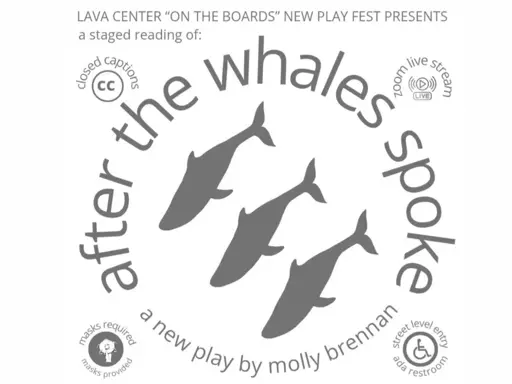

A mask-required reading of After the Whales Spoke, a new play written and directed by Molly Brennan, will be performed Saturday 6 June 2026, from 7 to 9 p.m. at The LAVA Center in Greenfield, Massachusetts, as part of LAVA’s fourth annual On the Boards New Play Fest. The story is described as follows:
Street medics have found a solution to the problem of anti-abortion, anti-trans legislators in a post-plague world where some people received instructions from whales.
The reading will star Ash Richardson-White, Foster Finch Schrader, Birdy Elliot, Drum Fernandez, Asa Rowan, Soe Noire and Nancy Brennan. It will be masks-required, with masks provided. Accessibility measures include captioning, audio description, space description and content description.
The reading takes place during the transnational expansion of COVID-conscious theater as its own genre.
Inspire: A Performing Arts Festival by and for the Airborne Aware
In April 2026, Inspire: A Performing Arts Festival by and for the Airborne Aware ran as a free, fully virtual Zoom festival featuring music, theater and comedy by COVID-conscious artists for COVID-conscious audiences. Its program included scenes from The Left by COVID-conscious playwright Caridad Svich, Ron Placone’s comedy special, the Long COVID Kids Choir and an open mic for emerging talent.
Recent COVID-conscious theater projects include Wake Up and Smell the C*VID, a hybrid monologue performance by Holy Erotic Propaganda Arson (HEPA), which premiered in New York and on Zoom on 24 April 2025 as a fundraiser for artists living with Long COVID.
Premiering the same evening was Anna RG’s AIR CHANGE PER HOUR, a Brooklyn performance structured around air purifiers and testimony from members of the arts community living with Long COVID.
COVID-conscious comedian Guiness Pig’s A Covid Christmas Carol, an audio play satirizing the Charles Dickens classic, was performed in December 2025.
Serina Estrada’s A Pan***ic Play, a 50-minute one-person show featuring stories from people whose lives have been impacted by COVID, was performed 21–22 January 2026, at The Art School in Glasgow as part of the Royal Conservatoire of Scotland’s Emergence Festival.
From Home Fest
Also in January 2026, From Home Fest, a virtual theater festival, included Equity, a COVID-conscious play by Stephen Fruchtman performed as:
a Private Equity take on the La Ronde formula.
Fruchtman is founder of Ongoing Pandemic Theater, which describes itself as:
championing and producing art that endeavors to keep the people making it safe amid an ongoing pandemic.
Theater and advocacy
COVID-conscious theater has also developed alongside advocacy for clean air as an access issue in the arts.
Performer and advocate Ezra Tozian has written for HowlRound about COVID protections in theater and the impact of the industry’s removal of precautions on disabled theatermakers. Tozian’s 2025 essay, “How to Negotiate COVID Protections“, is a practical guide for theater workers negotiating protections such as HEPA filtration, N95 and KN95 masking, remote auditions and on-site testing. Tozian also published “Challenging the COVID Status Quo“, about disabled theatermakers pushing back against the normalization of unprotected theater spaces.
In the UK, Dr. Sally Witcher OBE, founder of INN the Arts, has published Indoor Safety in the Arts, a framework for best practices aimed at reducing airborne infection risk in theaters and venues. Witcher’s work has been part of a wider push for clean air in live performance.
Protect the Heart of the Arts, a grassroots advocacy group sounding the alarm on the devastating impact COVID and Long COVID are having on the performing arts, has also organized public actions around arts events. In February 2024, the group coordinated a Long COVID awareness ribbon giveaway on the BAFTA red carpet, offering ribbons and masks to attendees and calling for solidarity with performers living with Long COVID. In December 2024, after a series of illness-related cancellations during David Tennant and Cush Jumbo’s Macbeth at the Harold Pinter Theatre, the group organized a festive mask and test handout outside the theater during the production’s closing weekend. The run saw four cancellations and reliance on six understudies.
There are also organizations hosting and providing infrastructure for clean air events. Clean Air Club in Chicago provides free air purifiers to artists, touring musicians and organizers. Positive Deviance in New York uses portable HEPA air purifiers, testing and respirators for COVID-safer events.
COVID-conscious performance
COVID-conscious performance has also developed through music, comedy and community events.
In comedy, Judah Friedlander continues to perform Zoom livestream stand-up shows.
In music, artists including Purity Ring perform in masks and work with volunteers to distribute masks at shows. Other musicians and performers have built COVID precautions into live performance, including Drew Empire, who performed at Positive Deviance’s debut COVID-safer hip-hop event in Brooklyn. phytocene, a Paris-based musician, has organized mask-required concerts in France. Car Seat Headrest frontman Will Toledo has asked audiences to wear N95 masks and has spoken publicly about Long COVID. Other artists including Jensen McRae, Deerhoof and Zoe Boekbinder have also requested or organized mask wearing and other airborne safety precautions for their performances.
There are also celebrities who continue to wear masks and advocate for mask wearing, including Nancy Sinatra, Stevie Nicks, Wil Wheaton, Morgan Fairchild, Serj Tankian and Matt McGorry.
Amidst this flourishing of COVID conscious theater, we’ve asked playwright and director Molly Brennan about the play, its inspiration and development process, and Brennan’s vision for COVID-conscious theater.
What was the initial question that made you know this had to become a play?
The initial question that led to After the Whales Spoke was:
Where is the pandemic leading us?
I wrote the first scene in 2020. I was living in Chicago. Two plays I had been cast in were cancelled: Be More Chill and American Idiot. I had no idea what I was going to do for money.
I had been a professional stage actor for 25 years, and a Clown and Acting teacher. I was reading about the 1918 Flu and the rise of fascism and nazism. I was observing, even in those first months, there were people in my life not social distancing or following COVID-safer protocols.
When George Floyd was murdered in May, I joined the folks protesting. There was a high level of care: people wearing masks, people providing water, medical aid, etc. I was moved by the show-up. As a person who has done a lot of direct action and demonstrations and protests, it was great to see a robust population of participants. Additionally, the networks of everyday care that were happening: sharing food and resources and medicine.
As tough as many things were, there was such a bright light of solidarity and care that was happening. The play started there, but got more cynical as the pandemic wore on, and the question changed:
What will happen to those of us who are refusing to be bought back by capitalism?
And:
What will happen to those of us who don’t ever go back to brunch?
The play is set in a post-plague future. What did that future allow you to explore that a present-day setting would not? How does the play understand the word “post-plague”?
The post-plague future of After The Whales Spoke allows a setting in which “The Virus” is no longer infecting people, and what those who did not stop wearing masks or following shared air practice feel about those who gave in.
A spoiler plot point, written before my current understanding of Long Covid, was that those who never got “The Virus” became victims of organ harvesting by billionaires.
I often wonder what my relationships will be to people if there ever is proper prevention and cure for SARS-CoV-2 infection and other airborne pathogens. What will it be like for me to not wear a respirator around people who haven’t worn a mask since 2021? Will my feelings of resentment ease?
How did your own COVID consciousness shape the writing of the play? Not only its content, but its form and maybe awareness of theatrical space?
My COVID-consciousness is the newest addition to my practice of disability access and community care, and so becomes integral to my creative process.
Before 2020, I was making projects that integrated ASL, captions, audio description, and sensory-friendly adjustments at the beginning of the creative process, making them part of production, rather than being an addition taken on by front of house/audience services.
The add-on of imagining actors in respirators, having productions mask-required, with Far-UVC, HEPA filtration and ventilation with CO2 monitoring wasn’t a stretch.
There was previously a staged reading of the play. What did you learn from hearing it with actors and an audience? Did anything change?
I did a Zoom reading of Whales, presented by MaskedNH and Breathe Free or Die, last year. I learned from feedback I was on the right track, in terms of making work for actors who have a strong shared-air practice and a decent amount of rage.
I also observed a disconnect between some “CC” [COVID-conscious] people and the suggestion of action against tyranny the play makes. I learned that some “CC” people are motivated by their self-preservation instead of shared care, and do not have a vested interest in other kinds of action.
Some “CC” people are single-issue, and it’s important to me to work with artists and collaborators who have a unified approach to justice. This idea of having a holistic approach to liberation is spoken aloud by Caspian in Whales. It challenges liberal check-boxing and encourages solidarity across oppressed groups.
What has it meant to develop this work in western Massachusetts, e.g., the mutual aid and COVID-conscious communities, the arts scene, general COVID awareness and receptivity to safety precautions?
The Franklin County region of Western Massachusetts has a relatively robust shared-air awareness crew. There are a decent amount of mask-required events, and it’s common to see people in public wearing respirators.
My wife and I actually chose to move here because of Last Ditch: a mask-required lesbian bar. We source & distribute masks and other public health items, crossing paths and working sometimes with local mask blocs.
The artistic spirit is quite unique in this area. There’s a lot of “art without permission”. People just doing things. Like making statues on their property of found items, doing decorated tractor parades, having a town scarecrow contest, disco bean shelling, stuff like that. Very art-for-the-people. Lots of farms and lots of farm-based art! The show-up for auditions of queer people who mask was awesome! Also, my “CC” mom is in the show, doing a drag version of Mitch McConnell.
What COVID safety measures will be in place for the performance?
After the Whales Spoke at LAVA Center’s On the Boards Festival will have HEPA filtration CO2 monitoring, and Far-UVC tech. Actors will be masked, and audiences will be required to mask as well. I will provide a variety of n95s and kn95s at the door.
There will also be captioning and audio description, and we are working on streaming the event. The building is ADA compliant, but the front door can be a bit tricky for mobility devices, so I’ll make sure to have someone posted out there to assist.
Two of the cast members use wheelchairs and have been helpful in figuring out what needs to happen to welcome the larger disabled community.
What role can playwrights play in keeping public memory alive when institutions are often eager to move on?
It’s important to name that my shared-air practice, which is wearing an N95 everywhere except at home and in specific outdoor situations, is only one element of my commitment to community care. And C19 is only one pathogen that is floating around and killing and disabling people.
I think there are different ways for playwrights, and other artists and writers, to communicate what is broken about our society, and I don’t hold playwrights responsible for “keeping public memory alive” about COVID. The problems we face are intersectional. If a theater piece focuses on racial disparity, gender, disability, poverty, it tells the story of struggle, oppression, and maybe how to fight it or grow out of it.
I believe it is the responsibility of all of us to do our best to make sure everyone has a path to life, liberty and pursuit of happiness. That includes wearing a respirator in public spaces, but not every play has to be about that specifically.
What would you hope a COVID-conscious audience member feels when they encounter this production? What would you hope someone who has not thought much about COVID in recent years takes away from it?
I would hope that a “CC” audience member feels safer to exist in the room without a looming threat of illness, in terms of being in the physical space. I hope that they would see themselves in the play.
Someone who has not thought about COVID recently, I hope they engage in the post-reading discussion, and take some free masks and wear them.
How do you imagine the future of COVID-conscious theater?
The future of “CC” theater relies on a complete restructuring of the structure. The LAVA center is a small, community art space, so this does not apply to them. They’re doing a good job. Large, professional theaters need to be worker-owned, and center the art and the audience instead of Boeing, Chase, Excellon, and the other earth-destroying funders.
The future of “CC” theatre is the future of theatre. If the structure is a people-based structure, community care of all kinds is a militant and inextricable element.
Tickets and Zoom stream info can be found at after-the-whales.mmm.page.
More info about Molly Brennan and After the Whales Spokecan be found at monsterclowngirl.mmm.page.
Featured image via…
By Protect the Heart of the Arts
From Canary via This RSS Feed.