


In these quite frankly desperate times for British progressivism, with Keir Starmer’s deeply unpopular government crumbling under the weight of its own timid orthodoxy, many on the left are (still) casting about for a saviour. Enter Andy Burnham, the apparent “King of the North”, Greater Manchester Mayor, and newly energised contender for the Labour leadership.
Polls show Burnham is outpacing Starmer among Labour members, which really shouldn’t be too difficult. Burnham’s folksy charm and occasional rhetorical flourishes about public control of essential utilities play rather well in working-class heartlands.
So let’s be absolutely clear from the word go. Andy Burnham is no saviour of the left. He is its latest disappointment, dressed in a tracksuit and a warm regional accent.
Worse, his brand of soft-left managerialism poses a direct danger to the Green Party’s growing, necessary challenge to the broken two-party system.
Burnham: the Menace from Manchester
Burnham’s recent announcements about how he would like to do things make the case against him with devastating clarity.
He has explicitly committed to Rachel Reeves’ fiscal rules — the very straitjacket of neoliberal prudence that has choked public investment, locked in austerity-by-stealth, and prioritised City bond yields over basic human need.
In interviews and statements this week, his team ruled out any changes to borrowing limits, even as they floated selective exemptions only for defence spending.
Burnham isn’t speaking the language of transformative left politics. It is the language of continuity with a Labour government that has already failed to deliver the scale of change Britain’s crumbling public realm demands.
Burnham’s fealty to Reeves’ fiscal rules signals he will offer little more than rebranded Starmerism with some warm words about the North and some devolution crumbs thrown in for good measure
Burnham’s positioning on immigration compounds the betrayal. Labour’s current policy has alienated principled left-wing voters without winning over the disaffected. Why on earth would anyone want more of the same?
Burnham has acknowledged a minority of the public’s concerns about immigration’s pressures on wages, housing, and services. But that acknowledgment isn’t some type of radical analysis because it echoes the triangulating instinct that has dragged Labour rightward for as long as I can remember.
A genuine left alternative would frame these pressures as failures of under-investment and deregulation, not symptoms of too many foreigners.
No more false dawns
This all matters because the left cannot afford another false dawn.
Burnham’s career is a masterclass in ideological elasticity. New Labour loyalist under Blair and Brown, a cabinet minister during the financial crisis and Mid Staffs scandals, reluctant Corbyn-era shadow minister, and now self-styled popular leftist champion.
He backed Remain, yet courts Brexit-voting constituencies with selective silence. He speaks of nationalising energy and water while chaining himself to fiscal rules that make genuine public investment a mirage.
This is not principled evolution but chameleon politics, designed for electability over ideology. We have seen this film before. It ends with broken pledges, watered-down promises, internal purges of anything to the left of Luke Akehurst, and disillusioned voters drifting to apathy or the populist right.
But this is where Andy Burnham becomes actively dangerous to the Greens. The Green Party, under increasingly bold leadership, is emerging as the clearest voice for systemic change.
The Greens are winning council seats, forcing debates on proportional representation, and appealing to younger, urban, and progressive voters alienated by Labour’s unforgivable betrayals on Gaza, welfare, austerity, and net zero delivery.
Burnham’s appeal directly undercuts this. By wrapping mild social-democratic gestures in northern authenticity, he siphons off energy, media attention, and potential defectors who might otherwise bolster the Greens.
For voters tempted by the Greens’ clarity on things such as the climate crisis, anti-austerity economics, and migrant rights, Burnham will insist that Labour can be reformed from within.
History shows this rarely works.
The end result is a weakened Green challenge, a Labour Party pulled only marginally left, and the continued dominance of centrist gatekeepers.
Green danger
The danger to the Greens is electoral and ideological. In by-elections and locals, Burnham-aligned Labour campaigns can weaponise his apparent popularity to portray the Greens as tree-hugging impractical purists or single-issue spoilers.
This type of framing kills the space that is needed for the bolder vision that the Greens represent.
Does anyone really think the North and the Midlands are craving reheated centrism? I would suggest they are desperate for material change — affordable homes, secure jobs, a functional NHS and local authorities that actually deliver.
These polls indicating Burnham’s strength against Reform UK simply reflect anti-incumbent sentiment and personal brand, not a deep endorsement of his fiscal conservatism.
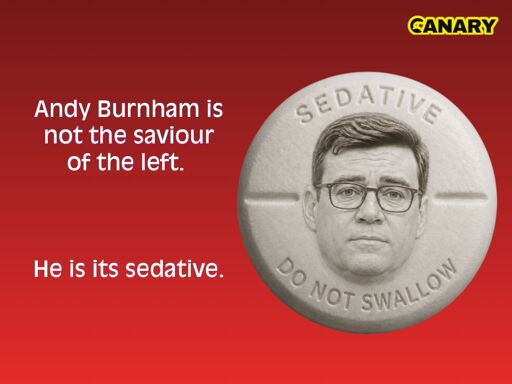
Andy Burnham is not the left’s saviour. He is its sedative. His rise risks anaesthetising the very discontent that should fuel a bolder progressive surge.
Our hopes cannot be outsourced to yet another Labour Messiah who has already pledged fealty to the rules that have already failed us. We need more than recycled disappointment.
At least the Greens — for all their organisational challenges and occasional missteps — offer some type of path toward genuine alternatives. Burnham’s project, for all its polish, leads back into the same old cul-de-sac.
Featured image via the Canary
From Canary via This RSS Feed.
Until the candidates start discussing beheading billionaires, they’re all the same party in my eyes.