



The day before yesterday, I participated in a panel on “elites” hosted the UC-Irvine chapter of the Platypus Affiliated Society. This was the prompt from the organizers:
What are the Elites, for the Left?
Historically, Orthodox Marxists thought that the working class had the potential to overcome capitalism. But they thought this in the context of an international working class movement which no longer exists.
Leftists have adapted to the decline of international class politics in many ways, one of which was a theoretical focus on elites. The elites might be thought of as driving social change through the managerial class, or alternatively, preventing social change as a roadblock to class consciousness.
In the 20th century, Elite theory tried to learn from the failure of working class politics and refound the left on a new basis. But did it learn the right lessons? What kind of elite should be the basis for left politics, if any? Are the elites a revolutionary subject, a roadblock to class consciousness, or something else entirely?”
What follows is a transcript of my opening statement, lightly revised at a couple of points for clarity. Obviously it’s less of an in-depth treatment of the topic than a suggestive preview of what that treatment might look like, but I hope it’s still interesting!
I’d want to push back against that prompt for two reasons. First of all, with all due respect to my hosts, I think the whole thing about “refounding the left” is one of the Platypus Society’s most unhelpful affectations. Like, if Earth were invaded by the aliens from War of the Worlds and the rest of us were saying “gosh, that looks really bad, let’s see what we can do to stop the invasion,” I’m pretty sure the Platypi would respond by opining on the folly of thinking it was possible to Refound the Left on the Basis of Opposing the Martians. Guys, sometimes people say things because we think they’re true, not because we think what we’re saying is the singular code key to capital-R capital-L Refounding the Left.
Second and more importantly, I’d push back against the idea that Marxists have historically only thought the working class had the potential to overcome capitalism because there was a powerful international workers’ movement. Certainly, if you think about the world of the 1840s when that Marxist analysis first came together, a powerful international workers’ movement was much more hope than reality. The reason Marxists have always thought that the working class was the agent of historical change that could overcome capitalism was that it was and is the only class within capitalist society that has the right combination of interests and capacities to do so.
The capitalist class has tremendous capacity to overcome capitalism. If every member of the capitalist class was separately visited by three ghosts a la Scrooge and woke up as convinced socialists, they could simply make a gift of the means of production to the rest of the society. That just won’t happen, because it wouldn’t serve their interests, and sure, you get the occasional Engels here and there but you really can’t count on ghosts coming through when you need them. The basic premise of all materialist analysis is that over time enough people are going to be moved enough by their economic interests that you have to analytically start from the assumption that this is how they’ll act.
Conversely, the population of unhoused and long-term jobless people sleeping in parks and under highway overpasses in every major city have a tremendous interest in living in a more equal society—as Joan Robinson liked to point out, as long as we’re living under capitalism, the one thing worse than being exploited is not being exploited—but they have basically zero capacity to bring it about. If that entire population disappeared tomorrow, not only would this not threaten capitalist production in any way, but the capitalists could quietly celebrate a social problem painlessly removed.
By contrast, the entire basis of capitalist society is the labor of workers—without whom, as the lyrics of Solidarity Forever put it, “not a single wheel can turn.” And the wealth of the capitalist class is entirely dependent on the surplus labor extracted from workers, which means that as long as capitalism exists, there’s an antagonistic mutual dependency between the interests of capitalists and the interests of workers. And the crucially important disanalogy is that workers could get along just fine without capitalists if we transition to a different system, whereas—for all the hype about AI supposedly meaning they can do without human labor—the same just isn’t true in the other direction. So the working class is the one class where interests and capacities meet in the right way.
That’s why Marxists think the working class is the necessary agent of radical change. The collective action problems are immense and often depressing. The task of turning a class in itself (i.e. a collection of people with the same class position) into a class for itself (i.e. the kind of powerful international workers movement that once again is now more of a hope than a reality) is immensely difficult and complex. There are certainly no guarantees of success. But as long as the overcoming of capitalism remains the long-term goal, finding a way to organize workers into a working-class movement remains the historical mission.
![Capital: A Critique of Political Economy, Volume 1 (Penguin Classics) Marx, Karl [Used - Good] [Softcover]](https://substackcdn.com/image/fetch/$s_!dOAQ!,f_auto,q_auto:good,fl_progressive:steep/https%3A%2F%2Fsubstack-post-media.s3.amazonaws.com%2Fpublic%2Fimages%2F730beb66-5678-4fa0-a2aa-07b8076aa30a_381x540.webp "Capital: A Critique of Political Economy, Volume 1 (Penguin Classics) Marx, Karl [Used - Good] [Softcover]")
OK, but what about the elites the panel prompt is really about—not the capitalists at the tippity-top of society, but those messy intermediary layers who have always been such an embarrassment to Marxist analysis?
The argument I just finished laying out only mentioned three layers of society—workers, capitalists, and people who are at a social level below the working class, economically oppressed but not exploited because they’re simply locked out of the economic machine completely. And if you read Capital Vol. 1, which is the volume that’s really about class structure and exploitation, that’s also pretty much the map of class relations you get there. When Marx talks about independent artisans in business for themselves, he tends to present them as pre-capitalist relics—like, when he discusses some trade formerly dominated by independent artisans being subsumed so that the formerly independent artisans who might have even used capitalist merchants as middlemen to get their goods to consumers become direct employees, Marx describes that as the capitalist conquest of that sector of the economy. Otherwise, he’s pretty much talking about workers and capitalists, plus I guess big land-owners he distinguishes from capitalists, and a teensy tiny little bit about the paupers and the lumpenproletarians in Ch. 25.
But the most interesting and suggestive passage hinting at a richer class map—and you’ll have to forgive me for a bit of literary license in how I’m parsing this—is in Ch. 7, when he’s imagining a scenario where some capitalist doesn’t make any profits because the revenues from his sales are only enough to cover the workers’ wages, and he imagines the capitalist complaining about this. It’s a great passage. He puts into the capitalist’s mouth all the standard talking points of bourgeois apologists about merit and entrepreneurial risk and all of that. And toward the end of the riff, he imagines his hypothetical capitalist crying out,
”Have I myself not worked? Have I not performed the labour of superintendence, of overseeing the spinner? And does not this labour, too, create value?’”
And then the next line is:
“The capitalist’s own overseer and manager shrug their shoulders.”
And of course in context the point of that shrug is to say hey guys the things you’re saying the capitalist has done are actually things that, in any decent-sized capitalist firm, aren’t done by the owners at all but by these specialized employees. Which is a good point! But, and this is where the literary license comes in, that image of the worker and the capitalist having an argument while the manager and the foreman “shrug their shoulders” really does feel like a great symbol of the idea that there’s a layer of skilled professionals and managers who have a somewhat ambiguous position in the binary class war between full-on workers and full-on capitalists.
Historically, Marxists have had a few different ways of thinking about these layers. The least helpful has been assuming that even if not everyone neatly fits into one of the main categories yet, eventually this problem will be solved by history, since as capitalism progresses everyone will either rise into the unambiguous capitalist class or (in most cases) sink into the unambiguous working class. Well over a century and a half after Capital was published it’s safe to say that we know better. Another response has been to say that the relatively simple class map you get in Capital, the relatively simple class map I assumed in my argument earlier, has to be substantively revised to reflect social reality. This is where PMC (“Professional-Managerial Class”) theory comes in.
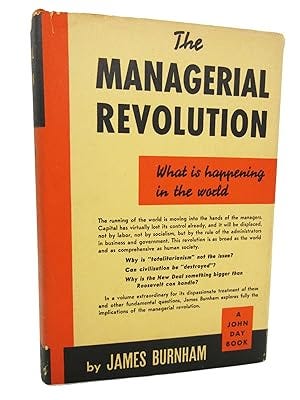
And there are two different lines of thought that need to be disentangled here. First, there’s a way of thinking about professionalized layers in between workers and capitalists that goes back to at least James Burnham’s The Managerial Revolution, and really it has roots before that, which says that maybe you’ve actually got a three-sided class war between workers, capitalists, and the PMC, and that the PMC could easily displace the capitalist class as the new ruling class. In some variants, it might say that’s what actually did happen in the Soviet Union. And the intellectual side of contemporary right-populism tends to postulate that there’s some sense in which it’s at least kinda sorta happened in contemporary highly-regulated corporate capitalism, that the real problem isn’t the oligarchs but the Oberlin grads getting paper-pushing jobs. For the record, my own view at least, we can discuss this, is that this whole line of thought is just abject nonsense.
The other, very different version of PMC theory comes from Barbara and John Ehrenreich (who are thinkers I have a lot of respect for,) who first coined the term, and people like my friend Catherine Liu (who teaches here!) who have continued in the Ehrenreichs’ vein. That line of thought postulates the PMC as a new subordinate class alongside the working class but with distinct interests from it. I think that’s a lot closer to the mark.1
But the tradition of how to think about this stuff that I find most helpful isn’t PMC theory in any form. It’s the Erik Olin Wright view that the class map of Capital, the class map of the argument I recited before, is perfectly correct as far as it goes. At a view from 10,000 feet, if we’re thinking about grand epochal historical change, that’s the right map to use to think about that stuff.
But just as you can have different kinds of literal maps that are useful for different purposes, ranging from simple maps that just show you state and city names and where the ocean is to topographical maps with little bumps for the mountains, and none of these are incorrect, they just capture different things and are useful for different purposes, if instead of thinking about grand epochal historical change we’re talking about short-term socialist strategy, we’re thinking about which kinds of demands will motivate which alliances of specific people in which specific circumstances, we need to zoom in on some of the details we’re abstracting away from when we use phrases like “the working class” and “the capitalist class.”
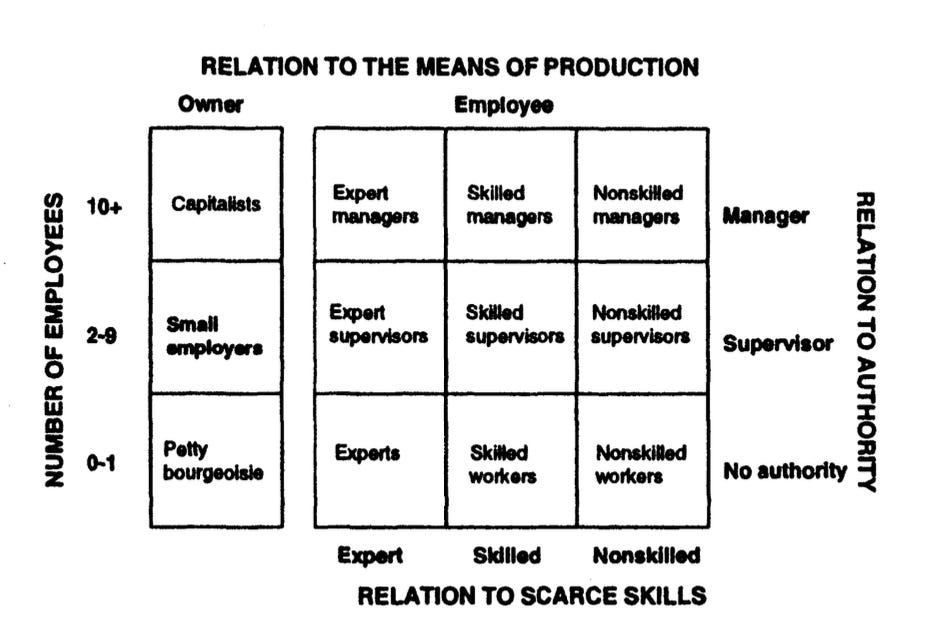
Diagram from Class Counts by Erik Olin Wright
For people who own means of production they use to try to turn a profit (so who are “capitalists” if we use that term very broadly), we need to ask are you a self-employed proprietor of a taco truck or something, or someone with a few employees, or someone with many employees? Those are going to have different consequences for how your interests are impacted by what’s at issue in various short term political struggles. Look at how Zohran Mamdani worked during the campaign last year to get guys with street-corner halal stands on board with a democratic socialist program by promising to cut red tape. That was smart.
And for people who work for a wage, we can ask questions about how highly skilled you are, which is going to have consequences for how much individual bargaining power you have and hence maybe what your attitudes are going to be toward collective bargaining power—you might think you’re better off without a union—and how much autonomy you have on the job. We can ask about how much managerial authority you have, if any. (It’s certainly possible to have some while also suffering some degree of capitalist exploitation.) Once we bring in factors like that, we can see ways that people can be pulled in multiple directions at the same time, having some interests that align them with the rest of the working class, and others that align them with the capitalist class in ways that start to feel a little bit like the position of the traditional petty bourgeoise. And I know I’m already more than two minutes over the 10-mintue allotment for these openings so let me make one last point if you’ll indulge me and then I promise I’ll shut up.
I kind of said this already but I want to say it a little more explicitly:
The point of that complicated messy relief map of contradictory class positions isn’t to write off people who are in some sense “PMC.” Look. I’m a very proud member of an adjunct professors’ union. So, that’s clearly not my position!
The point is to more carefully calibrate which alliances between class fragments we need at any given moment, and what demands, what mobilizations around what issues, are going to he helpful in forming and consolidating those alliances, as we try to engage in that immensely difficult and uncertain task of rebuilding the workers movement. Because, again, that’s the whole job.
Thanks for reading Philosophy for the People w/Ben Burgis! This post is public so feel free to share it.
In fact, it’s close enough to the mark that in some contexts and for some purposes, I’ve been happy to just talk that way myself. I’m sure you can find plenty of instances if you google my name + “PMC.” I agree with the point Vivek Chibber makes in this interview, where he argues that in some context the phrase obscures more than it clarifies, since plenty of professionals have zero managerial authority, but he also says:
If you look at the criticisms on the Left of the influence of the PMC, the people who they’re talking about, the strata that they’re talking about, someone like Catherine Liu, who writes brilliantly on the PMC and the way in which virtue signaling has overtaken political analysis, we know who she’s talking about, and those people actually exist. I wouldn’t want to say “stop using the concept” because the same way that the Ehrenreichs used it, you know who they’re talking about. I think they were analytically flawed in the way they used it, but what they did with it made a lot of sense.
I wouldn’t want to have people fill out a form before they were allowed to use the concept, and I wouldn’t want to say this is as useless as angels or demons or something like that. So no, I would not have strictures against it. What I would say is this, that because of the way in which it obscures real divisions and different sorts of emplacements within the economy, we want to be careful taking a sweeping negative view toward it…
From Philosophy for the People w/Ben Burgis via This RSS Feed.