

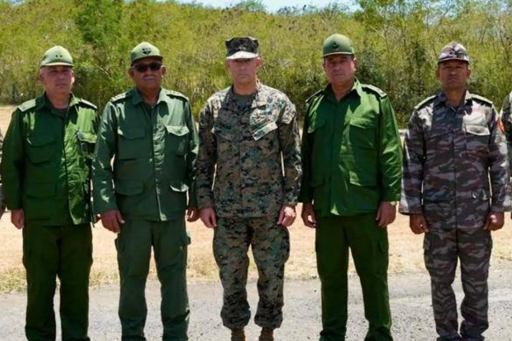
The head of the U.S. Army’s Southern Command, Gen. Francis Donovan, and the head of the Cuban Revolutionary Armed Forces (FAR), Gen. Roberto Legrá Sotolongo, met on May 29 at the U.S. military base in Guantánamo, which the U.S. has illegally occupied in eastern Cuba since 1903.
U.S. Southern Command issued a statement noting that they held “a brief exchange on operational security matters” with the Cuban side and that General Donovan had toured the base perimeter and discussed the safety of his troops and their families. For their part, the FAR reported that both parties viewed “the meeting positively because it addressed security issues along the perimeter separating the military enclave, and they agreed to maintain communication between the two military commands.”
Neither side publicly shares what is actually discussed at these meetings, which are central to the ongoing negotiations — both those reported publicly, such as this one in Guantánamo, and those conducted in secret. The most striking aspect of this latest encounter is that it took place between military forces: on the Cuban side, those that continue to wield significant economic and political control, and on the U.S. side, the very actor responsible for the protectorate in Venezuela.
Against the backdrop of the White House’s escalating threats of a military attack, this meeting in Guantanamo is a clear indication that the door to negotiations was never closed. It even shows that a “Venezuelan path” cannot be ruled out — that is, that the U.S. might find a sector of the Cuban bureaucratic leadership willing to submit unconditionally to imperialism, as happened with Delcy Rodríguez in Venezuela following the military attack and kidnapping of Nicolás Maduro and Cecilia Flores.
Economic Siege and Imperialist Aggression
Since early January, the White House has pursued a policy of economic siege based first on the oil embargo and then reinforced since May with new extraterritorial economic sanctions against companies and individuals linked to the Cuban government or who trade or do business with Cuban institutions or companies such as the FAR-controlled GAESA holding company.
Both policies have succeeded in their criminal objective: to push the population to the brink of a humanitarian crisis in order to destabilize the Díaz-Canel government, which is already heavily discredited as a result of years of austerity policies targeting workers and the repression of social protest.
The policy of imperialist aggression has placed Cuba in the worst economic and social situation since 1959. The lack of electricity, medical supplies, and other essentials has led to a sharp rise in infant mortality, the suspension of surgeries and treatments, and a shortage of drinking water, among many other problems.
This is a truly criminal policy, recently denounced by the UN itself, which we must urgently confront across the entire continent.
Over the past few months, the Trump administration has accompanied this policy of economic siege with militaristic rhetoric. The U.S. president went so far as to say that he could take control of the island very soon and do whatever he wants with it. At the same time, he has also made statements suggesting a “negotiated” solution under extortionate terms.
In this context, there have been reports of three high-level bilateral meetings (not counting this fourth meeting in Guantanamo) where the U.S. laid out its demands for profound economic and political changes. Due to the secrecy surrounding these meetings — and many others that have taken place and were kept secret — it is unclear whether there has been progress or if talks have stalled over certain red lines drawn by the Cuban bureaucracy regarding changes to the political system and relinquishing control of the economy.
As we have denounced, the ruling bureaucracy is willing to open the economy to imperialist interests and has been on a course toward capitalist restoration for years. But its goal is to maintain political control, along the lines of the Chinese or Vietnamese models, and its interests across much of the economic apparatus.
In recent weeks, the military threat has escalated with the formal indictment of Raúl Castro for the murder of four members of the organization Brothers to the Rescue in 1996 and the arrival in Caribbean waters of the aircraft carrier USS Nimitz and its strike group. In response to these events, the Cuban government has stated that any military action would be met with retaliation and lead to a “bloodbath.”
Another notable event — though it received very little media coverage — was the May 21 arrest in Miami by ICE, at the request of Marco Rubio himself, of Adys Lastres Morera, a legal resident of the city and sister of Brigadier General Ania Guillermina Lastres Morera, president of the Cuban business conglomerate GAESA. Days later, ICE also detained Alina Rosales Aguirreurreta, daughter of the historic General Ulises Rosales del Toro.
International Solidarity with Cuba, Independent of the Bureaucracy
The meeting in Guantánamo could be seen as a gesture of temporary détente, but also as a sign that the U.S. can negotiate with different sectors of the ruling bureaucratic leadership, aiming for an outcome similar to what occurred in Venezuela.
The situation remains open, and there are several possible outcomes. The Trump administration may be planning to continue the economic blockade at least until well into the summer. In any case, it is clear that any solution imposed by imperialism or negotiated between it and the restorationist bureaucracy will be completely contrary to the interests of the Cuban workers and people.
That is why it is urgent to develop strong international solidarity campaigns with Cuba, independent of the bureaucracy. These must condemn any imperialist military aggression and the criminal energy blockade, oppose puppet governments like Javier Milei’s in Argentina — which calls for Cuba’s “liberation” — and demand that the “progressive” governments of Lula in Brazil, Claudia Sheinbaum in Mexico, and Gustavo Petro in Colombia break with Trump and immediately send oil to Cuba.
Originally published in Spanish on May 30 in La Izquierda Diario.
The post Top Military Officials from Cuba and U.S. Southern Command Meet in Guantánamo appeared first on Left Voice.
From Left Voice via This RSS Feed.