

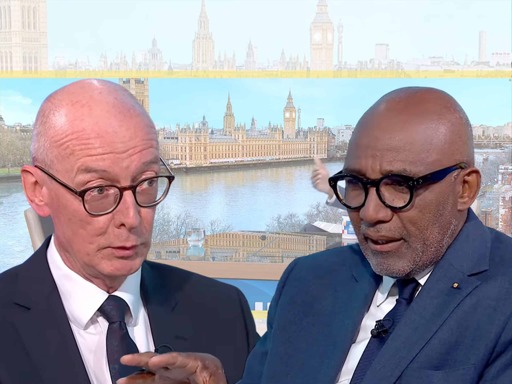

In 2024, Labour pledged to equalise the minimum wage across all age bands. Now, a senior minister has claimed that the act of governing is completely out of the hands of government:
Page 45 of Labours 2024 manifesto stated: “Labour will also remove the discriminatory age bands so all adults are entitled to the same minimum wage”
Pat McFadden is asked, when are you going to do this?
McFadden says its not up to the govt to do it. pic.twitter.com/RSVJaZvf7x
— Saul Staniforth (@SaulStaniforth) May 31, 2026
Has there ever been a government as comfortable with u-turning as the Starmer regime?
Weasel words
In the clip at the top, host Trevor Phillips said to DWP boss Pat McFadden:
When are you going to legislate to give young people the same living wage as people over 18? You promised to do it.
McFadden responded:
We do believe people should be properly rewarded. You know the way this works. In any given year, the rate for the national minimum wage is set by the Low Pay Commission. They have to take into account all the factors in the economy, including employment and the labour market.
The government promised to make a radical change. Clearly, it must be the body to enact such a change; not an entity which exists to make steady, proportional tweaks.
After some predictably bland back and forth from McFadden, an exasperated Phillips asked:
So why did you bother to put it in your manifesto? Why promise you’re going to do something when two years later you can come in and say, ‘oh, nothing to do with us?’
McFadden answered:
Because we’re giving them a direction of travel, and it’s good to give them a direction of travel. They have a remit. They have a remit letter from the government. So they have a direction of travel. But in any given year, the precise rate of the minimum wage is recommended.
Sorry, we meant to say ‘McFadden waffled’ rather than ‘McFadden answered’. The DWP boss later said:
And in the internationally admired model that we have in this country, it is for the low pay commission in any given year to set the minimum wage.
The point of manifesto promises is that they uproot the status quo. Clearly, for something to happen beyond the norm, the government has to step in and take action. Labour’s refusal to do so suggests that slippery Starmer likely never planned to equalise pay in the first place.
Minimum wage — Broader context
What McFadden and Labour are doing here would ordinarily be bad. It’s especially dire right now, however, because recently released data shows young people are facing an under-employment crisis. As Politics UKreported:
– Mid- and lower-skilled jobs have fallen by around 1.6 million over the past 20 years
– Hospitality vacancies have nearly halved in the last 4 years
– Apprenticeships for 16-24-year-olds have fallen by 35% since the Apprenticeship Levy was introduced in 2017
– The proportion of 16-17-year-olds in paid work has nearly halved from 35% in 2006 to 19% today
– If every current inactive 18-24-year-old was in full-time work, this would contribute an additional £38 billion to UK GDP
– 58% of inactive young people (6 in 10) have never had a job
As life has gotten more expensive in the UK, many young people are living at home for longer. This means fewer of them need to take the dead-end jobs that many of us accepted to ensure we could pay the rent. The knock-on effect is young people have less disposable income, and as a result they don’t go out, meaning fewer jobs in the hospitality sector. Increasing the minimum wage would better incentivise work, which would better drive economic activity.
The Apprenticeship Levy, by the way, was a plan to promote apprenticeships. The fact that the number apprenticeships has dropped despite it shows that something is going very wrong in the world of work for the next generation of Britons.
No future
Clearly, young people are ceasing to view the UK as a place where they can thrive. On 15 April, we reported that:
The TEFL Academy has released a report, The Great Gen Z Exodus. And it reveals that Britons are no longer waiting until their 30s to leave the UK. They’re doing it in their 20s, in record numbers, as economic pressure and shifting career priorities reshape life decisions.
In June 2025, departures among those aged 20–29 reached 130,000–140,000. This is significantly higher than pre-pandemic levels of around 92,000–95,000 in 2018. Meanwhile, emigration among those in their early 30s has fallen from around 78,000–81,000 in 2018 to 55,000–65,000 in 2025.
In the middle of a national crisis, this Labour government is pretending it can’t enact one the few changes which might actually improve things for young people. The sooner this government u-turns itself out of existence the better.
Featured image via Sky (YouTube)
By Willem Moore
From Canary via This RSS Feed.