

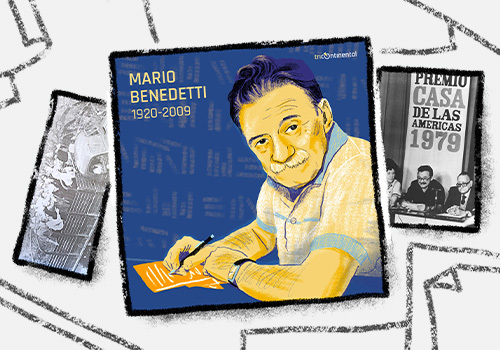
The Twenty-Seventh Art Bulletin (May 2026)
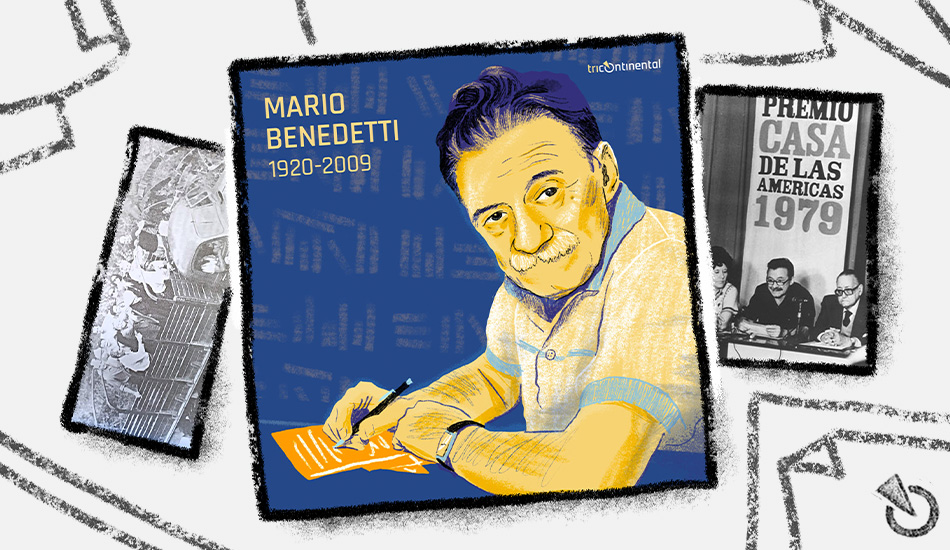
Listen to ‘Por Qué Cantamos / Canción Nueva’ (Why Do We Sing / New Song), from A Dos Voces (In Two Voices), a collaboration between Mario Benedetti and Daniel Viglietti that pairs Benedetti’s reading of ‘Por qué cantamos’ with Viglietti’s song ‘Canción Nueva’.
In Latin America, the paths of people’s struggles and the development of their cultures have always been intertwined. From Spanish and Portuguese colonisation in the fifteenth and sixteenth centuries to the independence struggles of the nineteenth century and the Monroe Doctrine of 1823, the peoples of Latin America have resisted successive forms of domination. José Martí, one of the leading figures in Cuba’s struggle for independence, gave this resistance one of its most powerful expressions in Nuestra América (Our America), his 1891 essay on the political and cultural unity of the continent.
For Martí, Nuestra América named not only a geography – the vast territory stretching ‘from the Rio Grande to the Strait of Magellan’ – but a civilisational project rooted in the histories, cultures, and struggles of the continent’s peoples. This was the anti-imperialist force of Martí’s reflection: Latin America could only free itself by knowing itself, by recognising the Indigenous, African, peasant, and popular roots that colonialism and sections of the intelligentsia had treated with contempt.
As Martí wrote in Nuestra América: ‘Solving a problem in full knowledge of its elements is easier than solving it without knowing them. … To know is to solve. To know the country and govern it in accordance with that knowledge is the only way to free it from tyranny’. Throughout its history, Latin American literature has been one of the principal means through which that self-knowledge has been produced. Through poetry, novels, essays, and song, the continent’s peoples have represented their realities not as abstractions but through lived experience.
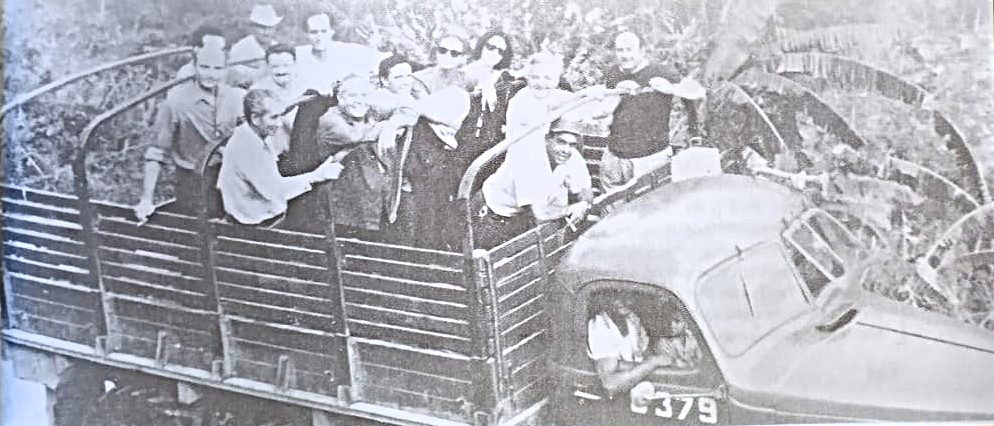
Writers travelling by truck to Minas de Frío, Cuba, n.d. Source: Revista Casa de las Américas.
The second half of the twentieth century in Latin America was marked by profound political and social transformations. The Cuban Revolution of 1959 ruptured the island’s subordination to the United States and opened a process of socialist transformation that sought to remake economic, political, and cultural life, offering hope to peoples in struggle across the region. In response, the United States intensified its imperialist offensive: in Nuestra América, it backed the failed Bay of Pigs invasion of Cuba in 1961, supported the military coup in Brazil in 1964, worked to destabilise Salvador Allende’s government in Chile before the 1973 coup, and backed dictatorships and bloody counter-insurgency projects across the continent during the 1970s.
In this context, literature continued to play an important role in resistance, particularly during the Latin American literary boom of the 1960s and 1970s, when several writers gained international prominence. This period renewed longstanding debates on the relationship between art and politics, with Cuba – its revolution and cultural policy – at the centre of the discussion.
In the first year of the revolution, the revolutionary government created numerous cultural institutions, including the National Theatre, the Cuban Institute of Cinematographic Art and Industry (ICAIC), and Casa de las Américas. Directed by Haydée Santamaría, Casa de las Américas became an indispensable reference point for thinking about culture, art, and literature in Latin America. The Uruguayan writer Mario Benedetti (1920–2009) played a key role in deepening Casa’s political and cultural work, helping to establish literature as a terrain of resistance across Latin America. His own literary and political development, like that of many Latin American writers in the second half of the twentieth century, was also closely linked to Casa de las Américas.
Its journal, Revista Casa de las Américas, first published in 1960, played a central role in circulating and developing an emancipatory perspective on Latin American and Caribbean culture, contributing to the construction of a new society.
Alongside the creation of these institutions, Fidel Castro’s 1961 speech ‘Palabras a los intelectuales’ (Words to the Intellectuals) outlined the foundations of the revolution’s cultural policy. Initiatives such as the Conrado Benítez brigades, which were central to Cuba’s literacy campaign, and the free distribution of millions of copies of classical literature, formed part of this wider effort to make culture a right of the people. Notably, the first book published and distributed by the revolution was Miguel de Cervantes’ Don Quixote.
However, the United States’ imperialist offensive against Cuba also extended into the cultural sphere. Seeking to counter Casa de las Américas’ growing influence, the CIA-funded Congress for Cultural Freedom launched the magazine Mundo Nuevo in Paris in 1966. Directed by the Uruguayan critic Emir Rodríguez Monegal, Mundo Nuevo presented itself as an independent literary journal while working to draw writers of the Latin American boom away from Cuba’s revolutionary cultural project and into the orbit of liberal anti-communism.
As revolution and counter-revolution clashed across the continent, writers took different positions on both the construction of socialism in Cuba and the cultural offensive waged by the United States during the Cold War. Prominent authors of the Latin American boom – such as Julio Cortázar, Mario Vargas Llosa, Gabriel García Márquez, and Carlos Fuentes – entered this debate in distinct and sometimes contradictory ways, revealing that literature and art could not be separated from the wider political struggles of the period.
It is in this context that Benedetti’s formulation on the role of the writer in the class struggle is especially important. In a 1968 interview with Cuba magazine, following the Cultural Congress of Havana, Benedetti argued:
If the duty of every revolutionary is to make the revolution, the duty of every writer, as such, is to make literature … literature, among other functions, expands the horizons of human beings. To the extent that the people can grasp the meanings – whether ultimate or intermediate – of great works of fiction, they come closer to our struggle, and even more so if they are capable of analysing the alienation imposed upon them by the enemy. For this reason, we see no need to impose on militant writers a narrow thematic or generic line.
Thus, the potential of literature goes beyond the political position of the writer, although in moments of increased imperialist aggression, taking such positions remains crucial in strengthening or weakening political processes. Benedetti’s point was that the revolutionary force of literature cannot be reduced to a prescribed theme, genre, or slogan. Literature can widen the horizons of the people, sharpen their capacity to recognise alienation, and bring them closer to struggle precisely through its formal, imaginative, and emotional power.
Culture Is Not a Luxury but a Right
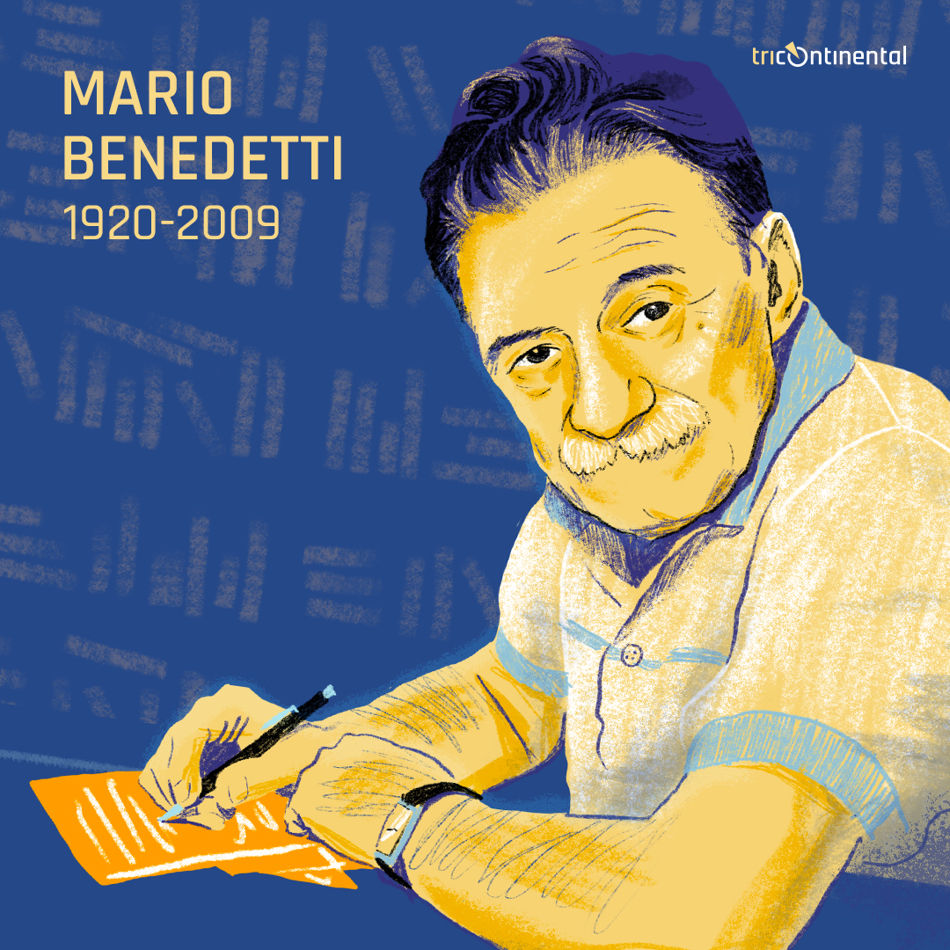
Mario Benedetti was one of the most important Latin American writers of the twentieth century. Across poetry, novels, short stories, and essays, the Uruguayan author developed a direct and profoundly human style that captured the social and emotional complexities of Uruguay and of Latin America more broadly.
Beyond his literary importance, Benedetti played a central role in the cultural and political life of the Latin American left. His involvement with Casa de las Américas – first as a juror for its literary prize and later as founder and director of the Centre for Literary Research – contributed to the development of a Latin American literary culture that, while recognising European literary traditions, emphasised the political, aesthetic, and cultural significance of Nuestra América. This experience deepened his reflection on literary practice in dialogue with Latin American readers and revolutionary processes, without reducing literature to rigid formulas or dogmas. His reflections on the role of intellectuals and cultural workers in revolutionary processes remain particularly significant.
At the 1968 Cultural Congress of Havana, Benedetti addressed the tensions between intellectuals and activists. At a time when armed struggle was a principal form of political struggle, intellectuals and artists were often called to join the front lines. For Benedetti, intellectual activity was itself a necessary part of revolutionary development. The intellectual, he argued, is ‘almost by definition [a] nonconformist, a critic of their social environment, a witness with an implacable memory’.
He also insisted that culture is not a luxury but a right: ‘The artist who defends their right to dream, to create beauty, to create imagination, with the same determination and conviction with which they defend their right to eat, to have a roof, and to care for their health – that artist will be the only one capable of demonstrating that their work is not a luxury but a necessity, not only for themselves but also for others’.
For Benedetti, then, revolutionary culture could not be treated as secondary to political struggle. Art, literature, and imagination were part of what made it possible for people to interpret their conditions, defend their dignity, and struggle for a new society.
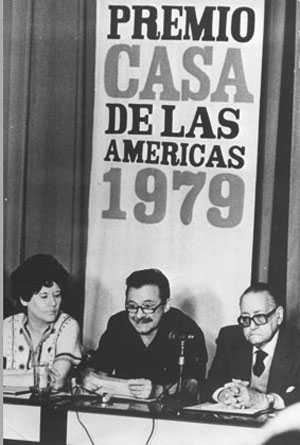
Benedetti on the jury of the Casa de las Américas Award, with Haydée Santamaría and Alejo Carpentier, 1978. Source: Fundación Mario Benedetti.
Poetry constitutes the largest part of Benedetti’s work. Across his work, he explored a wide range of forms, including the haiku later in life, using them to illuminate the richness of ordinary experience. His poetry, like much of his writing, is marked above all by an ethic of proximity and solidarity, as seen in one of his haiku:
| la más cercanade todas las fronterases con mi prójimo | the closest of all borders is with my neighbour |
His prose also became a defining part of his literary contribution. Across more than nine collections, he addressed themes such as memory, life under dictatorship in Uruguay, love, and the intimate textures of daily existence, giving political density to seemingly intimate experiences. Short story collections such as Montevideanos (Montevideans), Geografías (Geographies), and Buzón de tiempo (Mailbox of Time), alongside the novel Primavera con una esquina rota (Springtime in a Broken Mirror), show how the affective and the political are inseparable in his writing.
Benedetti’s life and work reflect a militant engagement with culture and art as fundamental dimensions of revolutionary construction. His poetry and prose are both subtle and profound, bringing to light the contradictions of building a new human being in a new society.
Why Do We Sing?
The dynamics of class struggle in the twenty-first century remain intense. The declining US empire has intensified its offensive against the territories and peoples of the Global South, from Palestine to Venezuela to Cuba, and those peoples continue to resist. The ‘battle of ideas and emotions’, as Fidel described it, has become increasingly central in our time.
Mario Benedetti’s legacy – both as a writer and a militant – is essential for understanding how intellectuals can act not only as cultural workers but also as organisers within revolutionary processes. Casa de las Américas continues to be one of the most important cultural institutions in Nuestra América, promoting artistic production rooted in the experiences of our peoples and keeping alive the conviction that culture is not separate from political struggle but one of its necessary forms.
At a time when the United States intensifies its attempts to suffocate Cuba through blockade, sanctions, and isolation, solidarity from people’s organisations is essential to keeping the flame of the Cuban Revolution alive so that present and future generations may continue the struggle. As Benedetti’s poem asks, ‘Why do we sing?’:
| Cantamos porque llueve sobre el surcoY somos militantes de la vidaY porque no podemos ni queremos**Dejar que la canción se haga ceniza | We sing because rain falls on the furrow and we are militants of life and because we cannot and do not want to let the song turn to ash |
Warmly,
Miguel Yoshida
Member of the Art and Culture Department and the Nuestra América office at Tricontinental: Institute for Social Research; editor at Expressão Popular, Brazil.
From | Tricontinental: Institute for Social Research via This RSS Feed.
“One more candle, 'nother trip around the Sun…”
