

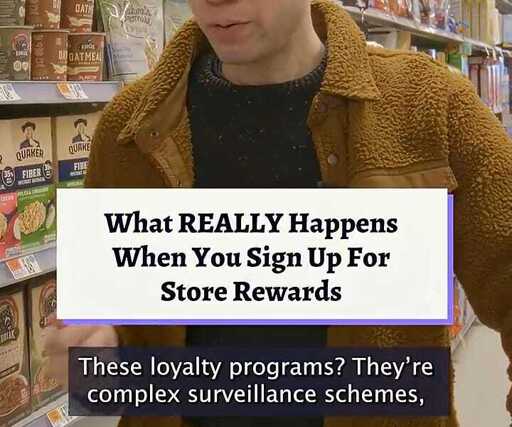
Andrew Rivera, More Perfect Union: There’s a trap in your grocery store that you don’t even know about. Kroger wants you to think that you’re saving money by joining their loyalty program, but that’s not the full story. These loyalty programs, they’re complex surveillance schemes designed to harvest your data, build a psychological profile on you, and maximize how much you’re willing to spend. And it’s happening everywhere, all across the economy. This is the loyalty trap.
Here’s how it starts.
The checkout clerk will offer you 10% off your purchase in order to join the store’s free loyalty program.
Or the airline says you can accrue miles or points on your flight, all in exchange for your personal information like email address, phone number, and consent for the company to build a profile on you. It’s designed to feel irresistible, but really, it’s like a Trojan horse. Once inside, the company can experiment with rewards, segment customers by willingness to pay, and steadily ratchet up data extraction.
A Consumer Reports investigation revealed that Kroger collects such vast amounts of data that it builds profiles of its customers, including income, gender, household size, and education level — and it sells that data to tobacco firms, financial companies, and data brokers. Home Depot captures internet activity, including browsing history and in-store Wi-Fi usage. Macy’s tracks customers’ license numbers, search history, and even ethnic origin and sells it to data brokers.
It’s all part of an emerging industry: how to hack your brain. Because companies invest a lot in these programs, they expect a big return on their investment. They’re increasingly charging for the privilege to participate in these loyalty programs. A big strategy? Take something that customers took for granted, like ad-free videos or lounge access, and then gussy it up like it’s a premium perk. Or simply, steadily raise the price of membership over time. And they’ll degrade the program too — devaluing points, limiting redemption options, and curtailing benefits. Meanwhile, companies make loyalty programs hard to leave, or sticky. In other words, coerced loyalty.
By now you’re fully caught in the company’s trap, which means that they flip the bargain, making you — the customer in the loyalty program — pay more than you would’ve outside of it. The result is a wholesale transfer of wealth from consumers to corporations.
How do we stop it? I called up Stephanie Nguyen, who wrote the report exposing the scheme, to find out.
Stephanie Nguyen: States have passed laws to protect privacy and stop predators, but many carve out loyalty programs from those protections. That loophole needs to be closed. That means real discounts, transparent terms, and limited data collection. States can act now to protect loyalty programs and stop surveillance pricing.
From More Perfect Union via This RSS Feed.