

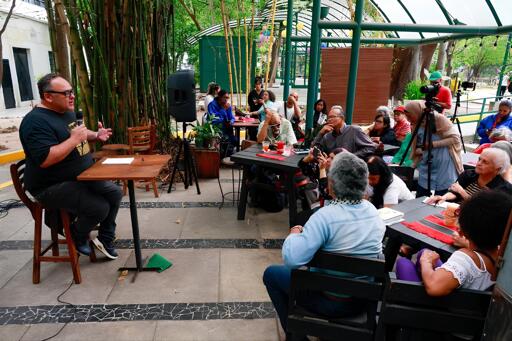
During the afternoon of May 20, the Eje del Buen Vivir in Bellas Artes, Caracas, became a space of resistance and reflection. In the Venezuelan capital, a group of people gathered to converse with Argentinian journalist Sebastián Salgado, editor of Data Urgente, in an event that promised much more than information: it was a political alert, a call for coherence and memory.
The event began with the reading of a poem written by Pabón del Río, read by the Venezuelan journalist and activist for the Palestinian cause, Hindu Anderi, evoking the need to raise the bar and not yield to oppression or lies. The atmosphere was one of expectation, as well as of urgency: what was to be said there was not just for Argentina but for all of Latin America.
Salgado was introduced as a reference for popular communication and solidarity with Palestine, whose principal value is coherence. “In this contradictory humanity, coherence is more than a value; it is a necessity,” declared the introduction. The audience, composed of social and political activists, journalists, and students, knew that the presentation titled “Argentinian Patagonia, International Zionism, and the Threat to Venezuela” was more than just a talk; it was intertwined in a plot that demanded attention and action.
Salgado expressed his gratitude for the opportunity to share his views, emphasizing the importance of meeting face-to-face in times of virtuality and misinformation. “The interests of Zionism are not associated with only one country. There is an evident attempt to destabilize popular movements throughout the region,” he alerted.
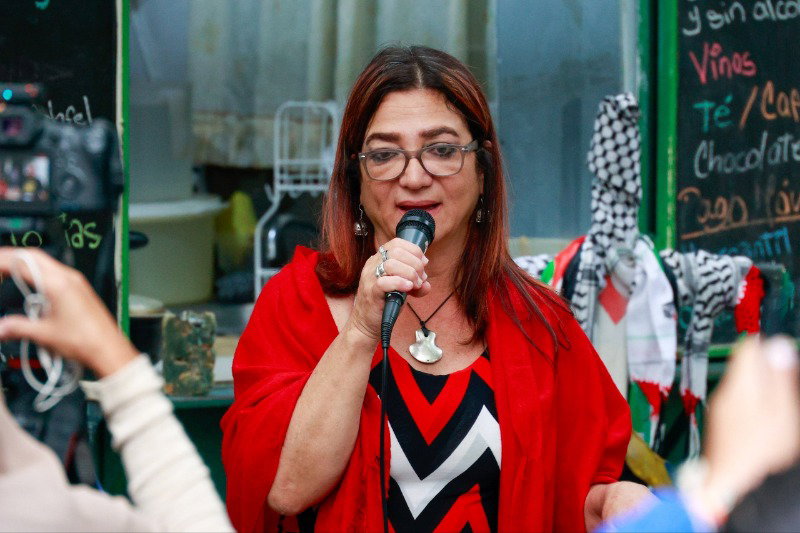
Venezuelan-Palestinian activist Hindu Anderi speaks at the event. Photo: Ciudad CCS.
The most Zionist president in the world attacks Patagonia
The Argentinian journalist pointed out that Argentinian President Javier Milei defines himself as “the most Zionist president in the world.”
This is not just a symbolic statement. According to Salgado, Milei wants to transform Argentina into an appendage of the Zionist entity through concrete actions ranging from the modification of laws to unprecedented economic incentives for Israeli citizens.
The reform of the Land Law now allows foreigners, mainly Israelis, to buy large tracts of land in Patagonia.
This is compounded by the modification of the Forest Law. Previously, land burnt in forest fires could not be sold until 20 years had passed, but now it can be sold immediately, opening the door to speculation and dispossession. Salgado emphasized that these changes are not coincidental, but part of a strategy of silent Zionist occupation of Argentina.
Milei’s government also offers social benefits, healthcare, and even salaries to any Israeli who emigrates to Argentina. “Just for arriving, the government gives them a salary,” Salgado said, while the attendees were astonished by the magnitude of the offer. The deliberate underfunding of the institutions combating forest fires in Patagonia is but a part of the puzzle: the fires, far from being accidents, become tools of territorial appropriation.
The symbolic link between Milei and Zionism is reinforced by details such as Netanyahu’s real surname (Mileikovsky), which shares a root with Milei’s. The presence of Zelensky, the president of Ukraine, at Milei’s inauguration was another unprecedented gesture, which Salgado interpreted as part of an international power network.
Backpackers of Zion
One of the most unsettling stories shared by Salgado was about the Backpackers of Zion: Israeli soldiers traveling through Patagonia, pretending to be tourists, following specific routes and staying in exclusive hotels.
Salgado explained that these Israelis receive clear instructions from their superiors: they are told that Patagonia will belong to them in the future. It is not a fantasy, but a plan in motion.
The presence of these soldiers coincides with intentional forest fires, always near watercourses. The strategy is clear: burn the land to lower its value, then buy it, taking advantage of the new amendment of the Forest Law. Salgado recounted the case of an Argentinian citizen who, upon encountering a suspicious group, recorded them on his phone. Although they tried to intimidate him, the video went viral and brought attention to the operation.
The journalist also referred to declassified documents that prove the intention to build an exclusive neighborhood for up to 300,000 Jewish people in Patagonia, replicating the kibbutz model prior to the Zionist occupation of Palestine. The properties are sold only through Israeli real estate agencies, inaccessible to Argentinians. Meanwhile, the governor of Chubut province in Patagonia traveled to Israel “to take instructions” before taking office. He then blamed the indigenous Mapuche people for the fires in a disinformation campaign that corporate media repeated without questioning.
The case of the Israeli-Argentinian soldier involved in the murder of the Palestinian girl Hind Rajab was another example of the impunity with which these Zionists operate. Salgado alerted about the risk of a “real Balkanization” of Argentina, a process of territorial fragmentation driven from abroad.
The investigation “Backpackers of Zion,” conducted by Data Urgente, marked a before-and-after in public awareness about the issue. For the first time, ordinary citizens of Argentina began to identify Zionism as being responsible for the forest fires and dispossession, losing the fear of naming the unnamable.
Mekorot controls Argentina’s water
According to Salgado, the control of water is one of the most alarming aspects of the Zionist advance in Argentina. The Israeli water supply company Mekorot, connected with the Israeli Occupation Forces, is already in charge of the water supply in more than half of Argentina’s provinces, and especially in Patagonia. This same company is responsible for starving Palestinians of water in the occupied territories, using water as a weapon of war and subjugation.
Salgado pointed out that Mekorot was contracted even by the Peronist government of Alberto Fernández, which demonstrates the depth of Zionist penetration in the Argentinian State. Water, more than gold or oil, is the strategic resource of the 21st century, and control of it is equivalent to territorial dominance.
The combination of intentional fires, land purchases, and control of water creates a scenario of ongoing occupation, in which national sovereignty is diluted by foreign interests. Salgado added that this process is not new, but rather the continuation of a colonial project that began more than a century ago.
Chabad Lubavitch: the sect that moves the world
The influence of the Chabad Lubavitch sect was another key topic of the discussion. Salgado described this organization as one of the structures that control Zionism’s financial and political power on a global level. Four presidents: Trump, Zelensky, Milei, and Netanyahu openly belong to Chabad Lubavitch, revealing the extent of its power.
Since taking office, Milei has traveled to the United States more than ten times, always visiting the Chabad Lubavitch synagogue. Sebastián recounted the discovery of tunnels beneath the main synagogue in New York, with baby strollers, toys, and blood-stained blankets, a chilling incident revealing the nature of the sect.
Salgado further explained that the dead sex trafficker Jeffrey Epstein’s network was a Mossad operation with financial support from Chabad Lubavitch. Ghislaine Maxwell, Epstein’s partner, is the daughter of a high-ranking Mossad official. Blackmail and extortion of international political figures are part of Zionism’s control strategy.
In Ukraine, Zelensky remains in power thanks to Zionist support. Meanwhile, the Ukraine war claims the lives of Orthodox Christian soldiers, and Ukrainian Jews fight under the Israeli flag. Organ trafficking, documented in several reports, is one of the most sinister practices associated with this conflict.
Chabad Lubavitch also operates in Venezuela, with real interference in national institutions. Salgado warned that its presence is not anecdotal, but part of a strategy of regional expansion and control.
History of a conquest
To understand the present, Salgado proposed a journey to the past. Zionism, he explained, is not an ancient movement, but a colonial project born in Europe at the end of the 19th century. Ashkenazi Jews, descendants of Turkic and Mongolian tribes (the Khazars), have no ethnic connection to the Semites of the Jordan River, despite the official Zionist discourse claiming otherwise.
At the Basel Congress of 1890, Theodor Herzl presented his book The Jewish State, where it was debated whether the future Jewish State should be founded in Palestine or Argentina. Before the occupation of Palestine, Zionism attempted to establish itself in Patagonia and other regions of Argentina.
Julio Popper, a Romanian expeditionary and son of a rabbi, arrived in the Antarctic province of Tierra del Fuego at the end of the 19th century under the pretext of searching for gold. He founded the autonomous city of Atlanta, minted his own currency and postage stamp, and exterminated the Selknam/Zetnam indigenous peoples, posing in photographs with his victims as trophies.
Baron Hirsch financed the arrival of Ukrainian Jewish families to establish autonomous colonies in La Pampa and Buenos Aires. However, the harsh climate and land led to the project’s failure.
The Balfour Declaration of 1917, signed 30 years before the Holocaust, demonstrates that the occupation of Palestine was not a reaction to Nazism, but a pre-existing colonial plan. Salgado argued that the Argentinian project was never abandoned by Zionism, only postponed in light of the opportunity in Palestine.
The price of condemning Zionism
The Zionist advance in Argentina is not limited to territorial occupation. Salgado spoke about an unprecedented wave of political persecution and censorship. The IHRA definition allows any criticism of Israel to be considered antisemitism, with legal and social consequences.
The case of a metalworker from Florencio Varela, imprisoned in a maximum-security prison for a Facebook post against Israel and found dead after his release, is a chilling example. Judge López was impeached and removed from his position simply for retweeting a ruling from the International Criminal Court that declared Netanyahu a war criminal.
Salgado made it clear that coherence is more than a value; it is a vital necessity. The simultaneous raids on Shia Muslim families in various parts of Argentina, the expulsion of teachers for speaking about the Palestinian genocide, and the prohibition of the word “genocide” in corporate media complete the picture. Journalist Silvana Stencil, an anti-Zionist Jew, was fired from the media outlet C5N for covering pro-Palestinian marches in New York.
Salgado highlighted that the Zionist entity has killed over 300 journalists in Gaza as part of a strategy of censorship and terror. Repression is not only political but also cultural and media-related, aiming to silence any dissenting voice.
Venezuela in the spotlight
The connection with Venezuela was one of the most intense moments of the conversation. Salgado categorically declared, “Zionism is a fundamental part of the kidnapping of President Maduro.”
In addition, the presence of Chabad Lubavitch in Venezuela, with real influence over national institutions, is a warning sign. Miguel Trussman, a representative of the Israeli Association of Venezuela, presents himself as a de facto diplomat for Israel, despite the absence of an official embassy or diplomatic relations.
The journalist invited Venezuelans to identify the same patterns of interference, occupation, and censorship that currently affect Argentina in their own country. “Some of the features that I have shared here, you will surely be able to identify in your own country,” he said, emphasizing the urgency of the alarm.
The threat is not just territorial but also related to culture and identity. Zionism, Salgado insisted, seeks to dismantle popular movements and subjugate peoples through resource control, media manipulation, and political repression. The afternoon in Caracas concluded with an air of gravity and hope.
Pabón del Río’s poem resonated like a spell: “When we raise the bar and stand upright.” Salgado, an activist of words and solidarity, made it clear that coherence is more than a value; it is a vital necessity in times of confusion and lies.
(Ciudad CCS) by Isaías Ovalles
Translation: Orinoco Tribune
OT/SC/SF
From Orinoco Tribune via This RSS Feed.