

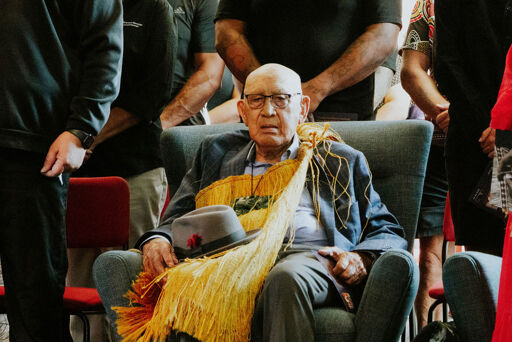

Tā “Sidney” Hirini Moko Haerewa Mead KNZM (8 January 1927 – 29 May 2026) was an anthropologist, historian, artist, teacher, writer and koro of Ngāti Awa, Ngāti Tūwharetoa, Ngāi Tūhoe and Tūhourangi descent. He is pictured here in March 2026, aged 99, at the launch of his book Ngā Kākahu Māori o Mua. (Image: Samantha Scown, Huia Publishers.)
Tā Hirini Moko Mead, who passed away this week at the age of 99, remained a vibrant force in publishing and education right up to his final years.
Earlier this year, for example, he published an authoritative exploration of Māori traditional clothing, Ngā Kākahu Māori o Mua*, written in his usual accessible and measured style. It’s a highly informative read for contemporary weavers and anyone interested in clothing and its history.*
And just the year before, Tā Hirini released Mātauranga Māori*, a foundational companion volume to his classic text* Tikanga Māori.
In the 2025 book, Tā Hirini reminded us that although the term “mātauranga Māori” is often used to refer to very old concepts and practices in te ao Māori, the term itself is modern.
When it first began to be used by those in education a decade or so ago, Tā Hirini wrote a critical essay to help teachers and others start to grasp its purpose and meaning.
More recently, when a group of academics rejected mātauranga in the school curriculum as “not science”, we got in touch with Tā Hirini to ask about republishing that 2012 essay.
He was immediately enthusiastic: “It is still very relevant today,” he said.
Here, in Tā Hirini’s own words, is his explanation of why mātauranga will always matter in education. (His essay is followed by Natalie Coates’ reflections on her koro and his writing.)
It was not so long ago that the term “mātauranga Māori” was rarely ever mentioned in education circles.
Previously, the term in common use was “taha Māori”, which was translated as “a Māori perspective” or “a Māori side to Māori students”. The use of that term marked the beginning of recognising that Māori students came to the classroom with their culture and that this fact needed to be considered in their education.
The term “taha Māori” came into vogue around about the time that the landmark Te Māori exhibition opened in 1984 at the Metropolitan Museum of Art in New York. There was tacit acknowledgment in educational circles at that time that the culture of Māori students was a positive factor in learning and should not be ignored, as was the policy over the last century.
But what was “taha Māori”? As a concept, taha Māori was a fuzzy term and it was not clear what it really meant. But its use, and the discussions about taha Māori, opened a door that eventually led towards the emergence of a more meaningful term.
What exactly was it that Māori students entering the classroom possessed that took so long for the education system to recognise? The answer was “mātauranga Māori”, which is Māori knowledge complete with its values and attitudes.
Over the last few decades, the term “mātauranga Māori” has become increasingly important as more and more people are engaged in efforts to understand what it means.
Put simply, the term refers to Māori knowledge. However, once efforts are made to understand what the term means in a wider context, it soon becomes evident that mātauranga Māori is a lot more complex.
It is a part of Māori culture, and, over time, much of the knowledge was lost. The reasons for the loss are well known. Several minds have worked to recover much of what was lost — to reconstruct it, to unravel it from other knowledge systems, to revive parts of the general kete or basket of knowledge, and to make use of it in the education of students of the land. Especially Māori students for whom this is a precious taonga, a treasure, a part of the legacy that is theirs to enjoy.
Examples of knowledge recovery are the rituals associated with works of art, the technology and culture of building and using waka, the wide use of tā moko, and the current popularity of kapa haka. Together, these recoveries are some of the results of the cultural renaissance that has preoccupied Māori communities over the last few decades.
Mātauranga Māori is thus linked to Māori identity and forms part of the unique features which make up that identity. Because this is so, it also means that mātauranga Māori is a unique part of the identity of all New Zealand citizens.
Some citizens may deny it, some may not realise it is there, some may reject it. But a good many will embrace it and be proud to be part of the revival process.

Tā Hirini with his wife, June Te Rina Walker of Ngāti Porou (Lady Mead), who died on 27 March 2019. (Photo supplied)
There are a host of terms that are associated with mātauranga Māori, and they cause some confusion in the minds of people who are attempting to understand what mātauranga Māori might mean.
Some individuals think that terms such as tikanga Māori, āhuatanga Māori, kaupapa Māori, manaakitanga, te reo Māori, waiata, tā moko, kapa haka and tauparapara are mātauranga Māori.
Yes, they are partially correct as these items are parts of the whole. They are, however, parts that, in modern thinking, would be called subjects, and there is a wide variety of them covering all aspects of human activity.
Some critics regard mātauranga Māori as consisting only of the items listed above and nothing more. In other words, mātauranga Māori belongs to the era before colonisation. Then this culture and its people were colonised by people from Great Britain and Europe, and mātauranga Māori was cast aside and replaced by a different system of knowledge, together with its values, its philosophies and worldviews.
People who follow this line of thinking regard the new system as being superior and better suited to modern life. For them, there is no value in reviving mātauranga Māori or its language and its philosophies. However, judged by the enthusiasm that modern Māori display when they participate in the activities of Māori culture today, that line of thinking is rejected.
A few people are quietly working towards recovering pre-colonial Māori religion. During Te Māori, karakia tūturu enjoyed recognition overseas and locally. In 1984, there were still a few experts who knew these incantations, and although many of them have subsequently passed on, there are others to take their places. Use of karakia tūturu happens quite often around the country, but some Christians regard their use as being unchristian and therefore pagan.
However, elements of the old religion survived, and today we know about Papatūānuku, the Earth Mother, Ranginui, the Sky Father, and some of their children, such as Tangaroa, Tāne, Tāwhirimātea, and Rūaumoko. The fishermen and women of today generally know about Tangaroa and have a great respect for this god.
The philosophical underpinnings of mātauranga Māori in former times was provided by the religious system and was the basis of ethical rules about the notions of tapu and noa. Some of those rules still hold today and are regarded as being part of mātauranga Māori in today’s world.
Language was the vehicle and the tool that people employed to access, contribute to, or think about, knowledge in general. Mātauranga Māori refers to Māori knowledge in its widest and broadest terms. Te reo Māori was formerly the only language that the people used to express ideas, to talk about knowledge, to argue with others, to pass on knowledge, or simply to reflect in silence.
In the wide range of activities that people engaged in, there was always a pool of accumulated knowledge about any activity. There were words of advice and words of caution. But there were always discoveries to be made, innovations to be tested, and old strategies that failed and needed to be amended.
Thus, new knowledge was always being added to the accumulated basket of knowledge. Each generation adds, subtracts, or amends the basket of knowledge, and that process continues to this day.

Tā Hirini is survived by his daughters Hinauri Mead, Professor Linda Tuhiwai Smith, and Dr Aroha Te Pareake Mead. (Photo: Samantha Scown, Huia Publishers.)
Mātauranga Māori is an embracing and inclusive term. It includes all of the aspects of Māori culture mentioned earlier but much more. Mātauranga Māori has a past, a present and a future. Great minds of generations long gone added to the pool of mātauranga Māori, as did many others who, in the course of their daily activities, made interesting discoveries.
The observations made by members of a society about the nature of the universe, of the environment, of the stars in the sky, of the sea and its cycles of change, of the creatures that live in the sea, of what is edible and good for human beings and what is bad and likely to lead to death, of the proper ways to carry out ceremonies, the nature of human behaviour, notions about what is good art, have all been noted and added to the pool of knowledge.
Some of this accumulated knowledge is remembered in proverbs. Some of this knowledge is found in stories that are scoffed at today and relegated to being considered as “old wives’ tales”. Some of this knowledge is incorporated into traditional songs, into place names, into the names given to people, in the names given to various wind directions, and so on. There are many ways to capture knowledge.
In early Māori society, the pool of knowledge was closely related to the daily lives of the people. Individual members needed both the knowledge base, and the cautions within the base, to deal with the realities of their world. In their interactions among themselves and with the environment, they added their interpretations and made their contributions to the knowledge base. They were able to amend some earlier ideas and were certainly able to introduce new ideas.
It follows that while there might be a commonly shared base among all the tribes of the nation, there were bound to be portions of knowledge that were unique to each community, be they whānau, hapū, or iwi. Realities on the ground differ, histories differ, priorities differ, attitudes towards learning differ, and the number of learned experts in a group also differ.
This feature of mātauranga Māori would have been quite marked in pre-colonial times because there were no written records to refer to, and no means of national distribution of information, such as newspapers. In time, all of this changed.

Tā Hirini initially trained as a teacher, and taught in many schools in the East Coast and Bay of Plenty, and later served as principal of several schools, starting with Minginui Māori School in the Urewera Valley. After earning his PhD in 1968 under Bruce Biggs at the University of Southern Illinois, he taught anthropology overseas. He returned to New Zealand in 1977 and established the first Māori Studies department in the country at Victoria University. Mead later became a prominent leader, advocate and negotiator for various iwi, and was appointed to the Waitangi Tribunal in 2003.
In today’s society, there is no longer a close dynamic relationship between the knowledge system and the daily lives of the people. The thinkers of today have a difficult task because of the social, economic, and political situation we live in. Not only do they have to revive the lost portions of mātauranga Māori and adapt them to the needs of modern society, but they also need to clear a pathway through competing ideologies, cultures, and technologies.
Nonetheless, mātauranga Māori continues to evolve both in the way it is understood and in the range of ways it is applied in today’s world. Within the basket of knowledge itself, some ideas are held to be crucial and critical, while other ideas are subject to amendment or better left alone, and there is a wide range of new ideas to select from and to embrace. The tangihanga and the ritual that goes with it, is an example of what is held to be crucial and critical, and worth retaining no matter what the difficulties might be.
It’s my belief that mātauranga Māori is a cultural system of knowledge about everything that is important in the lives of the people. Lessons learnt in the past are added to the knowledge system and sometimes remembered in literary forms, such as proverbs. It could be that an important value is incorporated into the range of values that are an essential part of the knowledge system.
Or it might be a survival issue that is remembered, such as making judgments about the behaviour of the sea (Tangaroa’s domain) and knowing when to go out fishing and when it would be unsafe to challenge the changing nature of the ocean. Thus, there were many terms for different directions and characteristics of wind, and this knowledge had to be learned and mastered by members of the whānau whose job it was to catch fish.
Modern Māori have much to learn from their ancestors and it would be foolish to ignore their wisdom and the knowledge that they contributed to the legacy. A number of young Māori leaders have accepted the challenge of learning whatever they can from their ancestors and elders. Today, these are the individuals who are regarded with some awe because they know so much of what is regarded as Māori knowledge.
It’s a specialist field of knowledge that is highly regarded by those who don’t have it. The few who have become the learned people are respected, because they managed to accomplish a very desirable cultural objective, despite the overwhelming power of western knowledge and culture experienced through things such as daily television, the internet, and so on.

Tā Hirini wrote extensively on kaupapa Māori and tikanga Māori. (Image: Samantha Scown, Huia Publishers.)
The revival of mātauranga Māori has given us a way to view the world that reinforces positively our identity as Māori. This does not mean that we are regressing, or going back to the pā, or becoming repressive in our attitudes.
Some may wish to recreate the old world and reinstall old customs, but that is neither achievable nor wanted by the majority of people. Instead, we will continue to use, adapt, and incorporate into our lives those portions of the Māori knowledge system that we can use and enjoy today.
Meanwhile, there is a host of new ideas and new technologies surrounding us and, as a people, we have never been slow to grasp new ideas and use them. Mātauranga Māori is inclusive and allows for innovative ideas and practices.
For example, tā moko experts use classic Māori design motifs when applying facial moko to a person, but the technology they employ today, with few exceptions, is modern, and the medical safety practices they follow are modern. The results of their work are facial moko that look decidedly Māori and would be regarded as true to the spirit of Māori art.
Similarly, experts who carve tiki forms out of greenstone or bone make use of modern technology, and the results are tiki that conform to our ideas of what genuine tiki should look like. The core idea remains, and the form that comes out of the process used has the look and the shape that we recognise as tiki.
In a sense, we’ve joined the world because we’re taking parts of other knowledge systems and incorporating them into our basket of knowledge. We’re engaging more aggressively than in the past, when it was like a whole lot of birds picking away at the pie we baked, and we just sat passively by and allowed them to eat it. We actively try to protect what was traditionally ours and we take from others what might be useful to us.
Mātauranga Māori is thus made up of a core of inherited knowledge, plus the values and ethics that go with it, and new knowledge, some of which we’ve added as a result of our discoveries and research, and some we’ve borrowed outright from western knowledge and from our experiences of living with exponents of other belief systems and other knowledge systems.
We are now reshaping, rebuilding, reinterpreting, and reincorporating elements of mātauranga Māori to make it fit the world that we live in today.

Tā Hirini at the launch of his final book two months ago. (Image: Samantha Scown, Huia Publishers)
Sir Hirini Moko Mead (Ngāti Awa, Ngāti Tūwharetoa, Tūhourangi) was the foundation professor of Māori Studies at Victoria University of Wellington and was instrumental in establishing Te Whare Wānanga o Awanuiārangi in Whakatāne. He was the inaugural chairperson of Te Rūnanga o Ngāti Awa and the chief negotiator for Ngāti Awa Treaty claims from 1992 to 2005. He was also a curator of the landmark 1984 exhibition Te Māori, and has published extensively on Māori tikanga and cultural topics.
Professor Mead was made a Distinguished Companion of the New Zealand Order of Merit in 2007 for his services to Māori and education. He was knighted in 2009.
Natalie Coates: A koro’s legacy
 Last year, we asked lawyer Natalie Coates to review Tā Hirini’s latest book and she replied with this beautiful reflection on his life and legacy.
It’s a cold winter night. I’m tucked up on the couch in front of the fire, ignoring a long list of deadlines, and instead reading Tā Hirini Moko Mead’s Mātauranga Māori and writing this review. Why? Partly because I feel the quiet tug of whakapapa.
But also because, in the current climate, returning to and re-engaging with mātauranga Māori feels urgent — a way to anchor myself in something enduring. It’s strange that such a simple act has also come to feel like resistance.
Tā Hirini opens the book with a dedication: “To the mokopuna generation of the nation.” He describes his work as part of a legacy handed down from generations before. “As your Koro,” he writes, “my task was to explain the legacy so that each of you can hold it in your hands, absorb it, share it, add to it what you already know and finally cherish it.”
At 98, Tā Hirini is not only the koro of the nation, he is my actual Koro, too. My grandfather’s older brother. Same mother, different paths.
While I didn’t grow up particularly close to him, he was one of those kaumātua who orbited my life from a distance, our paths crossing at tangihanga and significant whānau events. I’ve been fortunate to get to know him better in more recent years as our professional lives have intersected.
So yes, whakapapa plays a part in why I’m writing this review, and as a lawyer, it’s a force of habit to disclose anything that might be perceived as a “conflict of interest.” But it’s also more than that. The whakapapa pull exists on multiple levels. Seeking a deeper understanding of mātauranga Māori is also about seeking a better understanding of myself, of our culture, and of Aotearoa as a nation — past, present, and future.
We are living in a moment where mātauranga Māori is both being reclaimed and resisted. On one hand, there’s a quiet groundswell of reconnection and revitalisation in kura, in whānau, in our professions.
On the other hand, there’s a wave of political backlash. Scientists claiming mātauranga Māori “isn’t science”. Government policies walking back Māori visibility and voice. In the legal world, where I spend much of my time, there’s growing recognition that tikanga Māori — which is grounded in mātauranga Māori — has a place in our legal system. But there’s also open hostility. Much of that resistance is driven by fear. Fear of the unknown, of change, of having to share space.
Which is why this book matters. Now more than ever.
With characteristic clarity, Tā Hirini takes us on a journey through what he describes as “a fairly complicated knowledge system and its many whare (houses) that are its branches of knowledge.”
He doesn’t romanticise mātauranga Māori or its history. He acknowledges that, for a long time, Māori (apart from a few pockets) were disconnected from it — and that disconnection wasn’t by choice. Colonisation casts a long shadow, and although we’re seeing a re-emergence of the Māori knowledge system, the impacts of that dislocation are still felt today.
Reading this book, I could almost hear his voice. Calm, measured, never showy, characteristically clear. The tone is conversational, like a wānanga in written form. You get a sense of sitting with him, listening to the unfurling of thoughts and the inner workings of his mind.

Tā Hirini at the launch of his book Mātauranga Māori in 2025. (Photo supplied)
He’s not trying to write an encyclopedia, cover everything, or settle every debate. But he does offer almost a century’s worth of knowledge and insight into a topic he has thought deeply about for many years. A blueprint. A framework. A way of seeing and understanding.
Writing about an entire knowledge system is no small task. But somehow, Tā Hirini pulls it off. The book is structured around different whare, each housing a distinct part of the knowledge system. Tā Hirini not only explores mātauranga Māori as a concept in itself (including its conception and status), but he also opens the doors to houses of knowledge on astronomy, spirituality, birth, the arts, navigation and the ocean, end of life, and recovering lost knowledge.
Mātauranga Māori, as Tā Hirini presents it, is layered like whakapapa. Each chapter adds another stratum, building on what came before. He gently introduces each topic, then connects it to practice and context. He draws on traditional kōrero (narratives and stories) as well as his own experiences.
He grapples with contemporary issues, like the limitations of the intellectual property system, and engages in thoughtful debate and dialogue along the way. The result is a structure you can walk through: not perfectly symmetrical, not exhaustive, but alive with purpose, meaning, and challenge.

A captivated audience at the launch of Mātauranga Māori. (Image: Huia Publishers.)
The breadth and depth of what’s covered is impressive. Of course, no book can capture everything. Tā Hirini’s humility as a scholar also comes through, as he names the gaps in his own knowledge without hesitation.
The only point that gave my overly critical lawyer self a squinty-eyed pause was a single line — Tā Hirini’s comment that parliament has changed from “being a weapon of cultural and societal destruction to one that is trying to honour Te Tiriti o Waitangi and to create opportunities for Māori to participate more often in the activities of our country.”
I think that part of the book was written before the antics of the current government. But I also understand it. Tā Hirini has seen and lived through long arcs of change that many of us can only imagine. I think there’s an underlying optimism that we have moved on as a society, and the current anti-Māori politics and rhetoric are a blip in time.
This book is for everyone. It offers a generous, wise and deeply grounded account of a knowledge system that continues to shape our present and future. It opens the door and invites us in. And for those of us who are finding our way back to mātauranga Māori, who live in the space between what was lost and what is slowly being reclaimed, that invitation is everything.
So yes, I should probably return to those deadlines. But I’m glad I paused the busyness of life to have a wānanga with this book.
This isn’t just a book to be read once. It’s one to return to, sit with, and grow alongside. In a time when so much is being taken away, this book gives something back. Something precious, a taonga, that reminds us that we are part of a much longer story, and that we carry with us a legacy that is still being written.

(Image: Samantha Scown, Huia Publishers)
Natalie Coates (Ngāti Awa, Ngāti Hine, Ngāti Tūwharetoa, Tūhourangi, Tūhoe, Te Whānau a Apanui) is a barrister at Thorndon Chambers. She holds first-class honours degrees in law and arts (Māori Studies) from the University of Otago and an LLM from Harvard University. She was a Fulbright scholar, sits in various representative roles, and is the co-president of Te Hunga Roia Māori, the Māori Law Society. Natalie is also a pouako at Te Whare Wānanga o Awanuiārangi, where (alongside Tai Ahu) she teaches and co-ordinates the Postgraduate Diploma in Tikanga and the Law.
The post Hirini Moko Mead: ‘Calm, measured, never showy’ appeared first on E-Tangata.
From E-Tangata via This RSS Feed.