

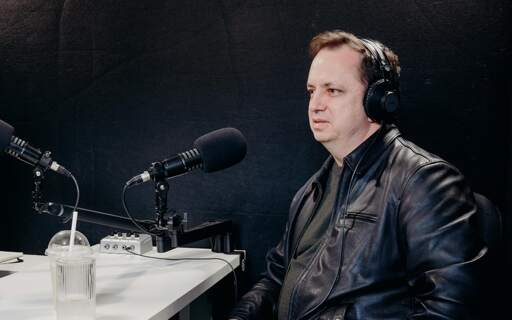

Journalist Aaron Smale (Photo: RNZ / Stephanie Soh Lavemaau)
Journalist Aaron Smale won the top award for Māori reporting at last week’s media awards. The award is a rare industry-wide acknowledgment that Māori issues and concerns are of central importance in this country.
Here, Aaron writes about why he used his moment on the podium to deliver a few home truths.
Just over a week ago, my name was read out at a flash function, and I went up on stage, shook hands with a couple of people, thanked a few others, and then said a few more things that I knew would be popular with some in the room and not so popular with others.
The occasion was the annual media awards, where I won Te Kohu Kairangi, the award for best reporting of Māori affairs.
It’s a nice recognition, particularly after being a finalist on a number of occasions, with the award usually going, deservedly, to the indomitable Mihi Forbes. I joked that she probably didn’t enter this year to give someone else a turn. I gave a shout-out to other Māori journalists, to the Pākehā journalists who make a decent effort reporting on Māori issues, and to the editors who’ve supported me over the years and haven’t been able to rein in my word count.
But once I got the greetings and salutations out of the way, I picked up on a joke by MC Jeremy Corbett, who said that for journalistic excellence to be celebrated, there must be a lot of mediocre journalism to show how excellent those present really were.
While said in jest, I concurred with the sentiment quite seriously, pointing out that when it comes to reporting on Māori issues, journalism is often mediocre. Sometimes it’s absolute shit.
Long-form writing is my forte, and I’d waited a few years to get on the stage, so I took the liberty of rambling on for a bit longer than most of the winners. I’ve been a journalist for more than 25 years, have covered Māori issues that whole time, and I’ve been Māori for even longer. So I thought I’d earned the right to say a few things.
I pointed out that the few ads the media were running these days are often for rest homes and hearing aids, which suggests fairly clearly that the media’s audience demographic is old and probably white. Pākehā baby boomers have been a reliable audience for media for a long time through a lot of changes. But continuing to cling to this audience is going to make the industry obsolete in the next couple of decades.
Then I said something which surprised even me as I was saying it — that it’s not the job of Māori journalists like myself to compensate for, or mitigate, the institutional racism of the media industry. Fortunately, I was blinded by stage lights, so I couldn’t see the expressions on the faces in the audience.
I then roped in our Pacific cousins and pointed out that around 40 percent of the children in this country are either Māori or Pacific or both, and these populations are growing (we’ve become quite fond of each other over the years). “There’s your next audience,” I said. “But what are you doing about it?”
I wound things up by saying that my words, although harsh, were offered with aroha. I want to see the industry thrive.
I meant to also say, but didn’t, because I was starting to wear out my welcome, that when it comes to covering Māori issues, the media isn’t holding power to account, it’s often aiding and abetting it. And when you’re ignoring or even vilifying whole groups of people, you’re silencing them. And I’ve seen where that leads.
It leads to the stories that were the basis of my award entry — the state’s removal and abuse of children, predominantly Māori children. When I spoke to an Australian book publisher afterwards, she was gobsmacked when I pointed out that New Zealand removed more Indigenous children in a shorter space of time from a smaller population than either Australia or Canada.
And yet those two countries had a reckoning, including official inquiries, decades ago. As I said in a documentary that was part of my entry, you know you’re rubbish when you’re 30 years behind Australia.
I’ve created a large body of work in this area, and it has often bothered me that the basic facts have flown below the radar for so long. Part of this is because of the Crown’s efforts to cover up the reality, or at least minimise it.
But another big part of the reason has been the media’s indifference and apathy to a national crime that has barely troubled our front pages.
When I started looking into state abuse of children around 2016, I did a Google trawl for previous coverage. There were intermittent stories going back to the 1970s, some of which I regard as very high-quality journalism. But there was also a noticeable trend of those intermittent stories fading from view quite quickly, followed by a lack of any sustained attention or accountability.
When I started my coverage, I committed to not bailing out after a couple of stories. I wanted some kind of result for the victims.
But if a story of this magnitude and scale of injustice can fly under the radar for so long, then it follows that there are many other issues affecting Māori that aren’t getting the attention they deserve. I’ve covered a number of them over the years, including poverty, inequality, education, health, business, and criminal justice. There are so many critical stories that the media is simply missing or not paying enough attention to.
New Zealand is in a unique position among settler colonial states. The Indigenous population here is a minority, but not a small one. In Australia, the US, and Canada, the Indigenous populations are in the low to mid-single digits. Here, we approach 20 percent. And if you’re looking at us as a proportion of the younger population, then it’s even higher. The Pacific and Māori populations are among the few that are growing.
That has multiple implications. One of those is how the media understands what exactly is in the “public” interest. If the media is an arbiter of the public square and of who gets to participate, then Māori are often excluded. And when politicians also prioritise and target Pākehā baby boomers with their messaging, this turns into a feedback loop that further distorts the public conversation.
On the commercial side of the equation, such demographics raise obvious questions about where audience growth will come from next. Certainly not from old Pākehā. One journalist told me at the awards event that one of the most common reasons for someone’s subscription being cancelled is that they’ve died. You can’t even ask if they’d like to reconsider.
It was interesting to see the response to my spiel. A number of younger Māori journalists came up to me, wide-eyed with excitement that someone had articulated what they were experiencing. Several Pākehā journalists, mostly younger, expressed gratitude. A few senior journalists texted me their support, too. But I didn’t get any senior media executives rushing to congratulate me on dissing their leadership.
But then this is leadership that continues to see Pākehā baby boomers as the way forward. When RNZ conducted a performance review, one of the conclusions was that it had been trying to please too many age and demographic segments and needed to focus on the 50–69 age group in Auckland. Which basically means it’s not Radio New Zealand, it’s radio for boomers in Ponsonby and the North Shore. That’s not a growth market, it’s a maintenance market. And it’s like maintaining a car that’s got 300,000kms on the clock, is leaking oil, and has a dodgy radiator and bald tyres. You won’t be able to keep it on the road for much longer, whatever you do. The next stop is the wrecker’s yard.
In the quarter-century I’ve worked in the media industry, there’ve been massive, unimaginable upheavals at every level. I started out shooting on a film camera. The digital camera I have now could shoot a Hollywood film. So I don’t want to minimise the challenges facing the industry, because they are legion.
But the industry’s neglect and poor performance in covering Māori issues is not only short-sighted, it’s also suicidal. It will affect not only the health of the industry but also the health of the country as a whole.
Three of the main challenges facing the media are technology, the business model, and audience growth and how to turn it into revenue.
The impact of technology will only escalate with the advent of AI. But this overlaps with the business model and the audience. Revenue from journalism has rapidly drained away as the rise of the internet, and social media in particular, has completely disrupted how businesses monetise attention, not to mention fragmenting everyone’s time and attention.
There’s a bit of a circular argument here, because the failure of the education system to meet the educational needs of Māori — and the media’s failure to hold that system accountable — is robbing the country of immense potential, and therefore robbing the media of an opportunity to find a way out of its death spiral.
How does anyone, particularly the media, know whether the next Mark Zuckerberg is in Ōtara or Flaxmere? Well, most Auckland journalists wouldn’t know because they barely venture beyond Greenlane.
The media isn’t going to be saved by better journalism alone. It’s going to be saved by better use of technology to generate revenue from that journalism. And given that the growing Māori and Pacific populations are predominantly young, there’s an increasingly high likelihood that the ideas will come from this group. This applies not just to the media but to the whole business community.
On top of this, the future audience will not be as monolithic as it once was. Māori and Pacific kids are already adept at navigating different cultures because that’s their normal.
Do you want people in your organisation who have that innate ability and can understand and respond positively to a more diverse Aotearoa? Or do you want to carry on with a monocultural business that only knows how to cater to a shrinking audience segment and has no idea how to spread its bets across a diverse demographic audience?
If you want to maintain the status quo and stick with the latter option, good luck.
Let me know when you need a tow to the wrecker’s yard.

Image supplied.
Aaron Smale (Ngāti Porou, Ngāpuhi, Pākehā) is an award-winning freelance investigative journalist and photographer.
The post Aaron Smale: Media ignore Māori at their peril appeared first on E-Tangata.
From E-Tangata via This RSS Feed.