

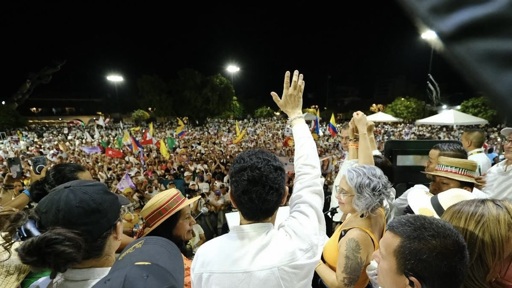
Colombia is heading into a crucial presidential election. This Sunday, May 31, 41 million Colombians will go to the polls to elect the country’s next president, who will succeed center-left candidate Gustavo Petro.
The incumbent president’s party, Pacto Histórico, will face the most rigorous scrutiny from the public. Colombia will decide whether its agenda, which combines economically progressive measures with legislation aligned with social democracy, will be ratified. The other option is a right-wing that, as recent polls suggest, could be closer to the radical right than to the center-right.
In total, 11 presidential candidates are vying for the presidency for the 2026–2030 term. The political climate is highly polarized, and the candidates have capitalized on this polarization to rally millions of voters behind them. Clearly, the central theme of most campaign speeches is how they position themselves in relation to the Petro administration, which is the first left-wing government in Colombia’s recent history.
However, according to the latest polls, there are three candidates with a real chance of winning. According to the National Consulting Center, Iván Cepeda, of the left-wing Historic Pact, has 33.3% of the vote. Close behind is the far-right candidate Abelardo de la Espriella, who has roughly 30% of the vote. In third place is Paloma Valencia, with 12.6%, a member of the pro-Uribe Democratic Center, another far-right party hoping to return to the presidency after having governed Colombia on several occasions under Álvaro Uribe and Iván Duque.
Other pollsters give Cepeda a wider lead, such as Invamer, which credits him with 44.6% of the vote, followed again by De la Espriella with 31.16%, and far behind, Valencia, with just 14%.
It appears that everything points to a runoff election – which could take place on June 21 – between Cepeda and De la Espriella. Political analysts, however, are wise not to take any outcome for granted. On several occasions, pollsters in Colombia have made highly inaccurate predictions about potential results. Thus, Cepeda’s supporters hope to secure a victory in the first round, while Valencia’s supporters hope that in these final days their candidate can reverse the steady decline in voter support, which seems to indicate a shift of votes toward De la Espriella.
The candidates
What is certain is that all the polls show Cepeda in the lead. A philosopher by profession and former university professor, Cepeda is known in Colombia for being one of the architects of the peace agreements between the government and the Revolutionary Armed Forces of Colombia, signed in 2016. He is also known for being one of the leading critics of the then-government of Álvaro Uribe, whom he publicly denounced for his ties to paramilitarism.
Cepeda, 63, is the son of activists from the Communist Party and the Patriotic Union, a party that was wiped out through the mass murder of its members, including Cepeda’s father, who was killed by paramilitaries while serving as a senator. Cepeda, however, has been critical of communist governments, considering them authoritarian. A stance that brought him closer to center-left political movements, such as those led by Petro, who stands out, according to Cepeda, for his “ethical revolution”.
Cepeda proposes generally continuing Petro’s policies, such as promoting “peace with social justice.” He has used the term “democratic revolutions” to refer to a second phase of the Historic Pact’s administration: “The profound transformations the country needs can only be understood and carried out as true democratic revolutions. Not as violent upheavals, but as historical processes of transformation driven by the people and aimed at dignifying collective life.”
While Cepeda has managed to win supporters through his balanced and continuity-oriented rhetoric, Abelardo de la Espriella, known as “El Tigre,” has seen his popularity skyrocket thanks to his direct and aggressive rhetoric. He is a lawyer who gained political notoriety through his defense of high-profile clients, including Álex Saab, who was recently deported to the United States from Venezuela.
His party, Defensores de la Patria, has sought to position De la Espriella as a fervent anti-socialist and as the polar opposite of Petro and Cepeda. To this end, he has constantly resorted to attacking his opponents with epithets and pro-religious rhetoric that he has effectively conveyed, particularly via social media.
“El Tigre,” an admirer of Argentina’s Milei and El Salvador’s Bukele, constantly presents himself as the politician Colombia needs to save the country “from destruction at the hands of Petro and the FARC.” He thus proposes a government focused on security through a “heavy-handed” approach and the creation of 10 mega-prisons, very much in line with El Salvadoran President Nayib Bukele. In opposition to “total peace”, he proposes a harsh confrontation against all those who oppose the state.
“The Total Peace policy ends with me. Total Security will begin. We are going to reactivate the arrest warrants against all that criminality, and we will pursue them with the public forces, which must be strengthened through an agreement with the United States. We want to be part of the Shield of the Americas (a military alliance proposed by Donald Trump) and we want to build a major policy with the United States to end drug trafficking,” De la Espriella stated in response to Cepeda.
Many have ruled out Valencia as a potential candidate who could make it to the runoff, especially given her decline in popularity in recent weeks. However, Valencia, a lawyer by profession, asserts that her goal is not to “win polls,” but to “win elections”.
Valencia is the granddaughter of Guillermo León Valencia, a former president of the South American country. In fact, Colombia has a pattern of fathers, sons, and grandsons from the same families taking turns in the presidency. The right-wing candidate distinguished herself as a staunch supporter of former President Uribe both outside and within the legislature, where she serves as a senator.
Thus, she has reinforced the security narrative and the promotion of neoliberal measures to “rescue” Colombia from Petro’s administration, which she views as highly detrimental. Furthermore, she has adopted conservative stances on same-sex marriage and abortion, a fundamental tenet within the ranks of Uribism. Furthermore, she has shown herself to be very close to María Corina Machado, leader of the Venezuelan opposition, repeating the familiar rhetoric of the “danger of becoming Venezuela”.
“I met with María Corina Machado, the woman who has shown the world how to confront a dictatorship without ever giving up … the undisputed leader of freedom on our continent and a voice that today speaks directly to the heart of Colombia. Thank you, María Corina Machado, for your words, for your strength, and for reminding us that freedom is neither negotiated nor surrendered. Your example is the compass we need so that Colombia does not repeat Venezuela’s history,” she wrote on X.
An election with high expectations
The May 29 election could go down in history as one of the most highly anticipated. It has been a long time since two candidates who are not part of the traditional Colombian political establishment have made it to a runoff. Furthermore, the two hold very different positions, which would make for a scenario featuring a clearly marked ideological debate.
Read more: Left-wing Historic Pact wins Colombian legislative elections but fails to secure a majority
The progressive forces of the Historic Pact are well aware that a runoff could be unpredictable, especially considering that votes for Valencia could shift to De la Espriella if the latter knows how to effectively exploit the anti-Petrista sentiment among a significant portion of the opposition. That is why Cepeda and others aim to win in a single round.
For its part, the far right, divided between two candidates, knows that if a runoff occurs, it will need allies to win. They will be forced to keep channels of communication and negotiation open. A move such as this one could develop into a sort of far-right coalition, something not seen in Colombia in recent years.
The post Could the left continue in power in Colombia? appeared first on Peoples Dispatch.
From Peoples Dispatch via This RSS Feed.
You must log in or # to comment.