

Bullets:
The costs to replace advanced missiles and platforms used thus far in the War on Iran is at least tens of billions of dollars, and will take years.
But the missile systems require rare earth magnets and other materials which can only be sourced through China, who has strict bans on their export to Western weapons makers.
The United States expended massive missile stockpiles in just a few weeks of the war, and committed more resources to the defense of Israeli than did the Israelis themselves.
Inside China / Business is a reader-supported publication. To receive new posts and support my work, consider becoming a free or paid subscriber.
Report:
Good morning.
Military and government analysts are trying to figure out just how many missiles and bombs have used up, during the War on Iran, and during the war in Ukraine. These munitions are very expensive, they take a long time to build, and the supply chains for everything that puts them into the air and blows them up—those all go through China, and China has shut off exports of those materials and components.
We know that it will take many years, and hundreds of billions of dollars, just to rebuild the stockpiles back to pre-war levels, and even that assumes that Chinese exporters will cooperate. This report from the CSIS concludes that arsenals are sufficient to continue operations against Iran, but there are big question marks around anything that happens after.
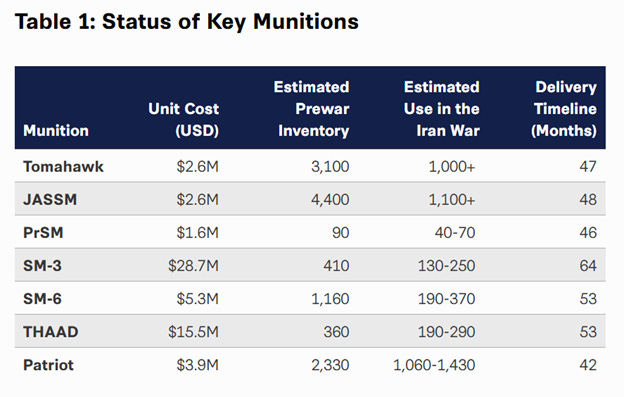
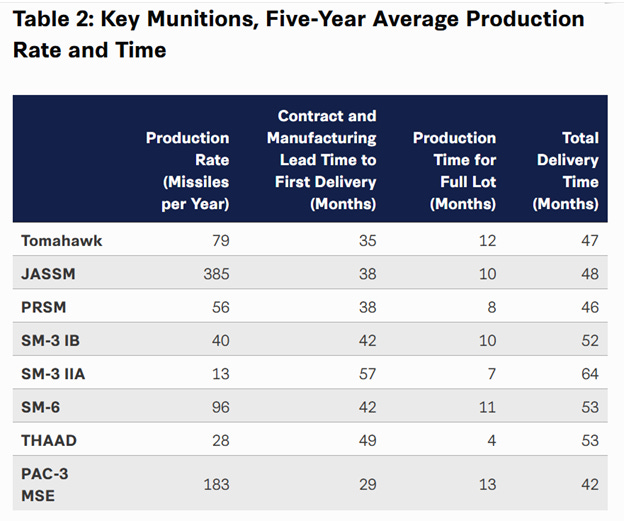
Here is where they THINK things stand. These are the seven critical missile systems. Each Tomahawk, for example, costs $2.6 million. Before the war on Iran, estimated inventory was 3,100. Over a thousand have been used, so far. During normal times, 47 months are required to build them.
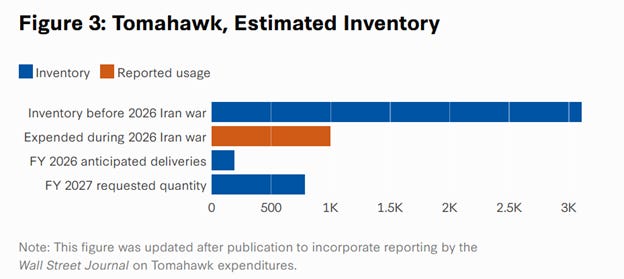
That’s four years or so, and these are not normal times. Usage running over a thousand, and fewer than 200 are expected for delivery in the rest of this year. Another 800 or so have been “requested” for next year.
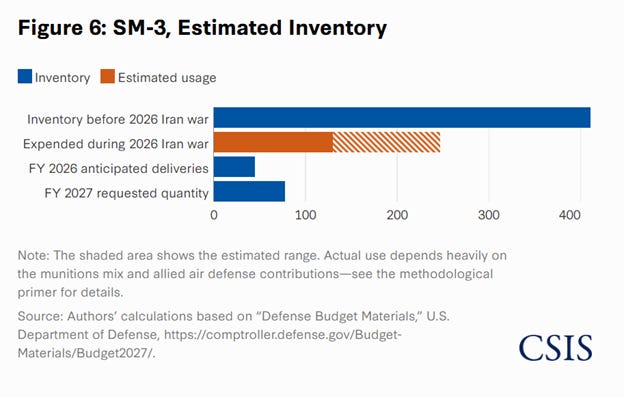
The situation for the SM-3 missile stocks is even worse. About half of them were used up, and those take over five years to build:
Patriot missile stockpiles have also dropped by half, and big orders have been placed to replace those. $3.9 million each, 42 months to make a new one. Patriots are also in high demand across the world; Ukraine has already used up 600 of them.
The THAAD’s are Terminal High Altitude Area Defense. Those are ground-launched missiles to intercept incoming ballistics. In last year’s war with Iran, over 150 of those were used. The US only has eight batteries worldwide. One of those was in South Korea and missiles from those systems were hurried over to the Middle East to replace what was either blown up by the Iranians, or used up. Those missiles take 53 months to build.
This table spells out a little more clearly, the annual production rates, the lead time to first delivery, and production time for the full lot. Add those two columns together, which results in total delivery time for the production lots:
Even before the war, munitions stockpiles were inadequate for conflict with a peer adversary, like Russia or China, and let’s remind ourselves again, that Pentagon contractors need Chinese materials to make these weapons in the first place.
Just to return to pre-war inventories—this is Iran, not Iran plus Ukraine—will take five years in the case of Tomahawks, and for THAAD’s, at least four years.
The Pentagon also has existing contracts and obligations to other countries, which were facing long delays and cost overruns which pre-dated this newest war. Switzerland ordered five Patriot missile batteries in 2022. At the time, final deliveries were expected throughout this year – 2026 – and next. Then came Ukraine, and that schedule was pushed back. Now the Iran war would mean even more delays and price hikes; delivery now is five to seven years, from now—2026.
Switzerland is looking at alternatives, including canceling the order outright. Contractors can’t build systems fast enough to replace what is being burned up in two theaters, now—Ukraine and the Persian Gulf.
Big problems with Patriot systems. THAAD stockpiles are also being drained, and are also in high demand not just by US forces, but by key allies.
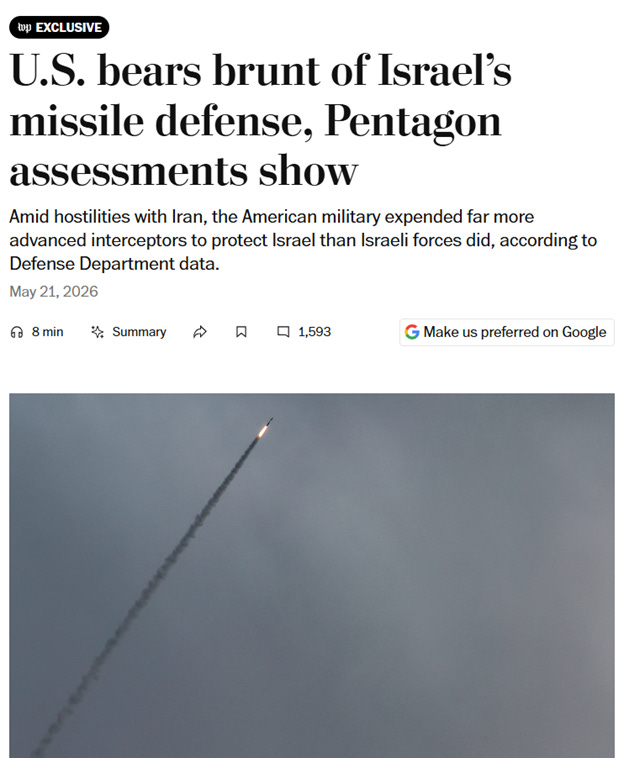
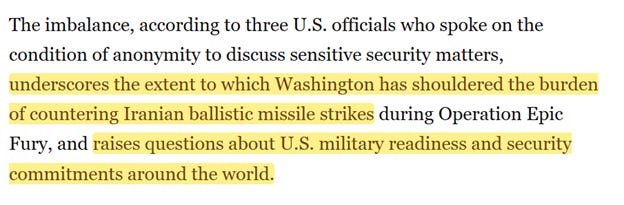
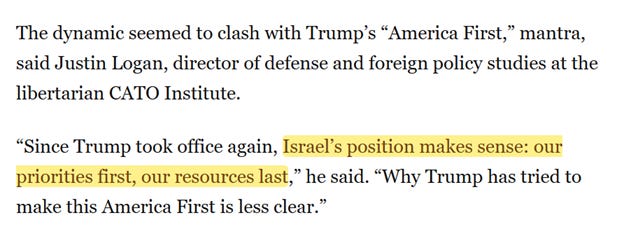
This was surprising to learn, that the United States burned through more interceptor missiles over Israel than the IDF itself. “The US expended far more advanced interceptors to protect Israel, than Israeli forces did.” That analysis emphasizes the extent of Washington’s burden of protecting Israel from missiles outbound Iran, and raises doubts about other commitments across the world:
Here are the numbers: the US launched more than 200 THAAD missiles in defense of Israel—which was about half what the Pentagon went into the war with. Another 100 SM-3’s and -6’s were fired also. In comparison, the Israelis used fewer than 100 Arrow’s and 90 David’s Sling interceptor missiles.
This is a “lopsided dynamic”—the US launched 120 more interceptors at twice as many Iranian inbounds than the Israelis did. The Israeli PM pushed for the war in the first place, and spokesmen for the Pentagon and the Israeli Embassy emphasize that it’s a joint operation. The Pentagon said that Israel and the US “carried the burden equitably”, and the “Israeli government also defended the approach”, with operations “coordinated at the highest and closest levels to the benefit of both countries.”
Those explanations went over badly with analysts, because these commitments were so obviously one-way. The United States took on most of the mission of Israel’s missile defense, while Israel conserved its own stockpiles. Even assuming that the operational strategies were sensible, somehow, the US only has 200 THAAD missiles left and no way to get any more before 2029.
Last year the Pentagon said they only had a quarter of the air defense capability required to meet existing obligations. And now lots of people in lots of places who are also reliant on American systems realize that the magazines are empty, there are no more coming, and that the Israelis have first call on any new production:
Not even the Pentagon seems to know how big a hole they’re in, or how much it will cost to get out. On 1 May, Pete Hegseth, the Secretary of War, went to the Senate to answer questions as to what the new $1.5 trillion defense budget will be for.
Mark Kelly is a senator from Arizona, and by the way is a former astronaut and who spent 25 years in the Navy. He points out here that these missiles cost a lot and take a long time to build. The new Pentagon budget request is for $31 billion to expand production for those missile systems. Hegseth looks down at his notes, and says it’s $53 billion. Which is $20 billion higher. We’ll make that part bigger. Senator Kelly is asking how many years it will take to replace the Patriots, THAAD’s, and other expensive munitions. Hegseth answers he actually thinks it’s closer to $330 billion. Senator Kelly: But how long will it take?
Secretary Hegseth: Months. Years.
We’ve done a lot of work on the channel from the very beginning, documenting the China problem for the Pentagon’s supply chains. This is a new one today—samarium. China makes all the samarium in the world, and the Pentagon needs it to rebuild all the jets and missiles that are blowing up in the war on Iran, then obviously what they’re need to build new ones for the Swiss and the Koreans and the Japanese. Please note, too, that these reports were from last year. Already it was a serious problem, and the United States had no alternative to China’s supply of samarium.
China produces 100% the world’s supply, and the only customers for it are weapons makers. That is unlike the other rare earth elements—which China also has monopolies on—but which have “dual-use” applications. Both civilian manufacturers and defense contractors need rare earth magnets from neodymium, for example. But Samarium magnets are only used in advanced munitions. So the rules that China’s Commerce Ministry put out to strictly regulate dual-use materials do not apply to samarium at all.
The biggest American buyer of samarium is Lockheed Martin, who needs 50 pounds of samarium to build a single F-35. A spokesman there said that Lockheed Martin’s supply chains for rare earth elements are the government’s problem.
The Biden Administration invested money with two companies to build samarium plants in the US, and neither of them got built. It was called the Defense Department way back then, and they gave $35 million to MP, who kicked in $65 million or so of its own, to buy new equipment.
Then the Administration handed $351 million to an Australian company to build a plant in Texas. MP was hoping for a monopoly on samarium production in the US, and backed out of the deal and didn’t even bother unpacking their new equipment. Then Lynas decided to build their new production in Malaysia, instead of Texas, and also backed out.
So there is no Samarium in the United States, and none coming. This is also from last year. Pentagon contractors hit the phones, looking for samarium anywhere they could get it from a non-Chinese address. The CEO of this company in New York, Arnold Magnetic, found a big pile of it literally just sitting in a warehouse in France from five decades ago, and bought up all of it, and signed a contract to process it. The entire stash is about 200 tons, which insiders said would be enough to supply some Pentagon suppliers for a year, given that the US defense industry needs less than that.
But remember, again, this was all before the War on Iran sped everything way up. China’s export bans are still on, and this supplier to Raytheon says that China has successfully closed off all the loopholes that could be exploited before.
Navigating China’s export bans on dual-use materials was already a challenge for the neodymium magnets, for example, where importers could pretend to be a broker for electric vehicles. Samarium cobalt magnets are what the Pentagon needs, and samarium cobalt magnets are ONLY needed by weapons makers. So until new sources of samarium are found, or new substitutes for samarium are found, American manufacturers can’t build new fighters or missiles.
The Pentagon is trying to catch up to China, and Iran, and Russia, who have successfully already deployed hypersonic missile systems, but those also require samarium. Aisha Haynes was in charge of supply chain issues at the Pentagon, and says here that “you never want to give any one nation that much power” since they can shut off the source whenever they want.
Now the Trump Administration is trying the supply chain thing, and just gave MP another $150 million to get some production going for samarium, among other raw materials. That will take years to come online, if it happens at all. ReElement Technologies is out of Indiana, and got an $80 million loan. And Ucore Rare Metals, a Canadian company, was handed $22 million in grants to build facilities for samarium and gadolinium in Louisiana. Both ReElement and Ucore Rare Metals are using new technologies, and critics are pointing out that those companies have never produced magnets at all. What’s more, most of the money is NOT going to build the samarium-cobalt magnets that the Pentagon needs.
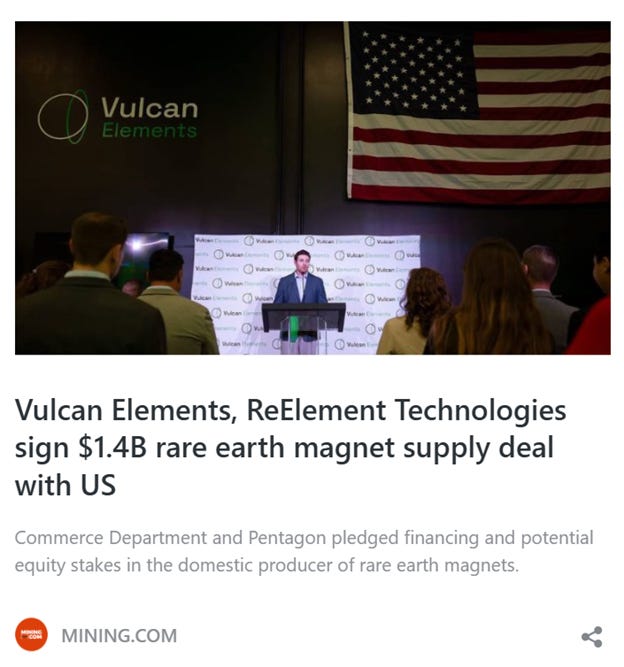
That was from last year, and part of a $1.4 billion rare earth magnet deal which included ReElement, and and which is already falling apart. The Pentagon is deciding now whether to junk it, after officials decided the company probably couldn’t scale the new technology they had developed. The Pentagon and the White House are fighting over it, and – if you can believe it — it’s the War Department this time who is saying that it’s a waste of money and that the numbers can’t work.
Whether those investments to build samarium capacity go through or not, for now the only source of it is China, unless that guy in New York finds some more in his garage or something. And China’s export controls are written to regulate how their materials are used, even years after.
So countries are racing to build up their own reserves. China has a head start of 30 years or more, but better late than never, is the thinking here. The United States put $12 billion aside for “Project Vault”, so that American businesses are never harmed by shortages. Trump compared Project Vault to the Strategic Petroleum Reserve, which ironically is also being drained right now, because of the energy supply chains blowing up by the war on Iran.
Australia is putting in a tenth of that– $1.2 billion. Efforts are underway to do the same in the EU. And South Korea has a plan to reduce reliance on China for its rare earth elements by diversifying their supply chains—to somewhere, doesn’t say—and increasing domestic production.
Lots of problems then. The Pentagon and its allies are out of missiles and are trying to build some more. Missiles and fighter jets need samarium, and China makes 100% of the world’s supply of it, and Pentagon contractors aren’t allowed to buy it. The handful of companies that have agreed to make the samarium magnets don’t have any experience doing so, and are years away from making it work, if ever.
But it’s not just the samarium; it’s the same story for literally everything else. Here are the critical minerals that go into just one of those systems, the Tomahawk:
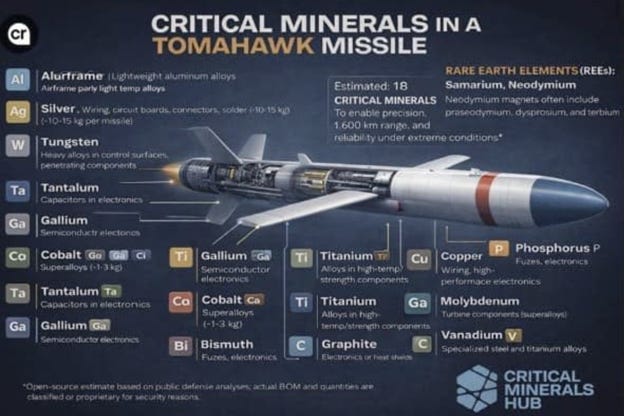
Samarium is there at the top right, along with neodymium, for the magnets. There are 16 other critical minerals, besides those.
Tungsten, for the control surfaces. China controls over 80% of global tungsten production, and almost all the chemical supply chains to process it.
Gallium is used in the semiconductors, and China produces 98% of all that.
Cobalt is part of the samarium-cobalt magnet, and also used for the superalloys in the missile. Another near-monopoly there for China, who controls 60% of the mining and 90% or so of the chemicals for that.
Bismuth. For the fuses and electronics. China, over 80% of global production.
Graphite. 70% of the mining, 100% of the refining.
Molybdenum. 81% of global refining.
Neodymium. Over 90% of the world’s refining and separation.
Going back to that Senate hearing, with Senator Kelly and the Secretary of War. The conversation started at $31 billion, the bill for munitions. Ten seconds later it jumped to $53 billion. After another minute or so it was $330 billion, and “you name it, they are investing” tens of billions of dollars for it.
That $1.535 billion budget was “a highly rigorous process” at the Pentagon, involving the Secretary himself, his deputies, top commanders, top lawmakers, to “ensure the budget reflects the realities of the world we live in.”
But the reality is that no matter how much money they spend, or for how long, those missiles can’t get built without China. And China won’t let them.
Be Good.
Resources and links:
China’s Chokehold on This Obscure Mineral Threatens the West’s Militaries
https://www.nytimes.com/2025/06/09/business/china-rare-earth-samarium-fighter-jets.html
How U.S. Defense Industry Dodged a Rare-Earth Shortage After China’s Curbs
https://www.nytimes.com/2025/12/22/business/defense-industry-rare-earth-restrictions-china.html
China Rare Earth Export Controls 2026: What New Licensing Rules Mean for Manufacturers
https://www.certivo.com/blog-details/china-rare-earth-export-controls-2026-what-new-licensing-rules-mean-for-manufacturers
Pentagon doubts over rare earths deal provoke White House clash
https://www.mining.com/web/pentagon-doubts-over-rare-earths-deal-provoke-white-house-clash/
US munitions depleted by Iran war will take years to restore, analysis finds
https://www.militarytimes.com/news/pentagon-congress/2026/05/27/us-munitions-depleted-by-iran-war-will-take-years-to-restore-analysis-finds/
WATCH: In SASC Hearing, Kelly Challenges Hegseth on Munitions Burn Rate, “No Quarter” Comment, and Massive Defense Budget Proposal
https://www.kelly.senate.gov/newsroom/press-releases/watch-in-sasc-hearing-kelly-challenges-hegseth-on-munitions-burn-rate-no-quarter-comment-and-massive-defense-budget-proposal/
Severity Of America’s Depleted Advanced Weapons Stockpiles Detailed In New Report
https://www.twz.com/news-features/severity-of-americas-depleted-advanced-weapons-stockpiles-detailed-in-new-report
U.S. bears brunt of Israel’s missile defense, Pentagon assessments show
https://www.washingtonpost.com/national-security/2026/05/21/us-bears-brunt-israels-missile-defense-pentagon-assessments-show/
Rebuilding U.S. Missile Inventory: A Multiyear Project
https://www.csis.org/analysis/rebuilding-us-missile-inventory-multiyear-project
Last Rounds? Status of Key Munitions at the Iran War Ceasefire
https://www.csis.org/analysis/last-rounds-status-key-munitions-iran-war-ceasefire
Swiss considering rival air defences after Washington delays Patriots over Iran war
https://www.reuters.com/world/united-states-informs-switzerland-delays-price-hike-patriot-delivery-2026-05-13/
Critical Minerals Strategic Reserve
https://www.pmc.gov.au/domestic-policy/critical-minerals-strategic-reserve
Exclusive: Italy, France and Germany to lead EU critical materials stockpiling plan, sources say
https://www.reuters.com/sustainability/climate-energy/italy-france-germany-lead-eu-critical-materials-stockpiling-plan-sources-say-2026-02-04/
Korea Strengthens Rare Earth Supply Chain Independence
https://www.businesskorea.co.kr/news/articleView.html?idxno=262606
Hasty redeployment of US missiles from South Korea to Middle East leaves Seoul rattled
https://www.theguardian.com/world/2026/mar/11/redeployment-us-missiles-thaad-south-korea-middle-east-seoul-iran
China, Russia, and Iran have hypersonic missiles. And that changes everything.
America’s Emergency Oil Reserve Is Shrinking Fast
https://www.newsweek.com/americas-emergency-oil-reserve-is-shrinking-fast-11983476
Inside China / Business is a reader-supported publication. To receive new posts and support my work, consider becoming a free or paid subscriber.
From Inside China / Business via This RSS Feed.