

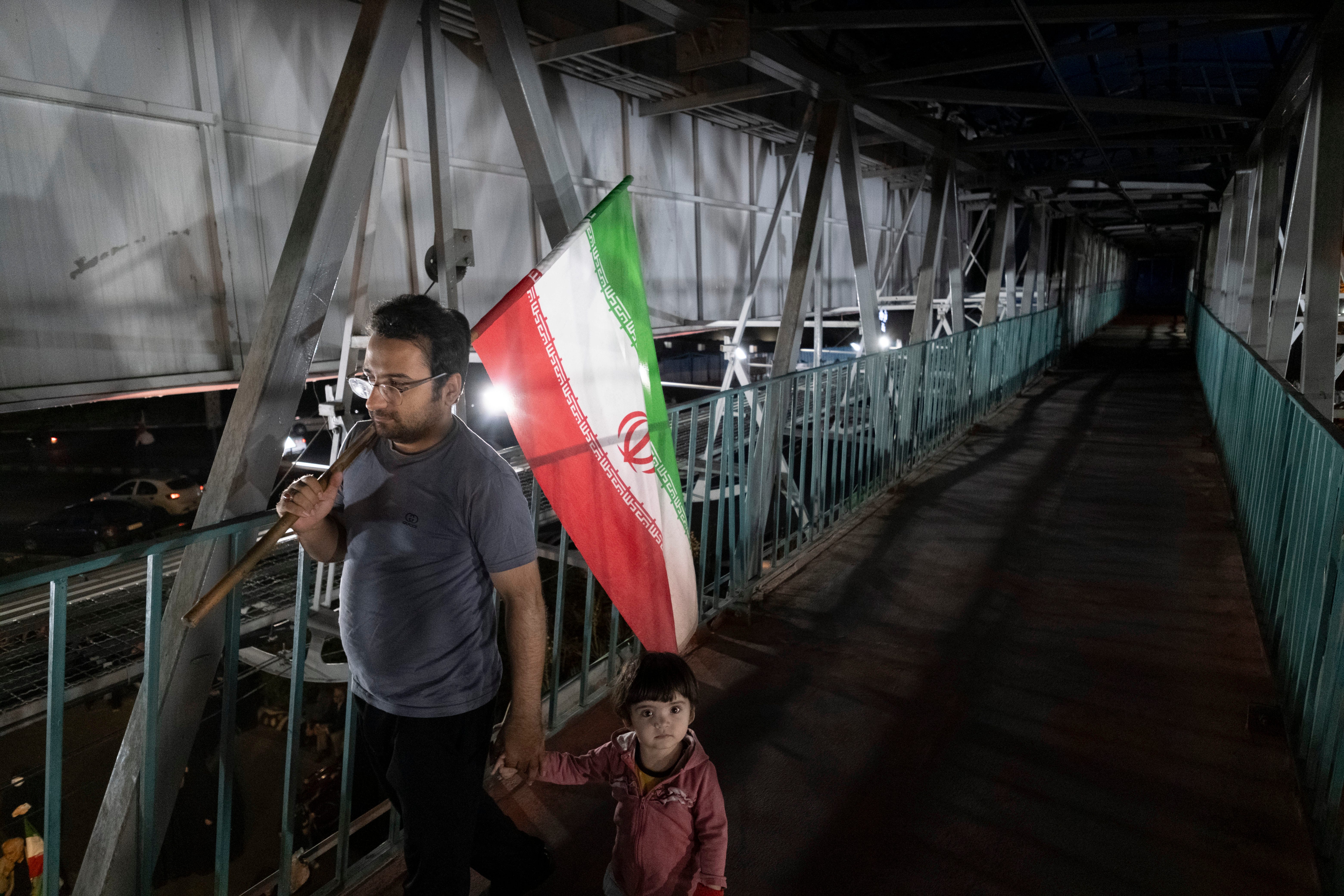
A pro-government supporter carrying a national flag walks with his son along a bridge during a nightly rally in downtown Tehran, Iran, on May 23, 2026. (Photo by Morteza Nikoubazl/NurPhoto via Getty Images)
The U.S. and Iran are in the midst of intense negotiations over a Memorandum of Understanding that could end the current war, while lifting the blockade on Iran and gradually resuming global maritime access to the Strait of Hormuz. On Friday morning, Donald Trump posted on Truth Social a list of requirements for Iran in any negotiated agreement, including commitments on its nuclear program and resumption of access to the strait in exchange for financial compensation, stating that he would be holding a meeting soon “to make a final determination.”
Trump’s statement about the pending MOU was disputed by Iran’s pro-government Fars News, which called the post “a mix of truth and lies,” stating that Trump had omitted the up-front economic concessions he had agreed to make to Iran and commitments to immediately end the war in Lebanon, and falsely portrayed Iran’s own agreed commitments about its nuclear program and future control of the strait. The report added that Iran was still waiting to give final approval to any deal, while continuing to negotiate, with “complete distrust of America.”
An Iranian official confirmed to Drop Site’s Jeremy Scahill that Tehran had agreed to what mediators said was final draft language of a memorandum of understanding. However, a “deep distrust” of Trump is preventing any official announcement. According to the official, Iran is unable to rule out further U.S.-Israeli strikes. “Some voices on the Iranian side are concerned that President Trump may reconsider his position at the last moment,” the official said, adding that Iran would not consider Trump’s decision final until U.S. “financial markets close at the end of the week.” Iran also warned Trump would likely mischaracterize the privately agreed terms to promote his “victor” narrative.
While there are hints that the war may yet be moving—slowly and painfully— towards a negotiated solution, the level of economic and social harm done to ordinary Iranians by the U.S.-Israeli air campaign and blockade of their country are likely to be felt for years. Earlier today, Drop Site published a story by Iranian contributor Peiman Salehi about the impact of Israeli bombings on Iran’s petrochemical industry, and efforts to rebuild the sprawling South Pars gas field that was heavily damaged during the war. [Read it here.](http://iranians/ Return to South Pars Gas Complex to Repair and Rebuild)
The following story, reported with Tehran-based journalist Reza Sayah, deals with the broader economic impacts of the war on Iran: skyrocketing inflation, destruction of jobs, and economic contraction that may send millions of ordinary citizens into poverty in the months ahead.
—Murtaza Hussain
Drop Site is supported by readers. Subscribe or upgrade today:
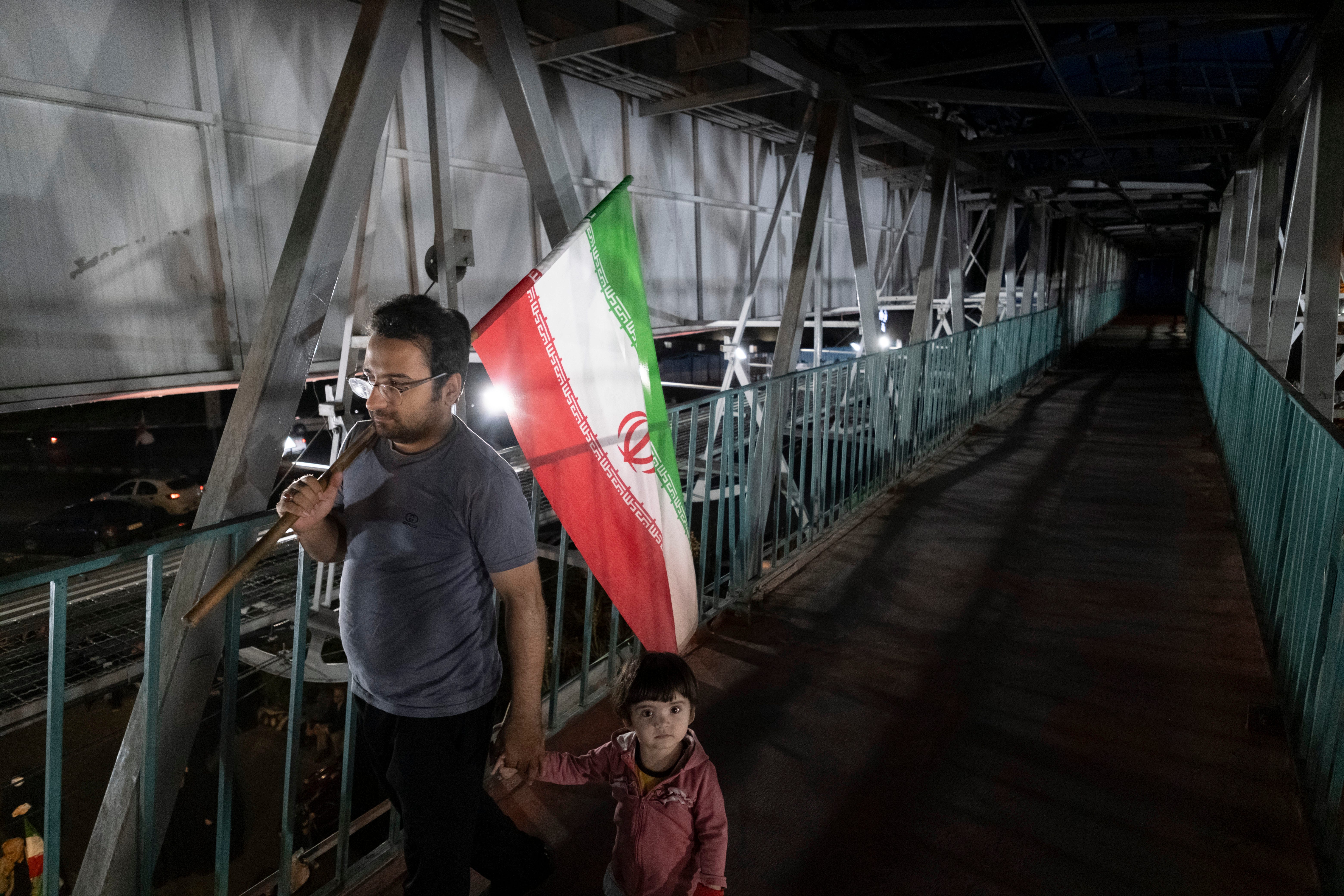
A supporter of the Iranian government carrying a national flag walks with his son along a bridge during a nightly rally in downtown Tehran, Iran, on May 23, 2026. Photo by Morteza Nikoubazl/NurPhoto via Getty Images.
As Possible Peace Deal Looms, Iranians Grapple With Economic Devastation, Corruption, and Entrenched Inequality
Story by Reza Sayah and Murtaza Hussain
TEHRAN, Iran—Over the past several weeks of war, Babak, the 42-year-old head of a small engineering firm in Tehran, has been forced to lay off most of his employees. The decision came following a catastrophic decline in business during the war, he told Drop Site, as well as a shutdown of the national internet that further constrained its ability to operate.
“At one point we had 25 employees. Right now, we’re working with a staff of six. Reducing our staff has been painful, we’ve spent a lot of time working side by side. They’re like your family, your brothers and sisters,” he said.
In March, the Iranian government increased the monthly minimum wage in the country to around $90 USD to help insulate the population from inflation. While the measure helped keep the economy afloat during the war, it also forced Babak and many other small business owners who had already been struggling to operate to lay off staff to survive.
His firm works on mining and oil and gas projects, including the design of pipelines and storage facilities. Despite the widespread infrastructure destruction that took place during the Israel-U.S. war and need for reconstruction, the lack of capital in the economy means that few projects are being commissioned even where need exists.
“Most of our employees have master’s degrees or PhDs in civil engineering and architecture. Right now, many of them have second or third jobs. They’re driving taxis, exchanging currency or selling gold to make money,” Babak said.
Despite the impact of yearslong sanctions and international isolation, Iran has a highly educated population and some of the world’s top engineering universities—several of which were attacked during the U.S.-Israeli military campaign. The economic impact of the war has forced many educated Iranians out of their professions in a desperate search to make ends meet in a shattered economy.
“Our most important duty right now is to protect the spirits of our young technically skilled employees who want to work,” Babak added. “To keep our staff’s spirit up and to keep them from abandoning their career and expertise to go after unskilled work. We have no hope of making money, that’s the bitter truth. The goal is to survive.”
Iran entered the war with an economy already in deep distress. National income per person had fallen from roughly $8,000 in 2012 to about $5,000 in 2024. As a result of the war, the International Monetary Fund now projects Iran’s GDP will contract by a further 6% in 2026, while consumer prices will rise nearly 70% during that time. Israeli and U.S. attacks on critical infrastructure like steel production plants, pharmaceutical companies, and factories have also resulted in the loss of an estimated one million jobs according to the country’s Ministry of Labor, with the employment of millions more indirectly affected.
In a sign of the strain on the labor market, a major Iranian employment search platform in late April reported a record 320,000 job applications to its platform on a single day. Due to damage to infrastructure, private businesses, and displacement, the UNDP estimates that as many as 4.1 million Iranians could be pushed into poverty as a result of the war.
Rampant Inflation
After the start of the fighting, the Iranian government instituted a retaliatory blockade on the Strait of Hormuz that upended the global economy and put extreme pressure on Washington to end the conflict. But a subsequent U.S. blockade that began in April on Iranian ports has also limited Iran’s ability to sell its own oil and gas and restricted maritime imports to the country.
The shutdown has thrown an economic system dependent on energy exports into turmoil, as the resulting loss of revenue has paralyzed government decision-making and halted planning for businesses. Iran is presently in need of tremendous reconstruction following the war, as well as the decay of infrastructure over years of sanctions. Yet the lack of access to funding and certainly about future economic conditions means that planning for much new construction cannot proceed.
“Our country is dependent on oil exports. When we are sanctioned and can’t export oil then the government can’t create projects. Projects and development are supposed to start from the top and it hasn’t been happening,” said Babak. “These days, due to shortages in electricity and water, the work day for government workers is from seven in the morning to one in the afternoon. In a global economy, where many are working ten or twelve hours a day, there’s very little a government worker can do in five hours. And they don’t have much of an income either, so there’s very little motivation for them.”
Following the outbreak of the war the government instituted a major internet shutdown on national security grounds. But the impact of the shutdown, which is still intermittent, has also crippled many Iranian businesses that are run online, with estimates putting the economic losses from the shutdown at more than $6 million a day, as businesses that rely on WhatsApp, Instagram and other social media channels for sales and communications have been forced onto more limited, state-run platforms.
Despite a significant domestic agricultural industry that provides Iranians with much of their food, prices have continued to rise sharply during the war, adding to a preexisting inflationary spiral that had been triggered by the collapse of the Iranian Rial under U.S. sanctions. Prior to the war, Iran had already been experiencing an annualized food inflation rate nearing 90%. But recent reports from government statistics agencies have indicated that over just the past few months of fighting and blockade staples like cooking oil, rice, and chicken have doubled or even tripled for consumers on a year-over-year basis.
“The media talks a lot about the inflation that is happening in the U.S., or what the IMF or the European Central Bank says about the inflation around the world, or in specific Western countries, but there is little attention paid to the ongoing inflationary pressure that is going on here, and the cost for reconstruction expenses that will hit this economy in a couple of months,” Mohammad Razavi, an economic analyst and retired professor at Tehran’s Azad University.
“I am very concerned about the fact that the real pressure is on the middle class and lower classes. These are the people that will be hit very hard, and the fact that a lot of businesses that belong to the middle class have been hit very hard in the past few months,” he added. “I really want to emphasize that the economic situation over the summer in Iran will be very dire. I don’t see any possibilities that would remedy the pressures on this economy.”
Military Economy
While the war is inflicting tremendous economic pain on a civilian population that had already been forced to adapt to life under sanctions, a small class of individuals has been able to leverage corruption and political access to carve out a disproportionate share of the country’s wealth. A network of state-linked, semi-private, and security-affiliated firms in Iran has expanded over decades of sanctions and war, enriched by the very sanctions regime that the U.S. has celebrated for suffocating the Iranian economy.
The origins of this network lies in Iran’s long process of partial economic privatization, which began in the 1980s and was formally presented as a transition toward a market economy. In practice, however, privatization often blurred the line between public and private ownership, creating an ecosystem of nominally private companies tied to the state, politically connected foundations, and elements of the security services.
Over time, firms with political connections came to dominate key sectors of the economy through their ability to control the chokepoints of a sanctioned business ecosystem, leaving smaller independent businesses far more exposed to the shocks of war, sanctions, and economic isolation.
“When there are sanctions, in order to get the economy going, you have to provide certain exceptions and permissions to some people with influence who are then able to profit. It leads to cronyism, profiteering, monopolies and a system capable of being exploited,” said Razavi.
The system extends to several industries, including oil, telecoms, and health care. “In general, special permissions are given to various factions in the armed forces to sell oil, import telecommunication equipment, import medical equipment, establish trustees through the banking system in certain countries that would circulate and manage the Iranian foreign exchange that exists outside Iran. You see how this adds up to the movement of billions of dollars without any transparency or oversight of supervisory bodies.”
Reform and Reconciliation?
While Iranians are still picking up the pieces from these attacks, Washington began a sanctions and blockade campaign titled “Economic Fury,” aimed at squeezing Iran’s oil revenues, financial networks, and supply chains, to force the government to capitulate after the failure of the five-week long bombing campaign.
Trump has also previously called on Iranians to overthrow their government. But Iranian society, heavily polarized prior to the war and massive protests and violence in January, has experienced some level of nationalist revival as a result of a military attack that wantonly killed thousands civilians and damaged hundreds of clinics, hospitals, bridges, schools and historical landmarks.
Seeking to leverage nationalist sentiment in the wake of the war, some economists and political advisors tied to the government have suggested that the time has come to propose economic reforms and a new social contract, including jettisoning liberal free market policies that have been embraced over the past several decades and moving towards more state intervention and redistributive policies.
“Unfortunately, in Iranian society, like everywhere else in the world, some of the revolutionaries, the elites, the university students, their views and thoughts were through a liberal mindset. They were also at the helm of the country’s economic system. This is what caused inequality and class divisions in Iran today,” said Bijan Abdolkarimi, an Iranian philosopher and political commentator at Islamic Azad University. “One of the criticisms of the government’s economic policies is in terms of free market policies and following the recommendations of the World Bank, the World Trade Organization, and the IMF [International Monetary Fund]. Many young people and individuals, especially ordinary people, found that these policies were not suitable for the country at all. We have to go back to the same policies of the beginning of the revolution, which were to provide housing and education to the people in need.”
Other figures associated with the Reformist branch of the Iranian political system have stated that a postwar priority of the government must be to rebuild a social contract that has been shattered by inequality, corruption, and divisions over social issues.
The creation of a large, disillusioned class of Iranian citizens alienated from what many now view as a ruling oligarchy has become a major security threat to the country in itself—weakening the social fabric of the country and encouraging more economic and military attacks aimed at triggering the disintegration of society.
“We have to reconcile with the people of Iran. A government that has maximum legitimacy can have a powerful economy and manage its security challenges. We have to quickly activate all of our land borders for trade. We have to rebuild our infrastructure,” said Saeed Laylaz, an economist and adviser to former Iranian President Mohammad Khatami. “Those who frighten the people of Iran about the destruction of Iran’s infrastructure don’t know about the technical capabilities inside Iran. Almost all of our roads, our railways, and our airports are already operational. The total destruction of housing during the war equaled the capacity of what Iran builds in one month. We build 10 million square meters of housing every month. Our maximum capacity is 15 million square meters every month.”
As Iran braces for the possibility of renewed fighting, Laylaz argued that the country’s most urgent vulnerabilities are not only military but economic: restoring trade routes, rebuilding infrastructure, and shoring up public legitimacy before another round of conflict tests the state’s survival.
“I say this as a pacifist, the only path towards peace is a war that establishes your deterrence against the enemy. Nothing other than deterrence guarantees peace. We have to be strong and bring peace to our nation. If the government takes a war footing in the fight for the economy, we will be able to rebuild and bolster our resilience,” he said. “This war that the United States started may wind up bringing lasting peace to Iran, because the United States now knows that Iran cannot be toppled easily. If we govern our country more effectively, reconcile with our nation, improve our economy, and root out the corrupt bureaucracy, our resilience will increase ten-fold.”
From Drop Site News via This RSS Feed.