

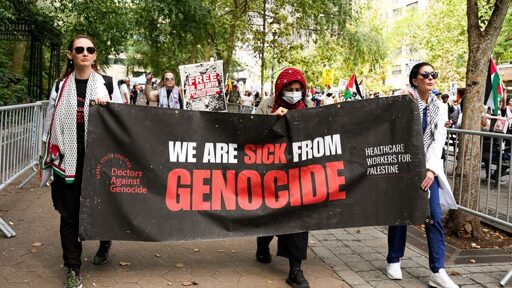
As healthcare infrastructure and health workers were actively targeted throughout the genocide in Palestine, a group of Gaza students participated in an international virtual cross-cultural exchange. What began as an academic space quickly became something else. Health conversations could not remain theoretical – they were shaped by lived realities where access to care, electricity, clean water, and safety were not abstract determinants, but daily uncertainties.
In Gaza, two million people are trapped in a deepening hole of bombardment, darkness, and scarcity. Hospitals operate without electricity; medicines are blocked or nearly impossible to find. Access to clean water is a privilege. Children search for moments of joy among the rubble, while students try to learn wherever they can, often in whatever corners they can find. Families share what little they have, holding on to hope as much as survival, while the sound of drones and explosions defines daily life.
Our exchange brought together students from Gaza with those across different countries. Discussions around health moved beyond theory, reflecting realities where social determinants of health are not abstract concepts, but immediate conditions shaping survival. It became more and more apparent that true awareness should not simply mean knowing that war exists, but also questioning how oppression dismantles health, dignity, and any sense of normal life – and even the smallest act of living becomes resistance.
Even after building this kind of awareness, the question remained: what will people do with the information they receive?
The architecture of control
Key questions focused on international organizations: why did institutions built to protect people disappear when needed most?
In Gaza, aid trucks sat idle as hunger grew louder than bombs. On May 2, 2025, the International Committee of the Red Cross warned that after months of aid blockade, Gaza’s humanitarian system was collapsing. But the crisis did not begin there. According to the UN Office for the Coordination of Humanitarian Affairs, around 80% of Gaza’s population depended on humanitarian assistance even before May 2023. This is not chaos; it is structure. The blockade, inspections, and delays are not accidental. They are designed to control and exhaust.
Many watched from a distance, convinced the situation was too far, too complex, or too political to engage with. It became easier to assume someone else would speak up. But one thing became clear: silence is not neutral, it becomes part of the system that allows this to continue.
The birth of solidarity
As genocide continued in Gaza, discussions repeatedly returned to another central question: what does meaningful solidarity actually look like, beyond awareness?
Through our conversations, it became clear that awareness alone – no matter how empathetic – does not interrupt systems of harm; what matters is whether awareness translates into action that challenges those systems. The examples we discussed were part of a broader pattern of refusal.
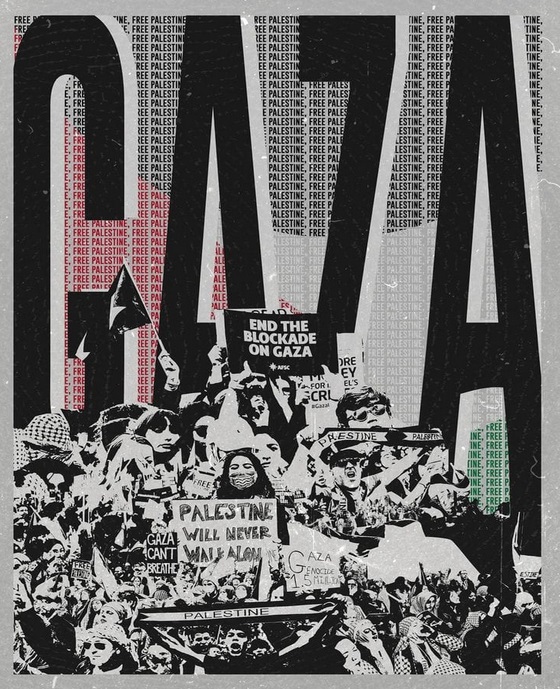
Source: PHM student group
Ships crossed the Mediterranean carrying food, medicine, and determination. The Global Sumud Flotilla, made up of activists from more than forty countries, sailed toward Gaza knowing the risks. Israeli forces had intercepted missions before. Drones followed them, and one ship was struck while docked in Tunisia. Still, they sailed. They knew they might never reach the shore, but they also knew the world was watching. The boats did not dock, but the message did.
On land, resistance spread across continents. Students from Columbia to Cambridge, Cairo to Amsterdam, built encampments, marched, and blocked streets, demanding accountability and divestment. At UCLA, tents stood for weeks despite arrests. Donations of food, money, and time poured in. Boycotts emptied stores – not through slogans, but through conscience. Offices of arms manufacturers were blockaded. Pension funds were questioned. Complicity became visible.
Refusal as a practice
As the exchange continued, discussions began to highlight refusal as more than a reaction: it emerged as a form of active solidarity. This became clear in the actions we examined. Medical teams crossed borders through chaos. Doctors Without Borders and the Red Crescent worked in overcrowded hospitals under fire, performing surgeries with limited resources. Artists, writers, and musicians turned their platforms into protest, canceling shows, rejecting sponsorships, and donating their work. While these actions took different forms – ships, tents, scalpels, brushes – they carried the same spirit: a refusal to accept silence as safety and let distance turn into detachment.
This understanding was shared across different voices, from within Gaza and beyond. Again and again, the same realization surfaced: without action, awareness risks becoming another form of passive witnessing.
The imperative of action in the face of a false ceasefire
The ceasefire has not ended suffering in Gaza. While bombings may have slowed, destruction remains. Hospitals are still overwhelmed. Families continue searching for the missing. Basic needs go unmet. A ceasefire, in this context, is not peace – it is a pause without justice.
The ceasefire was not an end, but a test of what follows. If awareness reaches its peak during a crisis, what happens when the noise fades? Action did not disappear with the headlines. It shifted. Journalists who documented life under bombardment ensured that those affected were not reduced to numbers. Medical teams and humanitarian organizations continued working long after global attention began to drift.
Collective responses began to take different shapes. Petitions gathered support across borders, reflecting how individual concern can scale into global pressure. Students and academics questioned institutional ties and demanded accountability. Grassroots movements organized through boycotts and divestment, turning awareness into sustained pressure rather than a passing reaction.
These efforts point to a larger pattern: action is not a single moment, but a continuation. The ceasefire may have quieted the bombs, but it has not ended responsibility. If anything, it has made that responsibility harder to ignore. The question is no longer whether the world is aware. It is what will be done with that awareness – and how long it can remain just awareness.
This article was written by Alaa Abu-Esaid, Rima Altelbany, Abed Al Hakeem Shamali, Jasmina Atroshy, Mohammed Ismail, Hesham Al Amassi, and Seraj Al Amassi.
People’s Health Dispatch is a fortnightly bulletin published by the People’s Health Movement and Peoples Dispatch*. For more articles and to subscribe to People’s Health Dispatch, click* here.
The post The quiet that kills: beyond awareness to action appeared first on Peoples Dispatch.
From Peoples Dispatch via This RSS Feed.
Not sick enough to kill billionaires profiting from it. 🤷♂️
