

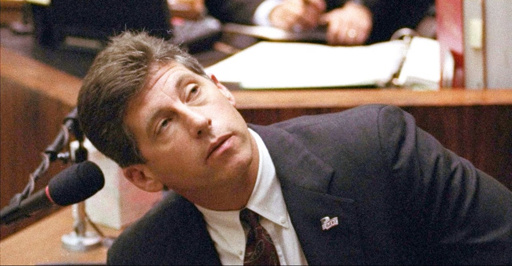
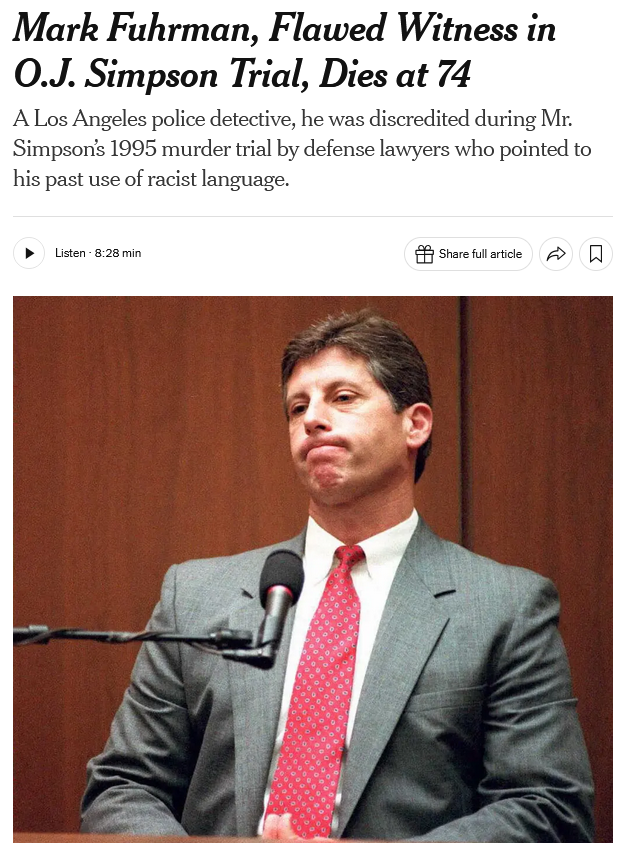
The New York Times‘ obituary (5/18/26) for former LAPD detective Mark Fuhrman quotes him saying that “policemen never get the benefit of the doubt.”
The racism of Mark Fuhrman, the Los Angeles police detective whose involvement in the O.J. Simpson murder investigation helped sink the prosecution’s case, was so well-known comedian Dana Carvey once mocked him with a Nazi salute, calling him “Mark the Fuhrer-man.”
Fuhrman’s death this month (New York Times, 5/18/26) took middle-aged and older Americans back to 1995, when the televised trial of Simpson, accused of murdering his ex-wife and her friend, dominated media for much of the year.
During the trial, audio recordings and witness testimony revealed Fuhrman’s use of the n-word and other racist views, sinking his credibility as the cop responsible for recovering the “bloody glove,” the key piece of evidence tying Simpson to the killings. Because he had previously testified that he never used the word, it opened an opportunity for the defense to suggest he wasn’t honest about other things—and had a motivation to frame a Black celebrity.
Unrelenting racism
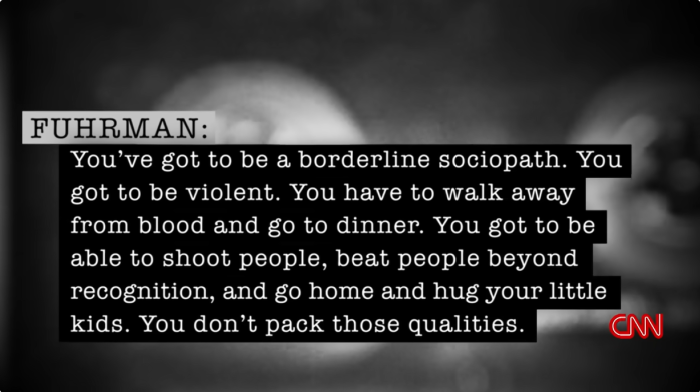
In July 2017, CNN‘s Kyra Phillips played new excerpts from the Fuhrman tapes.
The tapes portrayed hours of unrelenting racism. “All these n*****s in L.A. city government…all of them should be lined up against a wall and fucking shot,” he said. And often sexism as well: “What if I’ve just been raped by two buck n*****s, and a female shows up?”
During the trial, witness Kathleen Bell testified that Fuhrman had said, “If I had my way, all the n*****s would be gathered together and burned.”
Bell told the court, “When he sees a Black man with a white woman driving in a car, he pulls them over,” with no traffic violation needed (Washington Post, 9/5/95).
Fuhrman became the national representation of the American racist cop. He invoked the Fifth Amendment when questioned about his handling of evidence (LA Times, 9/7/95), offering the shadow of a doubt the jury needed to acquit the former football and movie star. In his fiery closing argument, defense attorney Johnnie Cochran characterized Fuhrman as “this perjurer, this racist, this genocidal racist.” Fuhrman pleaded no contest to a perjury charge a year later (CNN, 10/2/96).
But there was something bigger about Fuhrman, and it’s something we can deeply feel in the media environment today.
‘Unwitting catalyst’
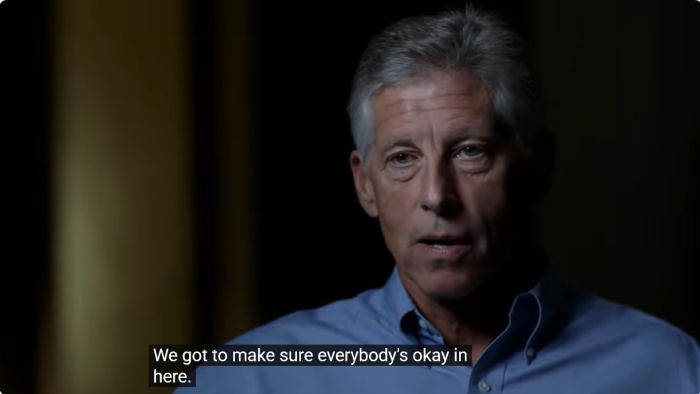
Mark Fuhrman interviewed in ESPN‘s OJ: Made in America (2016).
The legal “dream team” Simpson assembled certainly focused on pushing the jury for an acquittal—that’s a defense lawyer’s job. But as outlined in both the dramatized The People v. O.J. Simpson: American Crime Story on FX and ESPN’s OJ: Made in America, defense lead Cochran also built a larger case for a larger audience. (Side note: FAIR’s Janine Jackson briefly appears in the ESPN documentary in a segment about media coverage of the trial.)
Nicole Brown Simpson was killed at her Los Angeles home, along with Ron Goldman, on June 12, 1994, just two years after the city was engulfed in racial rioting as a result of an acquittal of police officers who had been videotaped brutally beating a Black man, Rodney King.
For much of America, the rioting was a dividing moment. Civil rights activists saw it as the explosion of a powder keg under pressure of decades of tension between LA’s Black community and the cops. A great deal of white America saw the rioting as an inexplicable overreaction. Press voices had their doubts too. Newsweek (5/10/92) called the looting “a manic fiesta, a TV game show with every looter a winner.”
Cochran set out to change the narrative, to demonstrate to the white public that Black Los Angeles has systemically suffered from racist policing.
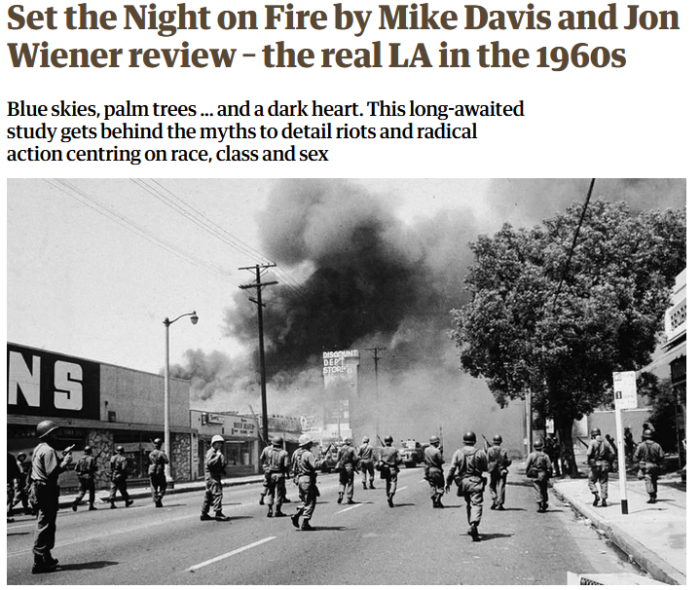
Ben Ehrenreich (Guardian, 4/22/20): “The thousands of African Americans who migrated to Los Angeles from the Jim Crow south had found similar cruel realities awaiting them.”
In Set the Night on Fire, Mike Davis and Jon Weiner outline the ongoing war against the Black community by LA cops in the 1960s, erupting in the 1965 Watts riots. From the Guardian‘s review (4/22/20):
LA’s police make dramatic appearances in almost every chapter, clubbing peaceful protesters, brutalizing activists and killing so many Black men, and with such absolute impunity, that Davis and Wiener’s claim that “the Manson gang were bit players compared to the forces of law and order” ends up feeling more than fair. In the authors’ telling, the wanton violence of the police acted as a consistent if unwitting catalyst to historical change: It was the chaos that followed a ferocious LAPD assault on anti-war protesters that added to Lyndon Johnson’s decision not to run for re-election in 1968, and the LAPD’s murder of a Black Muslim named Ronald Stokes—seven other Muslims were shot in the same incident—that pushed Malcolm X towards a broader vision of Black liberation. The shared experience of LAPD violence, Davis and Wiener write, forged a “common culture of resistance” among Black and Chicano youth, white hipsters and anti-war activists, and the city’s gay community.
This situation hardly improved with the economic turmoil of the 1970s, or the reactionary retreat of the 1980s. For many Black Angelenos, the 1992 riots weren’t about one videotape, but about this entire history.
Cochran had an opportunity to reveal the situation in the early ’90s to America. And with Fuhrman, who was called by the prosecution to bring the bloody glove into evidence, Cochran was able to show a feverishly racist man at the center of this investigation.
‘Kill somebody and go have some chicken’
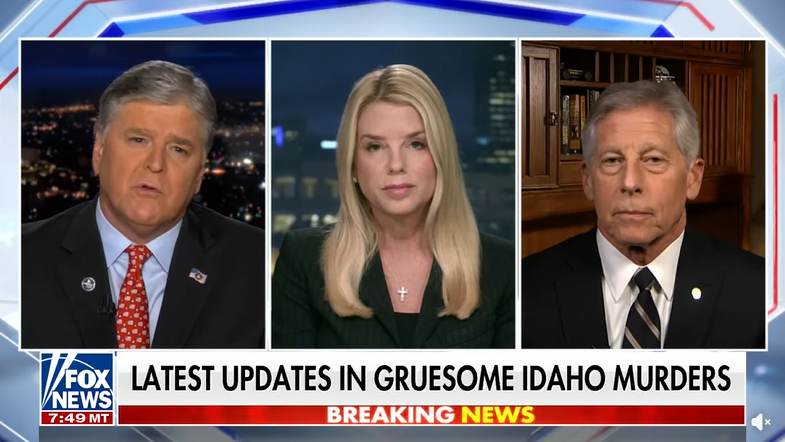
Sean Hannity (Hannity, 1/10/23) interviewing Pam Bondi (then a former Florida attorney general) and Mark Fuhrman.
In the end, Simpson was acquitted, and Fuhrman became a symbol of a divided America. It’s quite telling that the disgraced cop later found a landing place on Fox News.
The Murdoch media empire created the news network the year after the Simpson trial as the antithesis to what it claimed was a liberal slant in corporate television news. Bringing on Fuhrman as a recurring guest—and, later, giving him his own show on Fox Nation—didn’t just promote his own public rehabilitation, it foretold a shift in “acceptable” discourse on right-wing TV.
Fox‘s Greta van Susteren (5/19/05) defended having him on as a frequent guest:
Mark happens to be a very, very, very smart detective—one of the best I have ever worked with and I have worked with many. He really thinks about the investigations we book him on the show to discuss.
But Fox was attracted to Fuhrman not by his smarts, but by his hate. The racism that spilled out in the Simpson trial—Fuhrman’s animosity toward the people who he was sworn to protect and serve—catered directly to the Fox audience.
Another Fox star that routinely showcased Fuhrman was Sean Hannity (Extra!, 9/13). On Hannity & Colmes (11/16/06; cited by Media Matters, 11/20/06), Fuhrman asserted that the the type of “people” he “dealt with … for 20 years” will
kill somebody and go have some chicken at KFC. You will catch them eating chicken and drinking a beer after they just murdered three people.
He added that “these people are out there. They’re all over the place.”
In another appearance, Hannity (Hannity, 7/16/13) brought the ex-cop on to speculate on whether Black people would riot if George Zimmerman were found not guilty of murdering an unarmed Trayvon Martin in Florida.
“Mark, it seems to me like it’s going to be a dangerous scenario for the cities where this is going to occur,” said Hannity.
Fuhrman replied, “I think you’re right, Sean,” and proceeded to fantasize about protesters “assaulting people, assaulting officers, so when you cross that line, it’s pretty obvious, and, you know, this is completely drawn on racial lines now.”
‘They just take more and more’
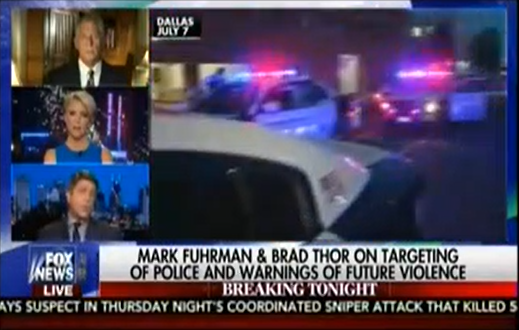
“You can always find something that doesn’t look like justice was served one way or another,” Mark Fuhrman tells Megyn Kelly (and right-wing novelist Brad Thor) on Fox‘s Kelly File (7/8/16).
Fuhrman had nothing but contempt for the Black Lives Matter movement erupting in Ferguson, Missouri. He told Fox News’ Megyn Kelly (8/10/15):
Stopping traffic is not a lawful demonstration. Stopping pedestrians is not a lawful demonstration. Stopping regular traffic on sidewalks in front of buildings. That is not lawful demonstrations. And they should enforce it. And you know, when you allow some kind of, you know, leeway, they just take more and more.
And now we have people that are not on the city council and they’re not on the police department, no matter how represented the Black community is. They are not there. You’re dealing with gang members and street drug dealers that are just hanging out. They’re armed and they’re taking advantage of a hesitant police department.
How did Fuhrman respond to a video of “a white school police officer in a Columbia [South Carolina] classroom grabbing an African-American student by the neck, flipping her backward as she sat at her desk, then dragging and throwing her across the floor” (New York Times, 10/26/15)? He made the officer a saint on Fox. Media Matters (10/27/15) quoted Fuhrman:
He requested her. He verbally did that. The next level is he put a hand on her. She escalated it from there. He used soft control. He threw her on the ground, he handcuffed her. He didn’t use mace. He didn’t use a Taser. He didn’t use a stick. He didn’t kick her. He didn’t hit her. He didn’t choke her. He used a minimal amount of force necessary to effect an arrest.
In 2019, he attacked Democratic presidential hopefuls for their police reform rhetoric on the Ingraham Angle (8/2/19), saying those politicians were looking to win “that 18-to-25-year-old base that is involved in all these movements—these anti-government, anti-establishment, anti-republic, anti-Trump” movements.
He eventually was given his own show on Fox News spinoff Fox Nation, the Fuhrman Diaries, which ran from 2018 to 2022. (Fox promoted him as “America’s most controversial detective”—LA Times, 11/29/18.)
‘Total reputational annihilation’
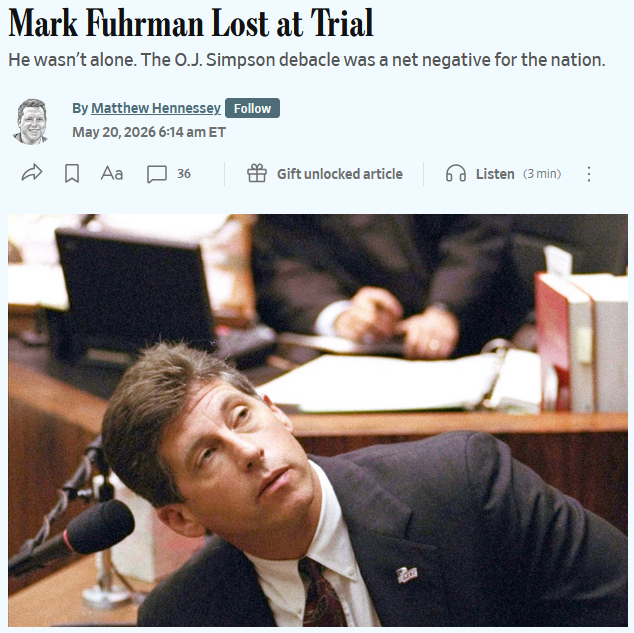
Just because someone lied under oath about using racial slurs dozens of times doesn’t mean they should be canceled (Wall Street Journal, 5/20/26)—and by “canceled,” we mean given their own TV show.
People can and do change over time. Fuhrman gave a somewhat nuanced view on Fox News (Ingraham Angle, 5/29/20) about the police killing of George Floyd, which resulted in widespread political unrest. He called Floyd’s killing “a slow-motion homicide,” and said the video footage was “a slow and really painful thing to watch of somebody grinding somebody’s face into the pavement until they’re dead.”
At the Murdoch-owned Wall Street Journal, columnist Matthew Hennessey (5/20/26) christened Fuhrman a victim of cancel culture, admitting that he was a “bad cop,” but that he
was among the first to suffer the total reputational annihilation that has become a hallmark of life in the digital era, where everything you say—or have ever said—will one day be used against you in the court of public opinion.
It’s a strange sort of “reputational annihilation” that gets you regularly showcased on a national cable TV network, and then gives you your own show.
Fuhrman’s afterlife as a commentator foretold a media conservatism that flips the narrative about racist policing on its head, where prejudice becomes a sign of expertise. It’s a legacy we live with today in MAGA America, even with Fuhrman having departed this world.
Research assistance: Priyanka Bansal
From FAIR via This RSS Feed.