


When a ceasefire is announced in a conflict zone, the international community breathes a sigh of collective relief. Headlines declare a pause, diplomats exchange handshakes, and the world looks away, assuming that the silence of heavy artillery equates to the beginning of peace. But when the conflict is with Israel, this assumption is not just naïve, it is dangerous.
‘De-escalation’
Recent truces have revealed a grim paradigm shift in modern warfare: “de-escalation” is no longer the antithesis of conflict, but a tactical phase of it.
Rather than halting aggression, recent ceasefires have functioned as a diplomatic screen. They offer the cover needed to consolidate a creeping military occupation, systematically demolish border villages, and reshape the demography of Southern Lebanon. All of this is achieved without the burden of international scrutiny and under the blind eye of international media, whether unintentionally or deliberately.
By treating peace processes as a logistical pause rather than a political solution, modern diplomacy is not stopping destruction; it is merely re-organizing it. To understand the future of Lebanese sovereignty, we must look past the rhetoric of the negotiating table and examine how the mechanics of “peace” are being used to institutionalize a permanent state of war.
The function of a ceasefire
Historically, a ceasefire implied a freezing of positions to allow for humanitarian relief and political negotiation. Today in Southern Lebanon, it acts as an engineering permit.
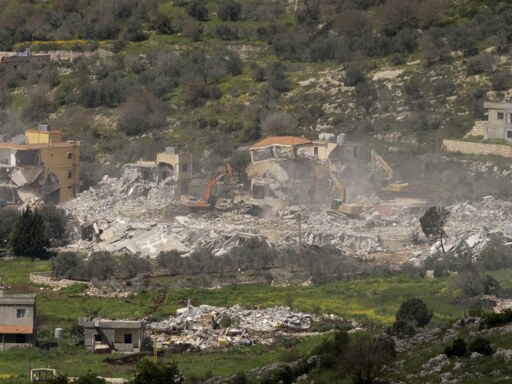
Under the shield of a nominal truce, the nature of the violence simply shifts from loud, high-casualty airstrikes to quiet, systematic ground erasure. With international media attention diverted by the declaration of “peace,” bulldozers and controlled demolitions flatten entire frontier communities, like Mhaibib and <Khiam, systematically erasing civilian infrastructure to carve out an unlivable buffer zone.
This low-noise, high-impact strategy accomplishes a core military objective: the physical and demographic separation of the border region from the rest of Lebanon without triggering the global outrage or immediate UN security councils that accompany an active bombing campaign. De-escalation, in this context, does not preserve the status quo; it secures the space to permanently rewrite it.
The erasure of Bint Jbeil
Nowhere is the strategy of “diplomatic cover for territorial erasure” clearer than in the historic city of Bint Jbeil. Known historically as the vibrant cultural and commercial heart of the south, Bint Jbeil did not suffer its worst devastation during the height of active, high-altitude warfare. Instead, the true annihilation of the city accelerated under the radar of the international community after ceasefire declarations were announced.
Freed from the constraints of active combat, Israeli ground forces and heavy machinery engaged in what is called “urbicide” – the deliberate, systematic destruction of an entire urban area to make it fundamentally unlivable. Satellite data and municipal reports reveal that over 80% of Bint Jbeil’s urban footprint has been either partially damaged or completely flattened, with more than 1,500 buildings and 3,000 housing units reduced to dust.
This was not surgical collateral damage; it was a methodical blueprint of erasure. Controlled explosions and bulldozers intentionally targeted the city’s oldest, most historic neighborhoods, including the Old Mosque Quarter and its 400-year-old Great Mosque, alongside vital civil infrastructure like the Salah Ghandour Hospital, power stations, schools, and water networks.
By utilizing the quiet of a diplomatic truce to systematically execute these demolitions, Israel achieves a permanent military and geographic reality: the total rendering of Bint Jbeil into a wasteland. It ensures that, even if the ceasefire holds, the 2,000 displaced families have no homes, no schools, and no infrastructure to return to, effectively executing demographic cleansing under the guise of an international peace agreement.
A calculated strategy of occupational power
This is not a new flaw in international diplomacy; it is a calculated strategy that the occupational power, Israel, has refined over decades of aggressions in Lebanon.
From the structural loopholes of UN Resolution 1701 in 2006 back to the localized “understandings” of the 1990s, Israel has consistently treated diplomatic agreements not as bindings to respect Lebanese sovereignty, but as frameworks to legalize its violations and occupational ambitions.
Past truces did not stop the violence; they merely codified it, establishing arbitrary “rules of the game” that normalized daily drone incursions, electronic warfare, and low-intensity border skirmishes. By reducing peace to a set of manageable technicalities, these agreements have historically served to desensitize the world to a permanent assault on Lebanese territory, effectively setting the stage for the next, more destructive phase of territorial encroachment.
Under this paradigm, modern diplomacy transforms from a tool of conflict resolution into an active instrument of subjugation and forced demographic change. The terms of these recent truces, laden with heavy restrictions on the return of displaced civilians, ongoing “security checks,” and the enforcement of vast no-go zones, amount to the bureaucratic institutionalization of ethnic cleansing along the border.
“Peace” redefined as ‘quiet’ destruction
By focusing strictly on the cessation of heavy missile fire, international mediators choose to prioritize an empty, superficial quiet over the fundamental rights of the indigenous population. International monitoring bodies like UNIFIL are reduced to passive stenographers, documenting the piecemeal theft of Lebanese land, while their presence provides a false veneer of international legitimacy to a brutal, ongoing occupation.
Ultimately, celebrating these ceasefires requires a deliberate blindness to the reality of what is being executed on the ground. When a truce allows an occupying power to systematically dismantle a nation’s geography, flatten its history, and permanently banish its people from their homes, it is an act of war by other means.
The international community’s obsession with a “negative peace” – the mere absence of loud explosions – has allowed Israel to turn de-escalation into a devastatingly effective weapon. If the metrics of global diplomacy continue to validate the silencing of guns over the survival of communities, then “peace” in Lebanon will remain nothing more than a euphemism for managed destruction, and sovereignty will be a concept sacrificed at the altar of geopolitical convenience.
Featured image via Amir Levy/Getty Images
From Canary via This RSS Feed.
You must log in or # to comment.