


This story was originally published byThe Imprint, a national nonprofit news outlet covering child welfare and youth justice. Sign up for The Imprint’s free newslettershere*.*
Nancy Marie Spears
The Imprint
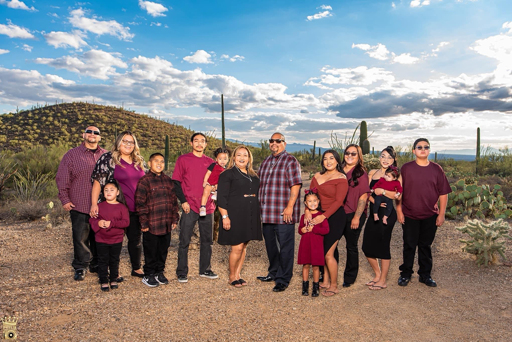
This is what growing up in a foster home on an Arizona reservation gave Rosa Soto Alvarez: family road trips to powwows. A foster mom who rolled out tortillas and fry bread to serve with simmering pots of chile con carne. A house surrounded by saguaros where she and her three siblings played with Barbies while listening to their relatives speaking Yaqui.
None of this would have happened without the protections enshrined in the Indian Child Welfare Act, Alvarez says. Keeping Indigenous foster children with Indigenous families whenever possible is the intention behind the 1978 federal law. It offers them a chance to maintain a connection to who they are and where they’re from — crucial ties often lost when placed in non-Native homes.
Today, Alvarez is a mother, a grandmother, and a small business owner. Over the years, she has opened her home to 25 foster children, including three siblings who lived with her for six years.
And, as a member of the Pascua Yaqui tribal council, she also works to ensure that tribal youth entering the child welfare system have the same ICWA protections she had growing up. Without them, she said, she would have led a profoundly different life.
“I grew up there, raised my kids there, and my grandkids are Yaquis,” Alvarez, 49, said of the Pascua Yaqui reservation. “This is exactly how the law works — to preserve our culture, our heritage.”
‘A great advocate’
ICWA law attempts to compensate for the U.S. government’s assaults on Native families through forced attendance at Indian boarding schools and foster placements in white Christian homes. It covers all 50 states, but 17 have local versions tailored to their tribes’ specific needs.
Arizona, which has 22 sovereign tribal nations, is not one of those states, and Alvarez wants to change that. Her mission is to educate lawmakers about why it’s important to codify ICWA into state law.
Every other month, Alvarez rises at 5 a.m., grabs a coffee and says a prayer as she heads out the door for a two-hour drive to Phoenix. Once there, she marches up and down the state Capitol’s hallways, visiting with as many lawmakers as she can.
Some lawmakers are familiar with the way child welfare systems must work with tribes; others hear about it for the first time when they meet her.
“She’s a great advocate,” said Marisela Nuñez, the Pascua Yaqui tribe’s enrollment director. “I admire her passion for the protection of ICWA and I think our community sees her in that light as well.”
On the Pascua Yaqui reservation, Alvarez chairs the tribe’s ICWA Committee which sends members around the state to advocate for the law. When Pascua Yaqui children enter the child welfare system, the tribe moves quickly to grant citizenship to ICWA-eligible youth so that they can receive its protections with minimal delay.
The tribe also keeps a database of Pascua Yaqui children in state foster care. It’s built on word-of-mouth accounts and information from Arizona counties, which are required to notify tribal nations when one of their citizens enters non-tribal foster care.
Alvarez said her advocacy work is steered by what ICWA did for her and her siblings. She remains on alert for instances when the law is not properly followed or consistently applied.
“I’m just a rez girl trying to make a difference,’’ she said. “There’s so many children out there who don’t have a voice and I know I have to be that voice.”
Turning pain into purpose
The path to advocacy didn’t come without struggle and sacrifice. While Alvarez and her siblings eventually ended up together in a safe foster home that reflected their tribal culture, their journey there was riddled with tragedy and abuse.
Alvarez is the oldest of four siblings who never knew their father. Their early years in Tucson were marked by their young mother’s struggles with substance addiction, she said.
When Alvarez was 6, she, her two sisters and a brother were placed into foster care.
One of the placements still lives in the siblings’ memories — “the blue house,” a non-Native home where children were locked in closets and neglected.
“It was bad,” said Alvarez’s younger sister, Irene Guzman. “To this day, I can’t sleep in total darkness. But that was what we thought was normal.”
Eventually, a childless Pascua Yaqui couple, Carmen and Jesus Alvarez, took in two of the siblings, while the others went into separate placements. Carmen then alerted a social worker that she believed the kids were Yaqui. Realizing they were eligible for ICWA’s protections and should be all placed in a tribal household, the social worker asked Carmen if she would take the other two.
The reunited siblings came to call the couple Mom and Dad, and the family moved to the reservation when Alvarez was 10.
Carmen and Jesus, devout Catholics, exposed Alvarez and her siblings to a vital part of their culture: In one Pascua Yaqui creation story, a deer foretold the coming of Christianity. A unique aspect of the tribe’s identity is the interweaving of that faith into its traditional practices and beliefs.
Carmen was a stay-at-home mom who made rosaries by hand and was deeply involved in the community. She also ran a snack shop out of her home on the reservation — selling snow cones, nachos and soft drinks. Alvarez remembers how neighborhood kids always flocked to her house for food and sleepovers.
Jesus worked as a janitor in juvenile detention facilities. He danced with all three daughters every holiday and birthday, a family tradition, and built an addition on their house just so Alvarez could have her own room when she became a teenager.
Enrollment director Nuñez, whose grandmother was Carmen’s cousin, watched the siblings grow up on the reservation. She saw them often at family gatherings and funerals.
What she remembers most about Alvarez as a child was her level-headedness. She was “the keeper of her siblings,’’ and a disciplined teen athlete who could always be found playing softball or basketball at the reservation’s recreation center.
“I used to watch these kids, take them on camping trips and swimming, and she helped me keep the other kids in line,” she recalled.
The families still come together regularly for ceremonies and dinners, occasionally over bowls of red chili popovers, a secret recipe that Alvarez’s small catering business, Cocina Alvarez, is known for on the reservation.
Connie struggles, but loves from afar
Guzman, now 46, was a toddler when she and her siblings entered foster care. The memories the sisters have of their biological mother, Concepcion Ochoa Soto — known to everyone as Connie — are fleeting and often chaotic, anecdotes tinged with happy and harrowing experiences.
Guzman doesn’t remember much about Connie, her heroin addiction or the circumstances of their removal from her care. She only recalls her big sister telling her “Mama’s sick” — Alvarez’s attempt to explain with child’s words why they couldn’t live with their mother anymore.
“She was 16 years old when she was pregnant and had me, but during her pregnancy she lost her mother — that was a tremendous amount of pressure,” Alvarez said. “I wish I could have that conversation with her now: ‘I understand why you tried to seek other coping mechanisms to deal with what you had to go through.’”
Connie’s parental rights were never terminated, Alvarez said. So now and then, she would visit the children at their foster homes, sometimes bringing clothes and toys.
But other moments were more unsettling. Once, the sisters said, all four children were riding in a car with Connie. Alvarez and Guzman didn’t fully understand what was happening at the time, but now believe Connie had wrestled with a dark urge to take the children away from their foster parents during that ride.
“She was crying — telling her boyfriend, ‘I’m not gonna take them back, because I miss them too much. I’m going to keep driving straight to Mexico,’” Guzman said. “The guy was telling her, ‘No, they’re in a good place.’”
She returned the children to their foster home that day. When she dropped them off, she thanked their foster mother for her care.
Recently, Alvarez and Guzman heard another story they’d never known about their biological mother, shared at a family dinner by a cousin: Connie frequently asked a relative to drive her to her children’s bus stop so she could secretly watch to make sure they made it to school.
“She was a drug addict, but she still was a mother,” Guzman said. “She still cared.”
Connie died of a drug overdose — the family believes it was intentional — when Alvarez was 11.
Through all of these experiences in foster care, Guzman clung to Alvarez as though she were a life raft in a raging storm. Whatever her big sister did, she wanted to do, too. Alvarez was good at softball so Guzman started playing. Alvarez wore bracelets and rings to school, so Guzman would sneak them to try to look like her. When she got pregnant as a teen, she ran to Alvarez, and moved in with her.
Like Alvarez, Guzman believes that ICWA’s guidelines around keeping siblings together and reuniting them when separated by foster care is the reason behind her strong relationship with her big sister today.
“She has been the constant in my life, and if it wasn’t for my sister, I don’t know if my life would be the same,” Guzman said. “If it wasn’t for the ICWA law, we would have been separated, and I wouldn’t even have known who my sister was.”
Still, the impact of family separation forced on Indigenous communities over centuries has shadowed the family.
Alvarez’s youngest sister Louisa got into trouble with the law and went to jail, and her four children wound up in foster care. Alvarez cared for her niece and nephews while they were in the child welfare system. They have since aged out.
A loved one’s death inspires advocacy
In 2005, Alvarez’s brother, Mariano Jr., was killed by a stray bullet after a fight broke out just a few blocks from their family’s home. He was 27. Today, anyone who walks by the house where the siblings grew up can still see Mariano’s initials, “M.J.G.,” etched into the sidewalk alongside his sisters’, by the third large rock lining the walkway.
Shortly afterward, Alvarez began working as a victim’s advocate for the tribe’s law enforcement department, where she spoke with families in crisis about their case and provided service recommendations. It was her first step toward advocacy work and a role in tribal government.
In recent years, ICWA has been upheld despite legal challenges from white foster parents who have argued that it discriminates against them — a sentiment Alvarez vehemently disagrees with. But the persistent lawsuits indicate to her that the work continues and her schedule remains full.
In the months to come, there will be public speaking engagements: an ICWA Day event that she is planning for June, and, in October, an annual ICWA conference on the reservation.
In all of these spaces, Alvarez said she will continue to offer her foster care experience as proof of how the law benefits tribal communities and its people.
“This has been my life’s calling, to advocate for all children in the system, especially our Indian children, to bring them home,” Alvarez said. “So I’m just turning pain into purpose.”
The post A ‘Rez Girl Trying to Make a Difference’ appeared first on ICT.
From ICT via This RSS Feed.
I was going to ask your opinion on NATO but I see the Hammer and Sickle so I already know you’re a bunch of astroturfing Tankies who would rape and murder native americans today given the opportunity.
Fuck China, fuck Russia. Fuck off Tankies.
