

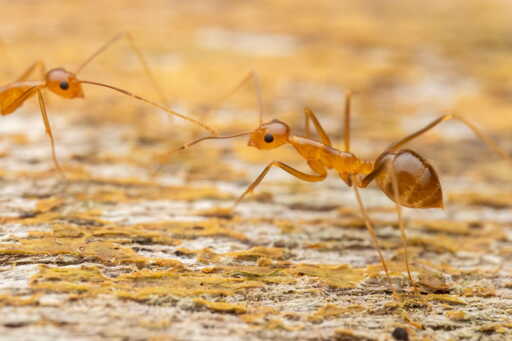
Avian vampire flies (Philornis downsi) were not discovered in the Galápagos Islands for almost three decades after they were thought to have arrived from mainland Ecuador in the 1960s. Even then, the first were found by accident. Birgit Fessl, a landbird ecologist, was surveying for native species on the island of Santa Cruz in 1997 when she reached into the branches of a tree to take down the huge, domed nest of a woodpecker finch. Inside was a surprise. “We found one dying chick, another dead one which just looked sucked dry and 20 large maggots full of blood,” said Fessl, who now leads the Charles Darwin Foundation’s Landbird Conservation program. “I was stunned — the first dead baby in my hands. Then I realized it wasn’t an accident: It was everywhere,” she told Mongabay over a WhatsApp call. Across each of the Galapagos’ human-inhabited islands, vampire flies had already wrought havoc, killing some chicks in nests they infiltrated and leaving others maimed for life. “But it went unseen because people didn’t really know what to look for.” Around the world, more than 37,000 invasive species have been introduced to new environments. Many of these cause suffering, from vampire flies maiming finches to yellow crazy ants (Anoplolepis gracilipes) spraying acid at the eyes of shrikes (Laniidae) on Minami-Daitō Island, Japan, and Australian quolls (Dasyurus) bleeding from the nose after eating toxic cane toads (Rhinella marina). But none of these are measured by the current global standard for assessing the impact…This article was originally published on Mongabay
From Conservation news via This RSS Feed.