


As a reader-funded independent news outlet, we operate free from the influence of governments, advertisers, and corporate backers. This is essential to our mission: to report on what matters most, beholden only to the truth. In that spirit, we made a commitment to ensure that our journalism is free for everyone, not locked behind a paywall. But that means we rely on the voluntary support of our community of readers. Please consider making a tax-deductible donation to support our work today.
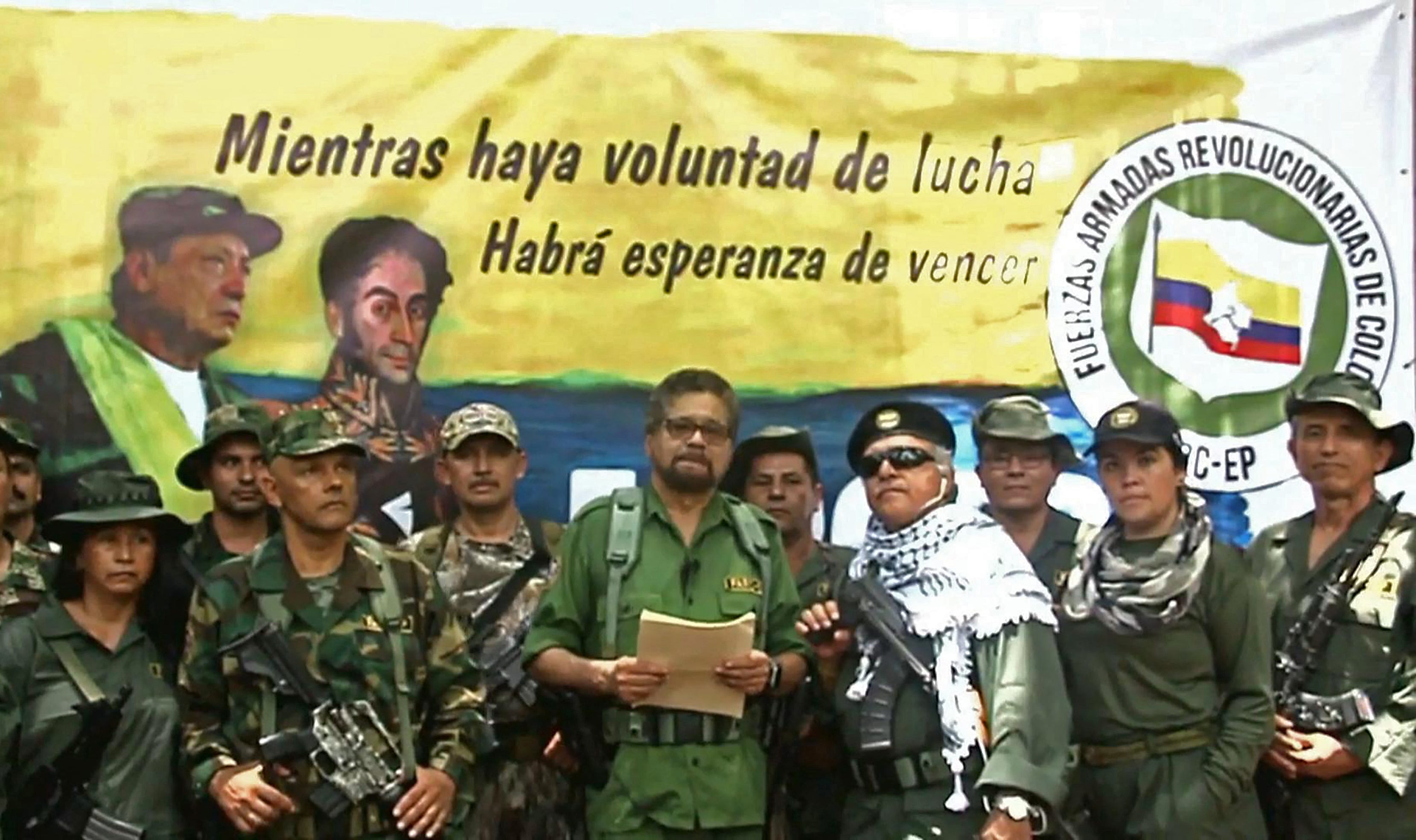
A video still released on August 29, 2019 shows former senior commander Ivan Marquez© and fugitive rebel colleague, Jesús Santrich (in sunglasses), in an undisclosed location in Colombia announcing that they are taking up arms as the Segunda Marqetalia. Photo by various sources / AFP via Getty Images.
Published in partnership with Intercept Brasil.
Lea este artículo en español.
When the Trump administration launched its bombing operation in January to abduct former Venezuelan president Nicolás Maduro, it accused him in an indictment of dealing drugs with the intent to enrich seven U.S.-designated terrorist organizations, including Mexico’s Sinaloa Cartel, the Colombian left-wing National Liberation Army, and a little-known insurgent group called the Segunda Marquetalia.
But the Segunda Marquetalia, a band of Colombian militants based along the Venezuelan border, has a unique backstory: It was brought into being by the U.S. government.
Founded in 2019 by former leaders of the Revolutionary Armed Forces of Colombia (FARC), the Segunda Marquetalia was spawned by an obscure U.S. government Drug Enforcement Administration (DEA) sting that derailed the Colombian peace process, pushing a top FARC negotiator back into the jungle and the drug trade, and ultimately into the arms of the Venezuelan government.
In a sleight of hand familiar from decades of disastrous U.S. policy in Latin America, the actions of the Segunda Marquetalia were used in part to justify January’s Delta Force raid in Caracas, which killed at least 47 Venezuelans and 32 Cuban members of the president’s security detail, and culminated in the arrests of Maduro and his wife, Cilia Flores. The former Venezuelan president is being held in a Brooklyn prison, awaiting trial in a Manhattan federal court.
In the past year, the Trump administration has engaged in aggressive, politically driven counternarcotics operations, escalating the U.S. drug war by involving the military. By designating a series of criminal groups as “terrorist” organizations, the administration has justified military strikes on small boats allegedly carrying drugs, invoking national security to conduct what are essentially extrajudicial killings at sea. At least 190 people have been killed in the strikes, including fishermen who appear to have been uninvolved in the drug trade.
The administration has also seized on accusations of drug trafficking to attack political adversaries like Maduro. In March, the New York Times reported that the U.S… Justice Department is investigating Colombian president Gustavo Petro, who has a complicated relationship with the Trump administration, for alleged drug trafficking. Last October, the administration sanctioned Petro and his wife, son, and Interior Minister for “flooding the United States and poisoning Americans” with Colombian cocaine, according to Treasury Secretary Scott Bessent.
“President Petro has allowed drug cartels to flourish and refused to stop this activity,” Bessent added.
The story of how an opportunistic battle in the sprawling U.S. drug war birthed the Segunda Marquetalia has never been fully told. But an investigation by Drop Site and Intercept Brasil reveals how a DEA cocaine sting targeted a longtime FARC leader and peace negotiator who goes by the nom de guerre Jesús Santrich. Santrich had agreed to lay down his arms and become a Colombian congressman. But when the U.S. sought his extradition, despite Colombia’s tenuous peace agreement, Santrich abandoned civilian life and launched the Segunda Marquetalia.
“This case created the Second Marquetalia,” said Elizabeth Dickinson, the deputy program director for Latin America and the Caribbean for the International Crisis Group,using the group’s English name.
The Santrich case underscores the Justice Department playbook of building high-profile drug trafficking cases in spite of their grave political implications for other countries. Although the DEA’s motivation for targeting Santrich is unclear, some Colombians have accused the U.S. of chauvinism and political meddling in the case.
Our investigation draws on hundreds of pages of U.S. federal court and law enforcement records; a report by the Colombian Truth, Coexistence, and Nonrecurrence Commission, a body established as part of the peace process to investigate human rights violations; an internal Colombian judicial complaint; a United Nations investigation; Colombian extradition records; and multiple interviews with one of Santrich’s co-defendants targeted in the sting, Armando Gómez, who recently completed a ten-year sentence in a federal prison in Atlanta.
The Department of Justice declined to comment. The State Department referred questions to the DEA, which did not respond to requests for comment.
Among the findings of Drop Site and Intercept Brasil’s investigation:
- The cocaine negotiations that led to Santrich’s arrest were initiated by a longtime DEA informant on the U.S. government payroll, whose actions were directed by special agents in Miami and Bogotá.
- All the cash involved in the purported drug deal, including millions of dollars in fake bills, was provided by the U.S. government. The five kilos of cocaine exchanged during the operation were provided by a drug dealer, with limited links to the FARC, who is now a cooperating witness with the U.S. Justice Department.
- Santrich was only tangentially involved in the deal after the DEA informants pressed him for a meeting. He was targeted despite being present at just two meetings during the nine-month sting, both of which occurred after the cocaine changed hands.
- Under the first Trump administration, the State Department repeatedly refused to cooperate with Colombian justice tribunals. The U.S. denied Colombian requests to hand over evidence against Santrich so the tribunals could determine whether he could be legally extradited to the U.S.
- The fallout from the operation led to the weakening of a peace agreement, the creation of the Segunda Marquetalia, and a United Nations investigation into the ordeal. The UN’s investigation found the operation may have been led by an “agent provocateur,” but it stopped short of identifying him as the DEA informant.
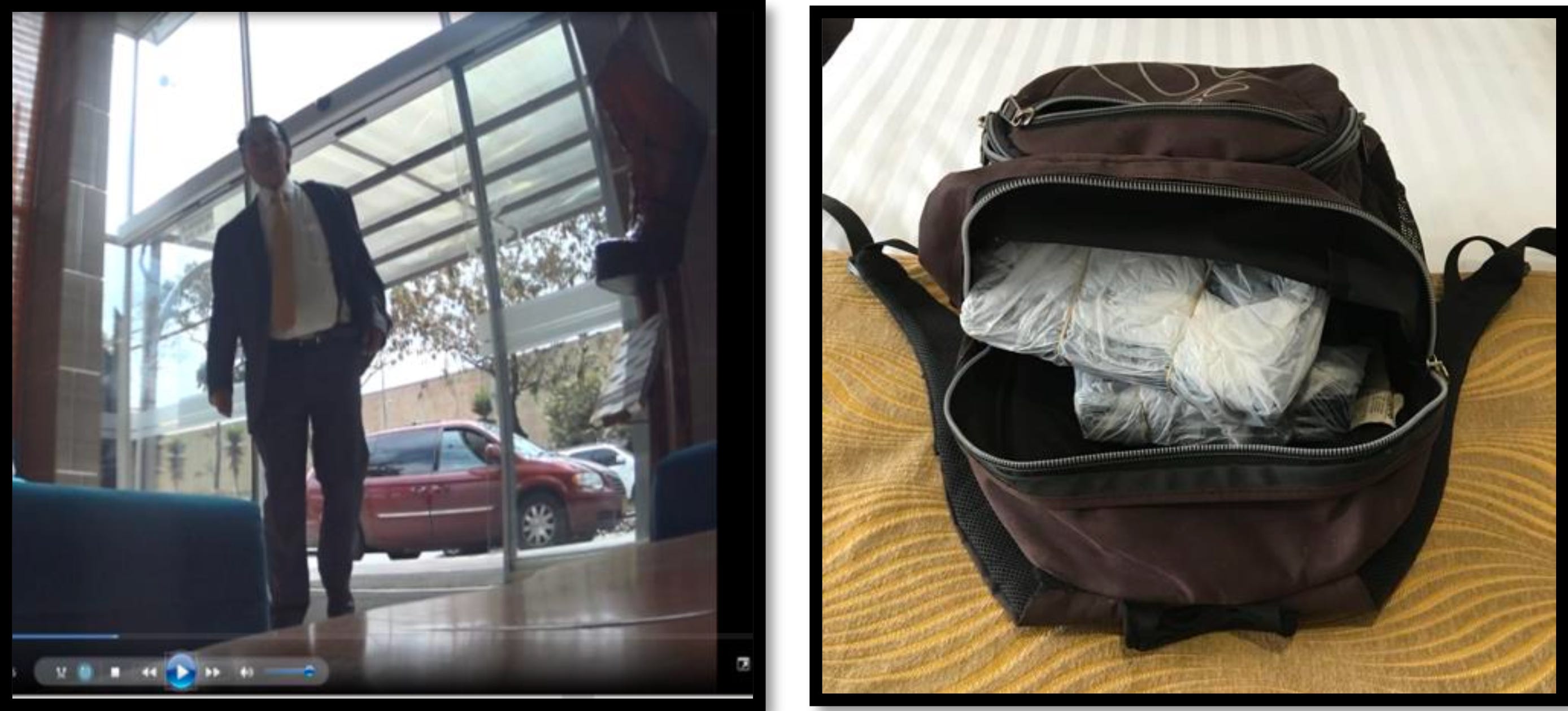
A video still from a surveillance video showing Armando Gómez and the bag of cocaine used in the DEA operation. From a U.S. Department of Justice sentencing memo dated January 6, 2023.
The Cocaine Connection
The origin story of the Segunda Marquetalia dates to November 2017, when a Mexican cartel member sat calmly in the lobby of a Bogotá hotel, waiting for a cocaine delivery.
The charming Mexican man, known to his associates as Marco Aurelio García Weinberg, was in his mid-40s and clean-shaven with cropped hair. For months, he and a close associate, both of whom claimed to be members of Mexico’s Sinaloa Cartel, had been negotiating with a group of Colombians to establish a massive cocaine-trafficking partnership. Now Marco was about to receive a five-kilogram sample of what the Colombians had promised was the “purest” cocaine, Justice Department documents say. If the quality held up and its transport to the U.S. was successful, the Mexican traffickers would continue negotiating for a multi-million-dollar cocaine deal. They were steps away from trafficking 10,000 kilos to North America and Europe.
The hotel’s automatic glass doors slid open and Armando Gómez shuffled into the lobby. The Colombian businessman was five-foot-seven and 69 years old, wearing glasses, a yellow tie, and a navy suit jacket. A brown backpack stuffed with cocaine hung from his shoulder.
“I arrived, entered the hotel, and saw him sitting on an armchair,” Gómez told Drop Site News and Intercept Brasil in a series of interviews from FCI Atlanta, the low-security federal prison where he was detained until his release in April. He approached Marco and put the backpack on the floor in front of him. “I said ‘Hi, here you go, no worries’ and left. I had other meetings to attend to.”
Marco took the bag to a hotel room and examined the merchandise. Satisfied, he and his cartel partner called Gómez and two other Colombian businessmen to say they wanted to move forward with the 10-ton, $15 million deal. But the Mexicans had one condition: They wanted the “blessing” of Santrich, the former FARC leader, before going ahead.
It was a tricky time for a former commander like Santrich to be involved in drug trafficking. He was about to enter mainstream politics, and when Santrich and his closest ally, Luciano Marín Arango, better known by his nom de guerre Iván Márquez, signed onto the Colombian peace accords in 2016, they had promised to refrain from any criminal activity.
Nevertheless, the following day, the Mexicans secured an in-person meeting with Santrich. The middle-aged, half-blind FARC ideologue told them to go ahead with the cocaine deal, but said he couldn’t be personally involved due to his role in the peace process, according to a Justice Department document.
What Santrich didn’t know, however, was that the two Mexican men were undercover DEA informants. The informants, part of a binational sting, were secretly recording their in-person meetings, while the Colombian Attorney General’s Office, led at the time by Néstor Humberto Martinez, a U.S. ally, had tapped some of the Colombians’ phones.
“That all speaks to some sort of entrapment,” said Adam Isacson, the Director for Defense Oversight at the Washington Office on Latin America. “If you were already very paranoid about whether the government was going to respect your status as a demobilized guerilla, that would certainly be the final straw to take you over the edge and make you decide to rearm.”
The ten tons of cocaine never materialized. But the five-kilo sample from the hotel and the hours of recorded conversations were enough to secure a federal indictment accusing Santrich, Gómez, two other Colombians, and an American man of conspiring to traffic the giant supply of cocaine. In April 2018, Colombian officials arrested Santrich and the other Colombian suspects.
Trump’s Justice Department praised the DEA and publicly thanked the Colombian Attorney General’s office for its hard work on the “significant enforcement operation.” In Colombia, news of Santrich’s arrest was splashed across every newspaper and television screen. The accusations against the soon-to-be-congressman only confirmed right-wing hysteria about the peace deal: FARC members were criminals who couldn’t be trusted. The long-lasting conflict, U.S. intervention in the region, and the war on drugs had to go on.
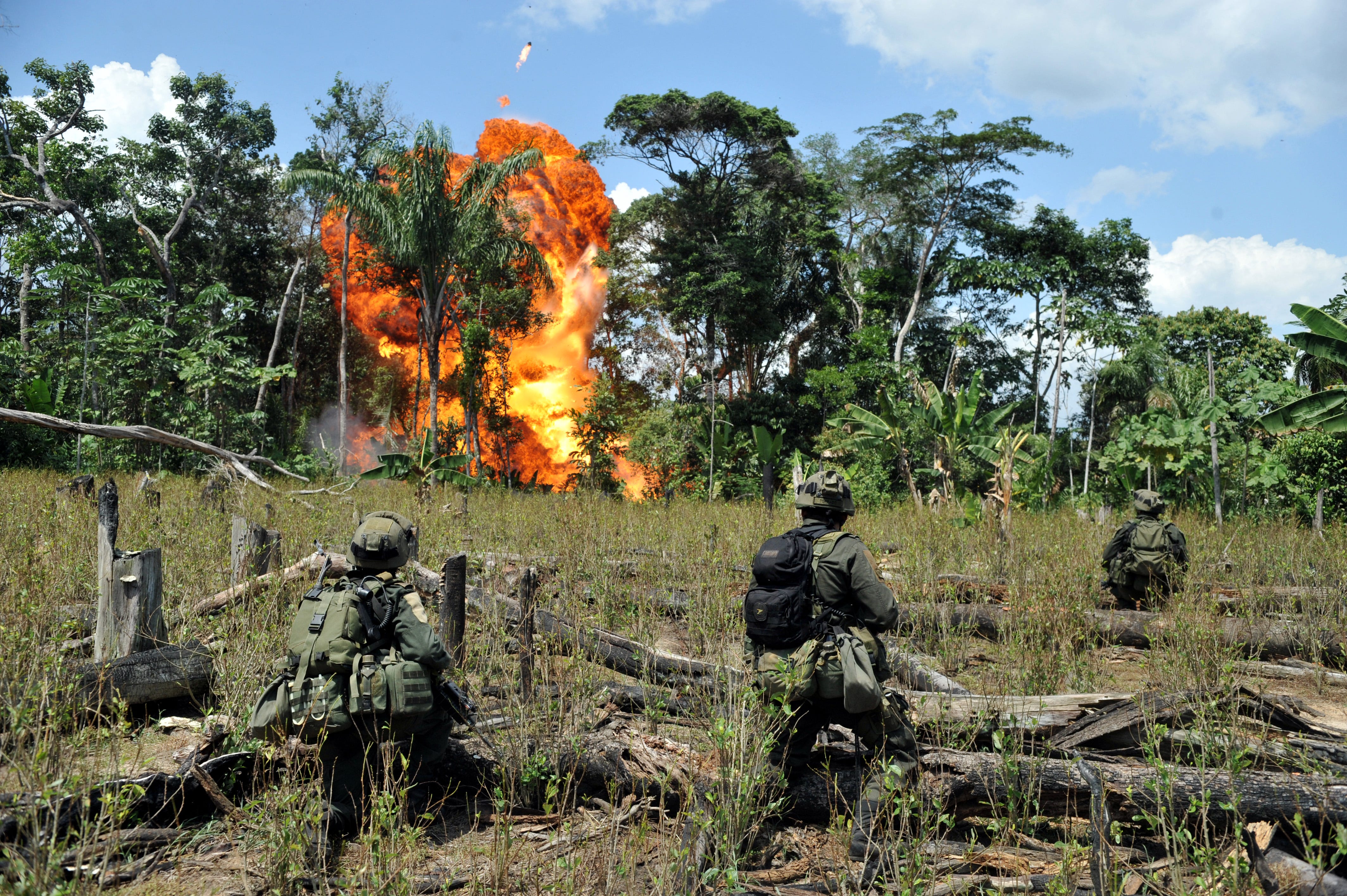
Anti-narcotics police officers blow up a laboratory for processing cocaine seized from the Revolutionary Armed Forces of Colombia (FARC) in the municipality of Puerto Concordia, Meta department, Colombia, on January 25, 2011. Photo by GUILLERMO LEGARIA/AFP via Getty Images.
La Violencia
In 1948, before the FARC existed, conflict between Colombia’s Liberal and Conservative political parties plunged the country into violence. Amid the civil war, guerrilla and peasant self-defense forces rose up in the countryside to fight right-wing groups. The period, known as “La Violencia,” ended 10 years later, but the leftist guerrilla groups, partly inspired by the Cuban revolution, continued their fight, forming a small, autonomous enclave in southwest Colombia called the Marquetalia Republic. The Colombian army later invaded the region, ushering in a period of anti-communist repression.
The FARC, created in 1964 from remnants of this conflict, pushed a program of agrarian reform for the impoverished countryside. For five decades, the U.S.-backed Colombian military and right-wing paramilitaries battled an assortment of left-wing guerrillas, including the FARC. More than 200,000 Colombians were killed and over 10 million were displaced.
Seuxis Paucias Hernandez Solarte joined the FARC as a young man in 1991, after years as a left-wing student organizer and political activist, eventually rising to become a member of its central high command. He took the nom de guerre “Jesús Santrich” after his friend, a student leader who had been killed by government officials. The guerrilla, who always wore sunglasses and a keffiyeh, became one of the FARC’s most visible leaders, giving rousing speeches, declaring allegiance to Venezuelan and Cuban leaders, and reportedly spearheaded the FARC’s propaganda efforts.
Throughout the 20th century, the U.S.-backed Colombian government also intensified its fight against cocaine trafficking. In the 1990s, Colombia and the U.S. began to dismantle major cartels and criminal groups running the cocaine trade; left-wing guerrillas and right-wing paramilitaries filled the vacuum. Most of the world’s cocaine comes from Colombia, and the FARC was responsible for trafficking large quantities. The country’s disparate militant groups partnered with criminal organizations around the world, including Mexican cartels, to sell drugs, using the profits to finance their political fight. In 1997, the U.S. government designated the FARC a foreign terrorist organization.
Two years later, the U.S. and Colombia launched a security agreement known as Plan Colombia that aimed to eradicate drug trafficking and violence in the country. The partnership was supercharged during the war on terror, when the U.S. government provided more funds to Colombian security forces that were later accused of war crimes. Washington also escalated covert CIA and NSA operations to secretly hunt down left-wing rebels.
But Plan Colombia only fueled the Colombian conflict. After his 2002 election, right-wing Colombian President Alvaro Uribe ordered the military to employ increasingly violent measures to stamp out so-called “narcoterrorism.” The FARC and right-wing paramilitaries followed suit.
The U.S. Justice Department says that in the early 2000s, Santrich and his ally Iván Márquez cultivated coca leaves on farms in Colombia and Venezuela. It accuses them of helping establish a FARC camp to process cocaine in 2003 in exchange for a $300,000 payment from an associate with ties to the Cartel de los Soles, a criminal group allegedly made up of top Venezuelan officials that the U.S. recently designated as a terrorist organization. The latest Maduro indictment removed any mention of the Cartel de los Soles and experts have repeatedly questioned U.S. claims about the group, saying they are overstated and that it likely does not exist.
In 2012, Colombian President Juan Manuel Santos began exploring peace talks with the FARC. The FARC negotiating team included Santrich and Márquez, who took a hardline approach, pushing for a gradual reduction of their weapons rather than an immediate disarmament. This placed Santrich and Márquez at odds with other FARC negotiators, who remain involved in mainstream Colombian politics. Santrich in particular was notorious for his long years of fighting and his arrogance, and he was widely despised during the peace negotiations. A reporter once asked him if the FARC would answer to their victims. In response, he sarcastically sang in Spanish: “Perhaps, perhaps, perhaps.”
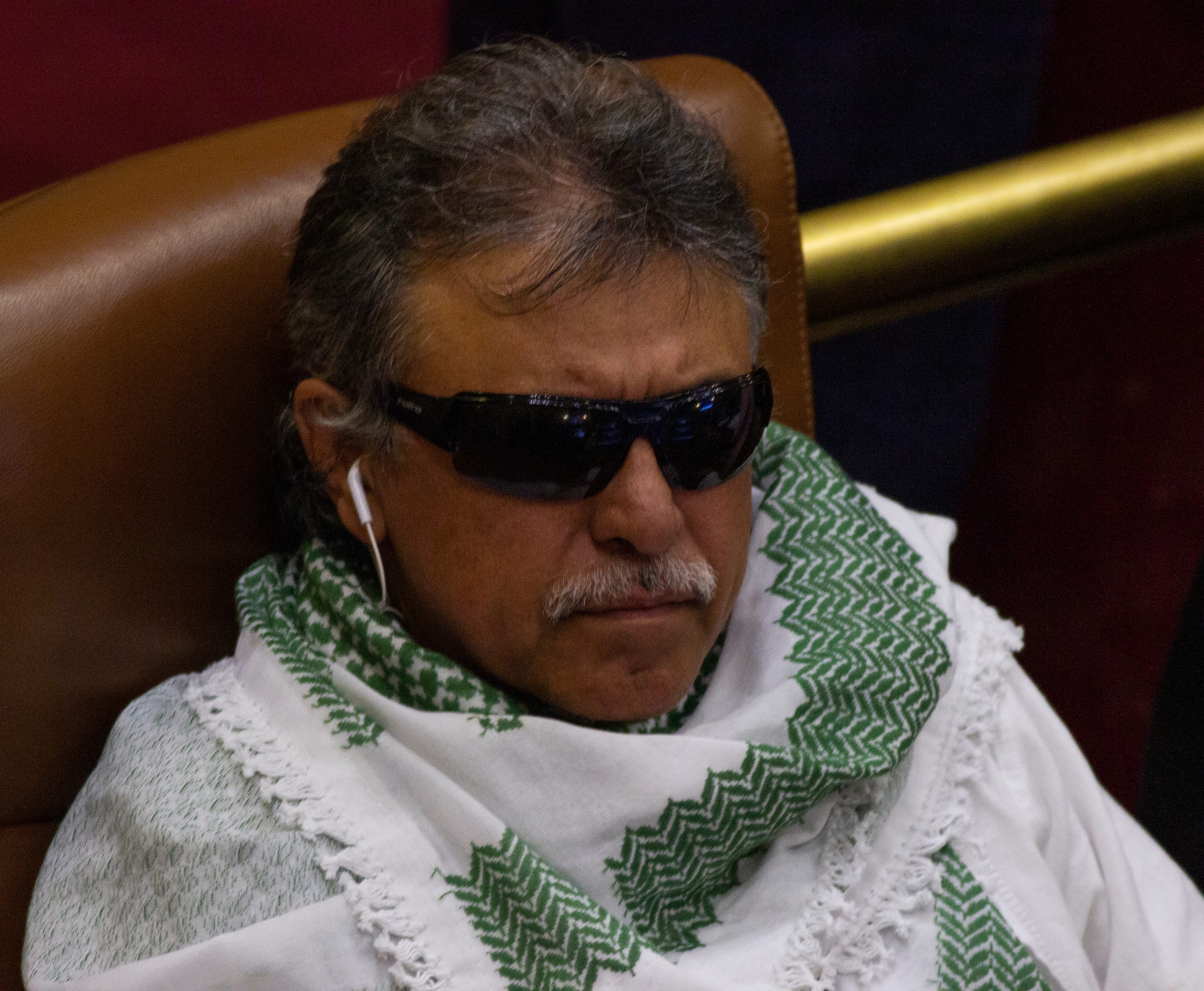
Seuxis Pausias Hernández known by his pseudonym Jesús Santrich, in Bogota, Colombia, on June 18, 2019. Photo by Daniel Garzon Herazo/NurPhoto via Getty Images.
The Blessing
The DEA operates in Colombia with little oversight. Jobs in its Bogotá office are highly coveted, but the agency’s operation there has been tarred by corruption allegations. In 2015, agents were accused of attending “sex parties” funded by drug trafficking organizations and accepting guns from paramilitary groups. And in 2021, a former agent was convicted of conspiring to launder money for a Colombian cartel.
The DEA informant who targeted Santrich is an elusive figure. Drop Site and Intercept Brasil were unable to determine his real identity. Only three things are certain: he went by “Marco,” said he was from Mexico, and had been a DEA informant since 1996.
His first contact in Colombia was Armando Gómez, a well-known businessman in Bogotá. In multiple interviews, Gómez explained how he met Marco through a business connection in 2017. At first, Marco portrayed himself as a wealthy Mexican searching for business partners in South America to sell and trade pre-Columbian artifacts. Marco hired Gómez to be his Colombian fixer.
“I was a subordinate, hired by Marco, so that he wouldn’t be cheated, and so that he wouldn’t have safety problems,” Gómez said. “Today, I’m convinced that he was a ‘snake charmer,’ as the saying goes.”
It was not until mid-2017, Gómez says, that Marco, who is referred to in U.S. courtdocuments only as “Confidential Source 1,” confessed to Gómez that he was a Sinaloa Cartel operative, seeking connections with FARC members to strike up a cocaine trafficking deal. He wanted Gómez’s help.
Throughout the operation, Marco’s actions were directed by U.S. officials, according to a DEA document presented to Colombian officials as part of an extradition request for one of the Colombians involved in the coke deal.
Gómez introduced Marco to Fabio Simon Younes Arboleda, a 71-year-old Colombian businessman. Younes Arboleda, in turn, connected the undercover DEA informant Marco to his FARC contact, a seedy character named Marlon Marín, who would become central to the operation. Though not himself a member of the FARC, Marín is a nephew of Márquez.
During their first meeting, Marco proposed buying cocaine to sell in Miami or Canada, according to a U.S. government document. Marín assured the informant he could access pure, high-quality coke.
Marín, a fringe figure who was already under investigation in Colombia for attempting to defraud the government, tried to sound tough, overselling his relationship to the FARC, the Colombian Truth Commission report said. As the men continued to negotiate, Marco pushed to meet with Santrich and Márquez.
In August 2017, after much prodding, Marco and another DEA informant finally made contact with Santrich, exchanging pleasantries over a brief phone call facilitated by Gómez. Santrich told the Mexicans that “inroads have been made towards favorable positive horizons,” Justice Department records say.
In late September, Marco and the other DEA informant paid Gómez, Younes Arboleda, and Marín $8,000 for the delivery of a five-kilogram cocaine sample to seal their partnership. On November 1, 2017, Marín sent Gómez to pick up the brown backpack with the five kilos of drugs from one of Marín’s contacts. The exchange at the Bogotá hotel was monitored by the Colombian Attorney General’s Office, according to documents accessed by Colombian journalist Edinson Bolaños.
In their meeting the next day, Santrich assured the Mexicans that “if anything went wrong with the business, the FARC would accept responsibility,” U.S. court records say. At the end of the meeting, Santrich drew and signed a sketch, with a message: “For Don Rafa Caro with all my best wishes and with the hope for peace.” Rafael “Rafa” Caro Quintero, a founder of the Guadalajara Cartel, was one of the most wanted Mexican kingpins for his alleged role in the killing of DEA Agent Kiki Camarena. (At the time, Quintero was on the run from authorities. He was arrested by Mexican officials in 2017 and sent to the U.S. last year. Like Maduro, he is now in the Metropolitan Detention Center in Brooklyn awaiting trial.) Santrich later said he believed Caro Quintero was a Mexican entrepreneur looking to support the Colombian peace process and related projects.
Marín also introduced the Mexican DEA informants to Vincent Schifano, a 62-year-old Miami businessman who was bidding on an oil pipeline project in Colombia. Schifano told the informants he would launder their millions of cocaine dollars through the oil project, adding that he had been “laundering money for 20 years—for the Italians, the Russians, and now the FARC,” according to a DEA agent’s deposition included in the court records.
Marín and the DEA sources met again with Santrich in February 2018. In a video of the meeting later released by the Colombian Attorney General’s Office, Santrich is sitting at a table with Marín and a DEA source whose face is blurred. After reviewing a screenshot of the video sent to him by Drop Site and Intercept Brasil, Gómez identified the man in the video as Marco. The other DEA informant secretly filmed the meeting, seemingly with a vape or another smoking device equipped with a hidden camera.
“You, yourselves, have to be on top of it so that there is no difficulty,” Santrich tells the Mexican DEA informants. “Because I can’t be on top of this because I’m tied up here. That is why you have to organize timing [inaudible] insurances and procedures, and all that.”
Santrich paused while the men at the table stared as if expecting him to say more. “My apologies for treating you like this, so—”
“No, no, no, no,” Marco interjects. “This is the situation.” After asking Marín about the timing for the drug delivery, he turns back to Santrich. “Can you give us the blessing so we can put effort into this?”
“Well, it’s fine, gentlemen,” Santrich sighs.
A day later, Marco flew to Florida to meet with Schifano, the American money launderer. He and an undercover officer gave Schifano the keys to a car with $5 million in fake bills in the trunk. As Schifano drove off, he was stopped by police, who took custody of the car and the fake money.
Feigning anger at the loss of the money, Marco insisted on meeting with Santrich and Márquez again. But Santrich was tipped off to his own looming arrest, according to Colombian press reports. “They were forced to work with the little evidence they had,” Isacson from WOLA, said. “It looked like the DEA and its Colombian partners wanted a stronger case.”
On April 4, 2018, a federal grand jury in the Southern District of New York returned a sealed indictment charging Gómez, Younes Arboleda, Marín, and Santrich with one count each of conspiracy to import cocaine and two counts each of attempting to import cocaine. Colombian officials arrested Santrich at his home, seizing his phones and computers.
Gómez, Younes Arboleda, and Marín were also arrested. Marín quickly turned on his alleged Colombian co-conspirators. He blamed Santrich, accusing him of masterminding the operation. He also struck a deal with the U.S. government and was voluntarily escorted by DEA agents to the U.S. Marín is now a cooperating witness for the Justice Department, with all court records related to his case under seal.
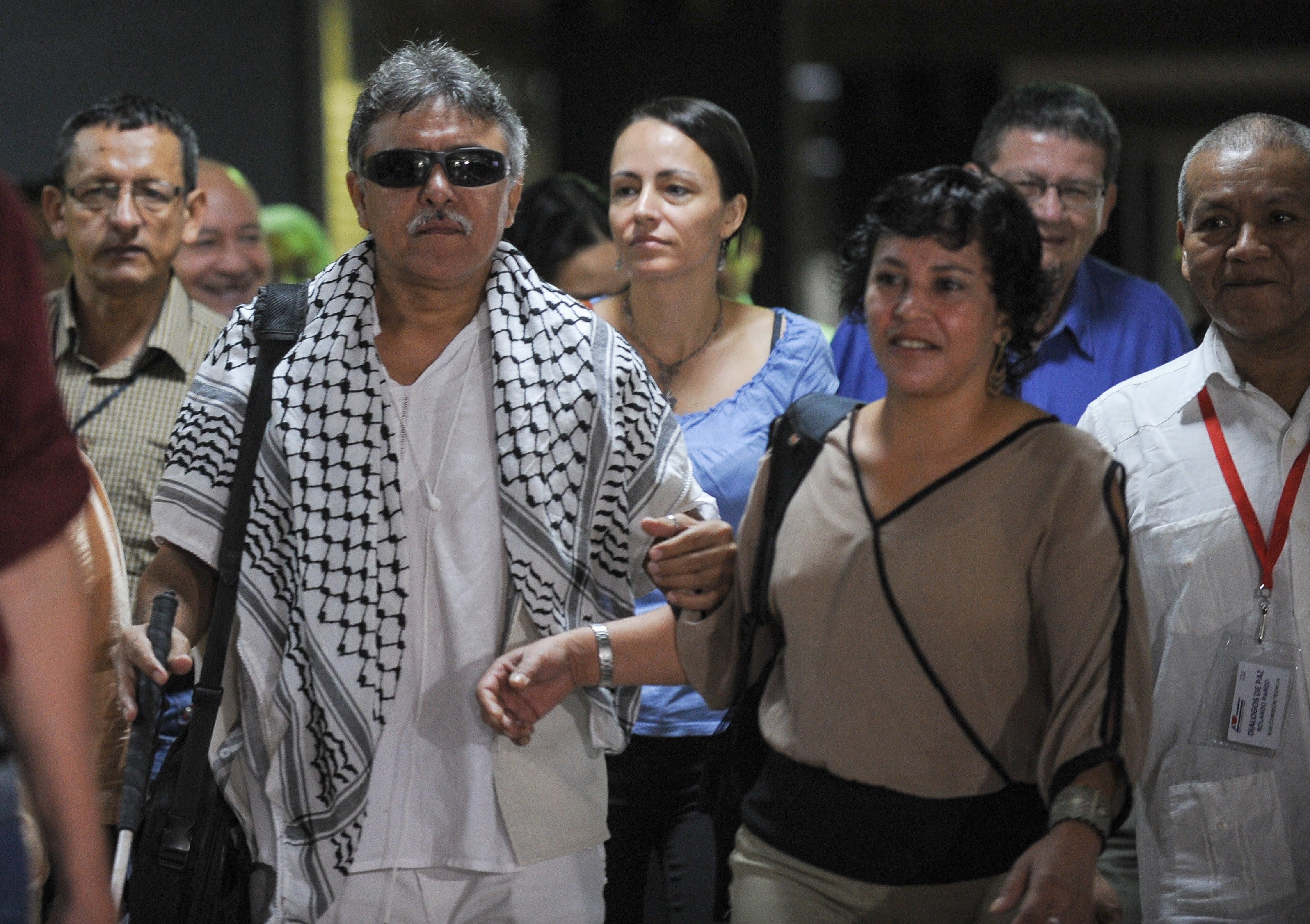
Leftist guerrilla commander Jesús Santrich (L) arrives at Convention Palace in Havana, on November 18, 2015 for peace talks between the Colombian government and the FARC. Photo Yamil Lage/AFP via Getty Images.
Sacrificing the Peace
The peace accords, ratified by the Colombian Congress in 2016, resulted in the formation of two separate institutions: the Colombian Truth Commission, tasked with investigating crimes committed during the conflict; and the Special Jurisdiction of Peace, known as the JEP, a transitional justice tribunal set up to adjudicate those crimes.
“It’s a big, sprawling institution, and it has an enormous responsibility,” said Michael Evans, a senior analyst at the National Security Archive who served as a consultant for the truth commission. “We’re talking about thousands of people trying to get some semblance of justice for the victims.”
As part of the peace agreement, former FARC members received a “no extradition” guarantee for any crime committed before December 2016. Since the alleged drug conspiracy took place in 2017, extradition for Santrich was fair game—but it was delicate and politically sensitive, considering his high-ranking status as a former guerilla leader. In the spring of 2018, as news of Santrich’s arrest circulated throughout Colombia, he and his legal team knew an extradition request was coming.
If an extradition order arrives for a former FARC member, the JEP is responsible for reviewing the timeline of the alleged crime and deciding whether they are eligible for extradition. The JEP, also anticipating that the U.S. would request Santrich’s extradition~~,~~ immediately began attempting to gather evidence, sending numerous requests to the Colombian Attorney General’s Office and the U.S. government.
U.S. and Colombian officials either ignored the JEP’s requests or refused to provide the evidence they sought, according to an internal JEP investigation obtained by Drop Site and Intercept Brasil and a subsequent criminal complaint the JEP filed against former officials in the Colombian Attorney General’s Office. The stonewalling continued after the extradition request finally came through in June of 2018.
Kevin Whitaker, who served as U.S. ambassador to Colombia under Obama and Trump from 2014 to 2019, said Washington’s primary concern was getting its hands on people who violated US law.
“The existence or non-existence of a peace accord in another country is not material,” Whitaker said in a 2023 podcast interview.
“That JEP law would have required the U.S. to provide all of the evidence with respect to individuals sought in extradition. That is not the way extradition works,” he added. “We cannot and would not provide the information.”
But the U.S. and Colombian stonewalling infuriated JEP officials. According to a special report by the United Nations, as of November 2023, the JEP had ruled on 72 extradition requests. In every case, the Attorney General’s Office had shared all the information sought by the JEP.
After the Constitutional Court, the highest court in Colombia, ruled in favor of the JEP, the attorney general’s office sent a USB drive containing recordings of 12 phone calls, despite Colombian press reports suggesting that the Colombian Attorney General’s office and the U.S. Justice Department had more than 24,000 recordings. The 12 calls had nothing to do with Santrich’s case, according to the JEP’s criminal complaint and an external law firm the JEP commissioned to investigate the case.
In September 2018, the attorney general’s office told the JEP that it could not provide further evidence because the other recordings were from a DEA confidential witness, and they were already in the hands of U.S. authorities. Months later, in February 2019, the Justice Department’s Office of International Affairs sent the JEP a letter stating that sharing evidence was contrary to U.S. practice, and that in any case, the evidence was “unnecessary” for determining whether to extradite Santrich.
In May 2019, the JEP declared that Santrich would not be extradited to the U.S. and ordered his release. Martinez, the Colombian attorney general at the time, resigned in protest.
That same year, according to Colombian press reports, the DEA provided information to the Colombian Attorney General’s Office about alleged corruption within the JEP, based on a DEA informant-led operation against JEP officials. The DEA informant, posing as a Mexican cartel operative, tried to intervene in the JEP’s review of Santrich’s case, offering JEP officials money to prevent Santrich’s extradition. When the informant failed to secure a meeting with a JEP judge, he targeted a JEP prosecutor and former senator, Carlos Julián Bermeo. Bermeo was found guilty of accepting a $40,000 bribe; the JEP claimed Bermeo did not belong to the office that decided on extradition orders, including in Santrich’s case.
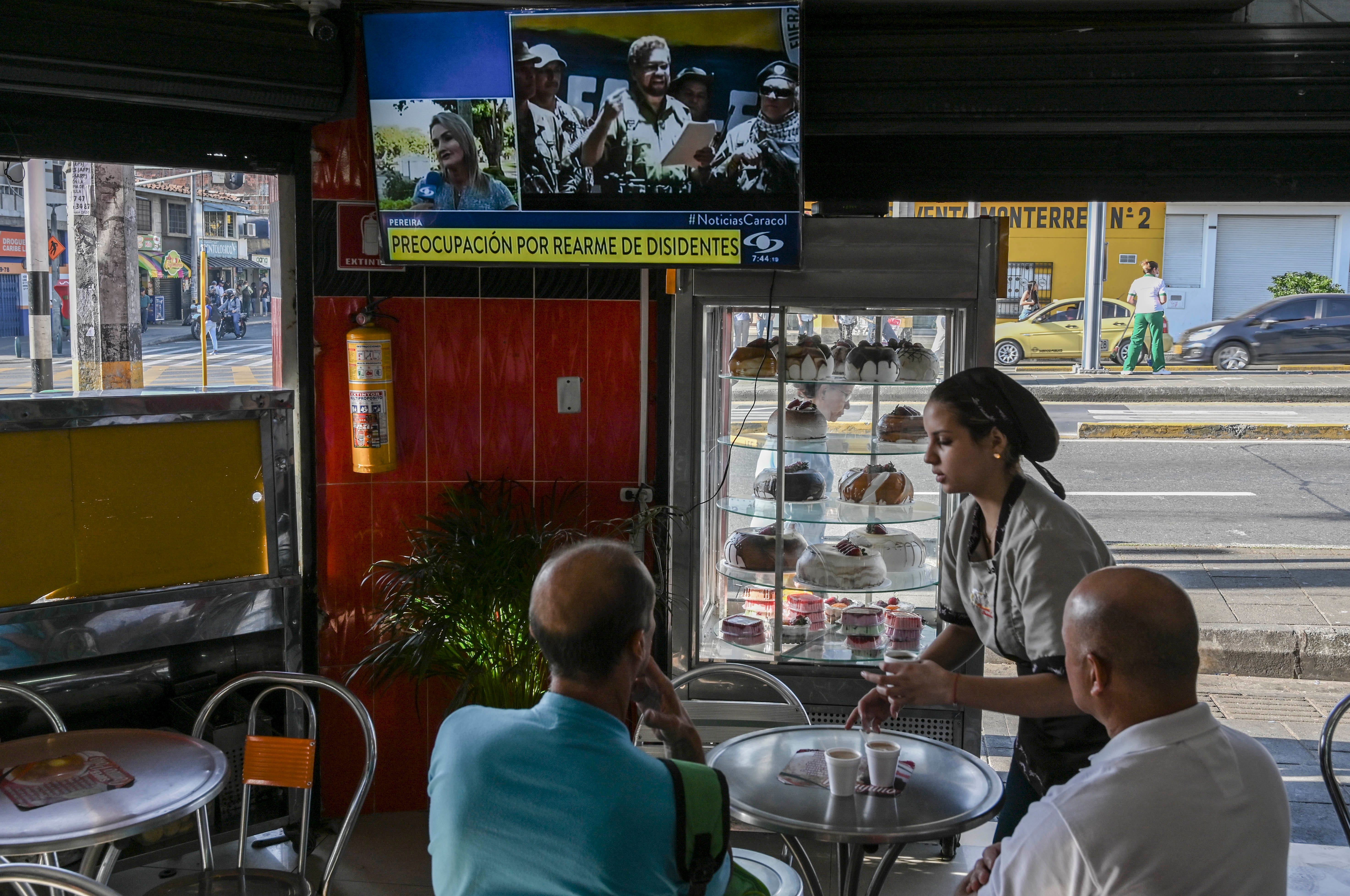
A TV in a bakery in Medellin, Colombia, broadcasts on August 29, 2019 a video of Ivan Marquez and fugitive rebel colleague Jesús Santrich. Photo by Joaquin Sarmiento/AFP via Getty Images.
A Return to Arms
Thirteen months in Colombian detention took a visible toll on Santrich. His mouth was slightly agape and his head hung low as officials pushed him out of the Colombian jail in a wheelchair on May 17, 2019. Santrich, 52 years old at the time, had been held at La Picota, a notorious Bogotá prison.
But as the media descended on the jail’s parking lot to document the guerrilla leader’s release, officials from the attorney general’s office approached with a new arrest warrant. As onlookers watched in confusion, officers re-arrested Santrich and bundled him onto a helicopter.
To justify the arrest, officials pointed to a “declaration by Marlon Marín” in which Marín said that the entire conspiracy to traffic 10,000 kilos of cocaine was Santrich’s idea. This time, the Colombian Supreme Court intervened and ordered the former FARC leader’s release, claiming his case was to be investigated by a special office within the Supreme Court.
After his second release, Santrich denounced the Colombian and U.S. governments, accusing them of entrapment. His comrade, Márquez, stood with him, saying on social media that the Colombian government had betrayed the peace accords and that it was “a grave error” to have handed over their weapons to a “deceitful state.” If the Colombian government wouldn’t respect the peace agreement, Santrich and Márquez argued, neither would they. The pair fled to the countryside in July 2019.
One month later, a video circulated online of Márquez, Santrich, and their comrades surrounded by political banners and posters, wearing military fatigues and holding guns. As Márquez read aloud a written speech, Santrich stood next to him, wearing a keffiyeh, a pair of sunglasses, and a black beret. In the video they announced they had taken up arms along the Venezuelan border once again.
“This is the continuation of the guerrilla struggle, in response to the betrayal by the state of the Havana Peace Accords,” Márquez read aloud. “All of this: the trap, the betrayal, and the treachery; the unilateral modification of the accord; the broken promises by the state; the judicial setup; and the legal insecurity, forced us to return to the countryside.”
They called their newly formed dissident group the “Segunda Marquetalia,” a reference to the 1950s enclave established by left-wing guerrillas during the civil war.
Their war against the Colombian government would begin anew.
Other former FARC members assumed that if high-ranking negotiators like Santrich and Márquez had been targeted, the same thing could happen to them. Between 2018 and 2021, during and after the Santrich debacle, 23 dissident and FARC offshoot groups took up arms, the Truth Commission reported.
As of May 2022, militant FARC offshoot groups that either abandoned the peace process or never joined were responsible for just over half of all homicides and forced disappearances in the country, according to the Colombian Attorney General’s Office. An internal intelligence document from the office describes the Segunda Marquetalia’s activities as including drug and weapons trafficking, kidnapping, extortion, human smuggling, illegal mining, and recruiting minors.
“Beyond the political people in the Obama administration, you had a huge contingent of State Department, career drug warriors, probably military people, who were always highly suspicious of the peace accord,” said Isacson from WOLA. “They would rather have stayed on the battlefield and fought these people, even if it meant making the war last another 20 years.”
“So if that’s their goal, it’s not ‘blowback’ at all, it seems they got exactly what they wanted.”
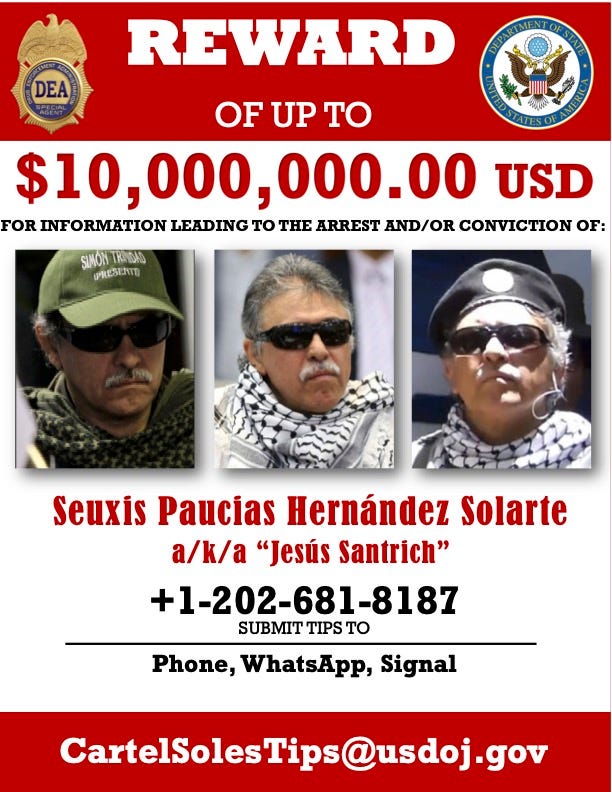
A U.S. bounty poster for Jesús Santrich.
A $10 Million Bounty
In March 2020, a separate indictment naming Santrich, Márquez, and Maduro was unsealed in the Southern District of New York. It accused them of narco-terrorism, cocaine importation conspiracy, and possession of machine guns and destructive devices, among other charges. Maduro was accused of providing cover for Santrich and Márquez. That summer, the U.S. government placed a $10 million bounty on Santrich’s head.
Eleven months later, the bill came due. An informant inside a Segunda Marquetalia camp deep in the South American jungle betrayed his leader.
The informant sent pictures and Santrich’s exact location to his Colombian military handlers, according to Colombian news reports. He warned the military officers that if they wanted to kill Santrich, the time was now—the 53-year-old guerilla leader was bidding his comrades goodbye before heading to another rebel camp.
The Colombian military commandos quickly gathered their guns and explosives. It is unclear whether Santrich was in Colombian or Venezuelan territory, but as his convoy left the camp, the commandos descended on the guerillas. A loud explosion disoriented the group, and rapid gunfire began striking Santrich’s convoy. A brief firefight ensued, but the guerillas were no match for the well-armed commandos. When the shooting stopped, Santrich lay dead on the ground.
A Colombian soldier approached Santrich’s body and took a picture. Then he bent down and cut off the guerrilla leader’s left pinky finger. The commandos quickly left for Bogotá, taking Santrich’s finger with them.
On December 1, 2021, with the official FARC having demobilized and entered mainstream politics, the Biden administration removed the FARC from the U.S. terrorist list. That same day, they added two new Colombian groups: the Segunda Marquetalia and the FARC-EP, another FARC splinter group. The Segunda Marquetalia controls part of the drug route along Colombia’s border with Venezuela, and often battles other guerrilla and paramilitary groups for territorial control, according to organized crime analysts. The Segunda Marquetalia was accused of orchestrating the high-profile assassination last year of a right-wing Colombian senator.
Under left-leaning Colombian President Gustavo Petro, the Santrich case has received new attention. Before taking the presidency, Petro in 2020 called the DEA and attorney general’s operation an “entrapment” that violated the peace accords. Just this year, he reiterated the claim on social media.
In August 2024, three years after the Colombian military killed Santrich, the UN released its report detailing how the Santrich case and the snubbing of JEP officials had impeded the implementation of the Colombian peace accords. The Santrich sting “may have involved the use of an agent provocateur,” the UN report says, but it stops short of naming the “undercover agent” or connecting them to the DEA and Justice department.
The special investigator who wrote the UN report, Antonia Urrejola, did not respond to multiple requests for an interview.
Petro’s government has tried to initiate dialogue with criminal groups under its program of “Total Peace.” Those discussions, including with groups like the Segunda Marquetalia and the National Liberation Army, have failed so far. Caracas served as the staging ground for negotiations between the Colombian government and the Segunda Marquetalia, but talks have slowed due to internal splits within the rebel group. Petro’s government announced in March that since November 2024, there have been no further peace negotiations with the group. “The Segunda Maquetalia was born of an entrapment of the peace process,” said Petro, according to the same announcement, “through a false-flag operation with DEA agents.”
From Drop Site News via This RSS Feed.