

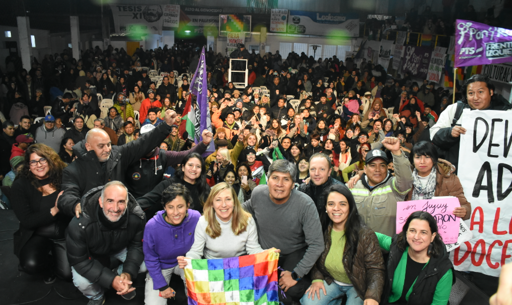
In San Salvador de Jujuy, in Argentina’s northwest, hundreds assembled alongside left-wing political leaders in a rally that reflected growing resistance to the far-right government of President Javier Milei. In attendance were Myriam Bregman and Alejandro Vilca, popular Trotskyist politicians and members of Left Voice’s sister organization, the Partido de los Trabajadores Socialistas (PTS).
Delegations of teachers, rural workers (most notably sugar and citrus workers), public employees, university students, artists, Indigenous communities, and left-wing activists traveled from across Jujuy and neighboring provinces to attend the event. The rally expressed mounting social anger in one of the country’s most unequal and historically marginalized regions.
The event was organized by the PTS, which in recent months has seen a surge in popularity of its public political leaders, including Bregman, due to their presence in every struggle against the austerity program of Milei and the Far Right.
Argentina’s Northwest: Poverty, Extraction, and Inequality
Argentina’s northwest — known as the NOA region — presents a very different reality than the metropolitan glamour that outsiders often associate with Buenos Aires.
The NOA includes provinces such as Jujuy, Salta, and Tucumán, regions marked by deep social inequality, agricultural labor, and extractive industries such as lithium mining. Despite containing enormous natural wealth, the region also suffers from some of the country’s highest poverty and labor precarity rates, and is home to many Indigenous communities.
In Jujuy, many workers depend on seasonal or informal labor tied to sugar, citrus, and other rural work, as well as state employment. Entire generations of young people grow up facing unstable employment, low wages, migration pressures, and deteriorating public services.
Under Milei’s austerity government, these conditions have only worsened.
A Generation Marked by Precariousness
Youth participation was one of the defining features of the rally.
Argentina’s youth are experiencing a profound social crisis. Around 90 percent of young workers face some form of labor precarity, while more than 42 percent of the region’s population lives in poverty. For many young people, stable employment, independent housing, and long-term planning increasingly feel out of reach.
Among students and young workers, exhaustion and uncertainty coexist with growing politicization.
Over the years, university and high school students have marched alongside workers’ delegations carrying banners against austerity, layoffs, and attacks on public education. Many are the first generation in their families to access higher education, even as public universities face severe funding cuts.
Across the NOA region, many young people are gaining political experiences not only through protests against austerity, but also through efforts to rebuild unions, organize democratic student centers, and develop a feminist movement rooted in working-class struggle.
For disabled and neurodivergent youth, the situation is often even harsher. Access to healthcare, transportation, education, and employment remains deeply unequal, especially outside major urban centers. In provinces like Jujuy, where public infrastructure and mental health resources are already limited, austerity policies deepen existing exclusion and instability.
This social crisis is not abstract. It appears in overcrowded hospitals, precarious jobs, underfunded schools, and the growing impossibility of imagining a future.
Resistance Beyond Buenos Aires
The rally also reflected the political importance of organizing outside Argentina’s capital.
National political coverage often centers Buenos Aires, but some of the country’s most important social conflicts in recent years have emerged in the northwest. Jujuy became internationally known in 2023 when Indigenous communities, teachers, students, and workers faced intense state repression while fighting against constitutional reforms promoted by former governor Gerardo Morales.
Vilca’s presence at the rally carried particular significance in this context. A garbage worker of Indigenous origin who became one of Argentina’s most recognized socialist legislators, he represents a political tradition rooted in working-class and Indigenous struggles.
Meanwhile, Bregman emphasized the need to confront Milei’s attacks on workers, retirees, women, and public education throughout the country and through collective organization and socialist politics.
The tensions are also reflected in growing attacks against left-wing and youth representatives. In recent months, sectors linked to President Milei’s La Libertad Avanza have pushed for the removal of Keila Zequeiros, Jujuy’s youngest city councilor and a representative of the PTS who is most known for her role in student and feminist struggles. For many activists, the attempt is part of a broader strategy to intimidate opposition voices amid deepening social unrest.
In Argentina’s northwest, where poverty coexists with immense natural wealth and multinational extraction projects, resistance is taking shape. That resistance is no longer expressed only through isolated protests, but through a new generation gaining political experience in workplaces, universities, unions, feminist organizations, artistic spaces, Indigenous communities, and in the streets.
As Milei deepens austerity and repression, the struggle emerging in provinces like Jujuy points toward a broader confrontation between far-right politics and a collective working-class fightback.
The post From Argentina’s Northwest, Workers and Youth Rally with Trotskyist Political Leaders Against Milei appeared first on Left Voice.
From Left Voice via This RSS Feed.