

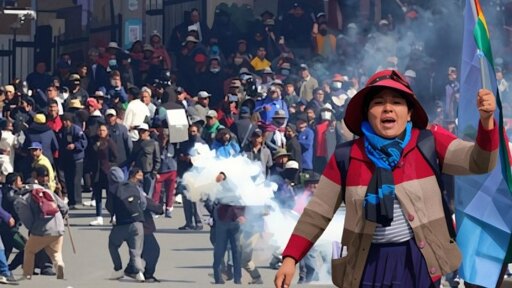
Over the past few weeks, the key question in Bolivia has been whether we are witnessing the beginning of a counteroffensive in the streets against the new right-wing wave in Latin America.
President Rodrigo Paz has been in power for just over six months and is already facing a rebellion that has been brewing since the beginning of the year, despite government repression and the labor bureaucracy’s betrayal of the rank and file. His administration is planning to raise fuel prices and attack education and health care while cutting taxes for big business. It is also seeking to encroach on peasant and indigenous lands, plunder lithium, and deepen the country’s subjugation to the IMF and imperialism. But resistance has been fierce: from December to January, the country saw three weeks of roadblocks and demonstrations. Now it is facing a full-scale rebellion of workers, peasants, and the masses.
On May 16, the government’s repression against these mobilizations left four dead. But the outcome was the opposite of what the Paz government intended: the next day, there were even more roadblocks, and the following Monday, a massive march descended from El Alto to La Paz with the slogan “Paz Out.” From May 22 to 24, more protests and roadblocks took place across the country, which the government failed to break up thanks to worker resistance. On the 25th, a new day of mobilization took place from El Alto to La Paz — the largest in recent weeks — incorporating new sectors into the conflict.
The Trump administration has come out in full force to back Paz, as have Israeli prime minister Benjamin Netanyahu and Argentinean president Javier Milei; the latter is sending Hercules transport planes to aid the Bolivian government. This support is unsurprising, given that what is happening in Bolivia raises the prospect of defeating pro-imperialist, right-wing governments in the streets. Amid imperialism’s growing offensive in the region, the U.S. fears that the Bolivian rebellion could take down one of its pawns. This must also be understood in the context of competition with China, as Washington seeks to reassert geopolitical control over what it has long considered its backyard. And Bolivia is a strategic area: it forms part of the Lithium Triangle, along with Chile and Argentina.
With his new National Security Strategy, Trump has launched his own Monroe Doctrine. In Venezuela he established a quasi-protectorate with the help of Delcy Rodríguez. Now he is putting extreme pressure on the Cuban people, who might possibly face a direct attack. On May 20 there was a two-pronged operation: Raúl Castro was charged with murder over the downing of two light aircraft in 1996, and the aircraft carrier USS Nimitz was deployed to the Caribbean.
Trump has been weakened by his defeats against Iran and is facing significant opposition at home; his approval rating stands at a low of 35 percent. The decline of U.S. hegemony is accelerating, which is driving the country toward more aggressive interventions against the peoples of the region. A defeat of the Paz government in the streets would, in this context, be a severe blow to the region’s ruling classes and to U.S. imperialism.
Paz, Milei, Kast: Three Faces of the Same Troubled Offensive
If we look at the broader regional picture, the question is whether the right wing’s project of imperialist subordination is beginning to crack across the southern part of the continent.
Milei, Kast, and Paz are three faces of the same imperialist offensive, and all three are already in trouble. Kast took office just over two months ago and already has a 58 percent disapproval rating. In Argentina Milei’s disapproval rating is hovering around 65 percent. Paz, too, has seen his popularity erode rapidly, as evidenced by the rebellion in the streets. These governments are increasingly in crisis but nonetheless continue on the attack.
In Chile in the face of attacks through fuel price hikes and cuts to education, the student movement — a major player in Chilean politics — is returning to the streets. The country is emerging from the 2019 uprising, which chanted “Out with Piñera” against the then-president but was ultimately curtailed by the union bureaucracy and former president Gabriel Boric’s Broad Front. Meanwhile, in Peru, the student movement has been leading extensive university occupations this month, demanding democratic reforms against university authorities. The country is undergoing a deep political crisis, with a delegitimized regime stemming from the institutional coup of 2023.
In Argentina, where Peronism and the labor bureaucracy have been key in enabling Milei’s attacks, many sectors are drawing progressive conclusions, which are expressed in the growing political sympathy toward Myriam Bregman and the Trotskyist Left. The rebellion in Bolivia is the most explosive part of this broader regional phenomenon. The strategic question of how to defeat the offensive of the Right and imperialism is becoming increasingly concrete.
“Democracy” and the Right to Rebellion
Meanwhile, Brazilian president Lula, one of the organizers of the recent progressive summit in Barcelona, is expressing solidarity with the Paz government, which the popular rebellion in Bolivia seeks to overthrow, calling for “full respect for democratic institutions and the rule of law.” We must not forget that these right-wing forces came to power thanks to the failure of reformist and post-neoliberal governments. That is to say, the failures of Boric in Chile, Peronism in Argentina, and the MAS governments in Bolivia all paved the way for these reactionary leaderships by channeling mass-movement organizations into the state.
The Latin American right wing and imperialism claim that what is happening in Bolivia is an attempted coup d’état, and they accuse Bolivian workers and peasants of disrespecting democracy by demanding Paz’s resignation. For them, “democracy” means that the people simply vote every four or five years, while everyday decisions are made by the agents of imperialism, the business owners, and the landowners — the true holders of power.
In the last elections, many voted for Paz and Vice President Lara against far-right candidates like Tuto Quiroga, but as soon as he took office, Paz launched a brutal austerity plan, revealing what the ruling classes understand by “democratic.” As the self-organized blockade committees rightly point out, the real “coup plotters” are the government — because they deceived the people by implementing a program different from what they promised.
Bolivia’s recent history has seen repeated processes of great radicalism, yet they were pushed out of the picture through a combination of political maneuvers and repression. Today, we’re seeing a workers’ and popular rebellion because those at the bottom no longer want to endure utterly degraded living conditions. Bolivia’s deep-seated racism is a key factor driving the rebellion: the recent burning of the Indigenous peoples’ flag, the Wiphala, has contributed to the proliferation of roadblocks.
The Bolivian people have a right to rebellion, and only through it is there a chance for the majority to determine their own destiny. The crucial question is how to prevent that force from being diverted, contained, or defeated once again.
Combining Popular Rebellion with a General Strike
What we are witnessing in Bolivia and across Latin America points to the emergence of a new situation in the region. Within this framework, fundamental strategic discussions are resurfacing that demand deeper exploration. There is a pattern running through all the uprisings of the recent period: mobilizations erupt, and immediately the problem arises of how to prevent the demobilization driven by union and social bureaucracies. This is not a minor detail; it is the crux of the strategic issue.
Breaking this pattern requires addressing a key issue: the coordination of forces and the development of self-organization in the struggle to impose a united front on the major mass organizations. To achieve this, it is essential to build coordinating institutions that bypass the bureaucratic apparatus and unify the sectors in struggle. This is central to successfully combining popular rebellion with the general strike — the main tool the working class has to assert its power, defeat these right-wing governments, and open a path forward in favor of the majority. These are extremely tough struggles that do not happen on their own; hence the importance of a strong revolutionary Left to wage these battles for working-class hegemony.
As the recent statement from the LOR-CI in Bolivia points out, the rebellion of workers, peasants, indigenous people, and the masses is growing, despite the government’s attempts to demobilize it through repression, prosecution, intimidation, and negotiations with traitorous leaderships behind the backs of the rank and file. The bureaucrats who negotiate outside the collective are being rejected from below, as has happened with parts of the Single Trade Union Confederation of Peasant Workers of Bolivia (CSUTCB), the Confederation of Indigenous Peoples of Bolivia (CIDOB), the Teachers’ Union, and the Federation of Neighborhood Councils (FEJUVE) of Southern El Alto. More and more town hall meetings, assemblies, and spaces for self-organization are being created to discuss how to sustain the struggle.
Despite the massive scale of the roadblocks and the enormous popular will, a central element that could truly tip the balance is missing: an effective indefinite general strike with a work stoppage across all sectors of production. This measure was voted on at the COB’s May 1 town hall meeting, but the union’s leadership has yet to implement it. In response to this, representatives of the self-organized blockade committee from District 8, Senkata, rightly pointed out, “We are putting our bodies on the line; we are already fighting. Now we must call on [the miners of] Huanuni, Coro Coro, and Colquiri because they also want to privatize the mines. We have to make the general strike a reality.”
Bolivia as a Laboratory of Class Struggle: Three Provisional Conclusions
Those of us fighting the pro-imperialist right wing in the region can draw several conclusions from the Bolivian rebellion. First, it shows that these governments are not defeated by asking them to respect the democracy they themselves violate as soon as they take office in order to implement pro-imperialist plans, but rather through direct action. While there were statements, communiqués, and “dialogues,” President Paz moved forward with his austerity plan. But when the blockades and mobilizations began — which repression was unable to break — the government entered a deep crisis.
Second, self-organization is the only alternative to the demobilization pushed by the bureaucracies. It is thanks to self-organization — expressed essentially through the blockades and sustained by self-convened committees — that the struggle continues despite the maneuvers of the COB and government repression. The development of these forms of self-organization into higher forms of coordination can begin to bring forces together to impose a united front, growing the struggle and helping implement the general strike to force the resignation of Paz and all the coup plotters.
Finally, direct action and self-organization constantly clash with the bureaucracies’ attempts at betrayal, underscoring the importance of a strong revolutionary party that decisively takes up the fight against the bureaucracy. The goal is to prevent the movement from becoming dependent on the will of the bureaucracy itself and to ensure that the energy unleashed by the masses is not trapped in a cycle of mobilization and institutional containment. It is essential to have a political organization that consistently fights for the independent emergence of a workers’, peasants’, and people’s bloc that takes the lead.
The Bolivian rebellion is not an isolated episode; it is a laboratory where the strategic questions affecting the entire region are being put to the test. If Paz falls, if the general strike takes effect, and if the blockade committees manage to go beyond the bureaucratic apparatus and organize themselves into national coordination, then the effect on Milei, Kast, and the rest of the region’s right-wingers will be inescapable.
What is at stake in Bolivia — and is beginning to play out more broadly across the region — is the possibility of changing the course of history. That is the strategic horizon, and the revolutionary Left must rise to the occasion.
Originally published in Spanish on May 27 in La Izquierda Diario.
The post Bolivia: The Start of a Counteroffensive against the Right-Wing Wave in Latin America appeared first on Left Voice.
From Left Voice via This RSS Feed.