

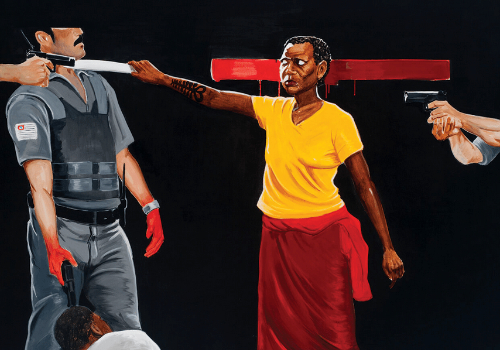
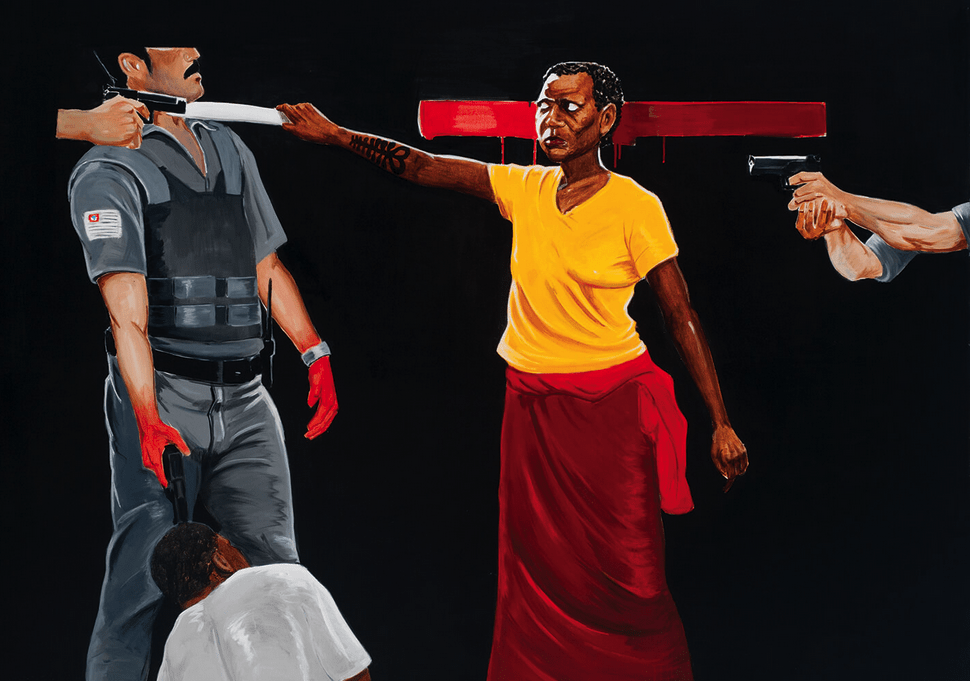
Sidney Amaral (Brazil), Mãe Preta ou A Fúria de Iansã [Black Mother or the Fury of Iansa], 2014.
Dear friends,
Greetings from the Nuestra América Office of Tricontinental: Institute for Social Research.
There is a long, silent, and profitable war being waged in Nuestra América: the war on the poor. Although uniforms, doctrines, or slogans change—ranging from ‘pacification’ to ‘iron fist’ (mano dura) or ‘zero tolerance’—whether under the shield of the ‘war on drugs’ or the ‘war on crime’, the war produced by the inequality of the prevailing economic order is fought to simultaneously criminalise poverty and terrorise the population.
The ‘Angry Tide’ that has recently swept over the governments of Latin America has made combating the region’s perceived security crisis one of its central targets. In its strategy to discredit Latin American progressivism, the new right presents leftist forces as inefficient and incapable—even as accomplices—of criminality. Frequently, political debates use polls that reveal crime as one of the main concerns of the electorate in the region and even point out that, for this reason, the population has been favoring governments that promise a harsh and inclement iron fist against delinquency. It is not surprising, in this sense, that even though they are the most affected by policies criminalising poverty, people speak out in favour of fighting crime. According to the AtlasIntel survey, for example, 62 percent of Rio de Janeiro residents supported a police operation that left 121 victims last October. From Kast to Keiko Fujimori, right-wing campaigns have highlighted the fight against crime among their priorities. Uruguayan President Yamandú Orsi himself noted in an interview that 50 percent of Frente Amplio voters also sympathise with Salvadoran President Nayib Bukele. “The right took the banner of security, which is a human right, and monopolised it for a long time,” he added.
Currently, the vast media apparatus presents the so-called ‘Bukele model’ to us as the most effective formula to combat insecurity and organised crime. However, an in-depth analysis leads us to ask: whom does the order he seeks to impose serve, and upon whose bodies is it built? Bukele has built a system through policies of State dismantlement and social precariousness, shielded by the indefinite extension of a state of exception. Today, El Salvador holds the world’s highest incarceration rate, 1,650 people per 100,000 inhabitants. Childhood is criminalised through lowering the age at which children can be tried as adults, collective trials and mass incarcerations are common, and political dissent is persecuted, as in the case of human rights defender Fidel Zavala.
Among the figures that Bukele hides, however, is the increase in poverty to 9.6% or the 10,000 students who have dropped out of school.
This demonstrates that both the existing insecurity and this mirage of order and security end up hitting hardest those who live on the periphery—who, nevertheless, have directed their votes toward tangible solutions rather than more conciliatory and sociological discourses of the regional left. According to the CB Consultora poll from April 2026, Bukele leads regional popularity with a 70.1% positive approval rating, while Lula da Silva hovers around 48.4% support with 49.1% disapproval, and Gustavo Petro barely reaches a 38.2% approval rating. Lula himself has been forced in his campaign to present a plan against organised crime, promising maximum security standards in his prisons.
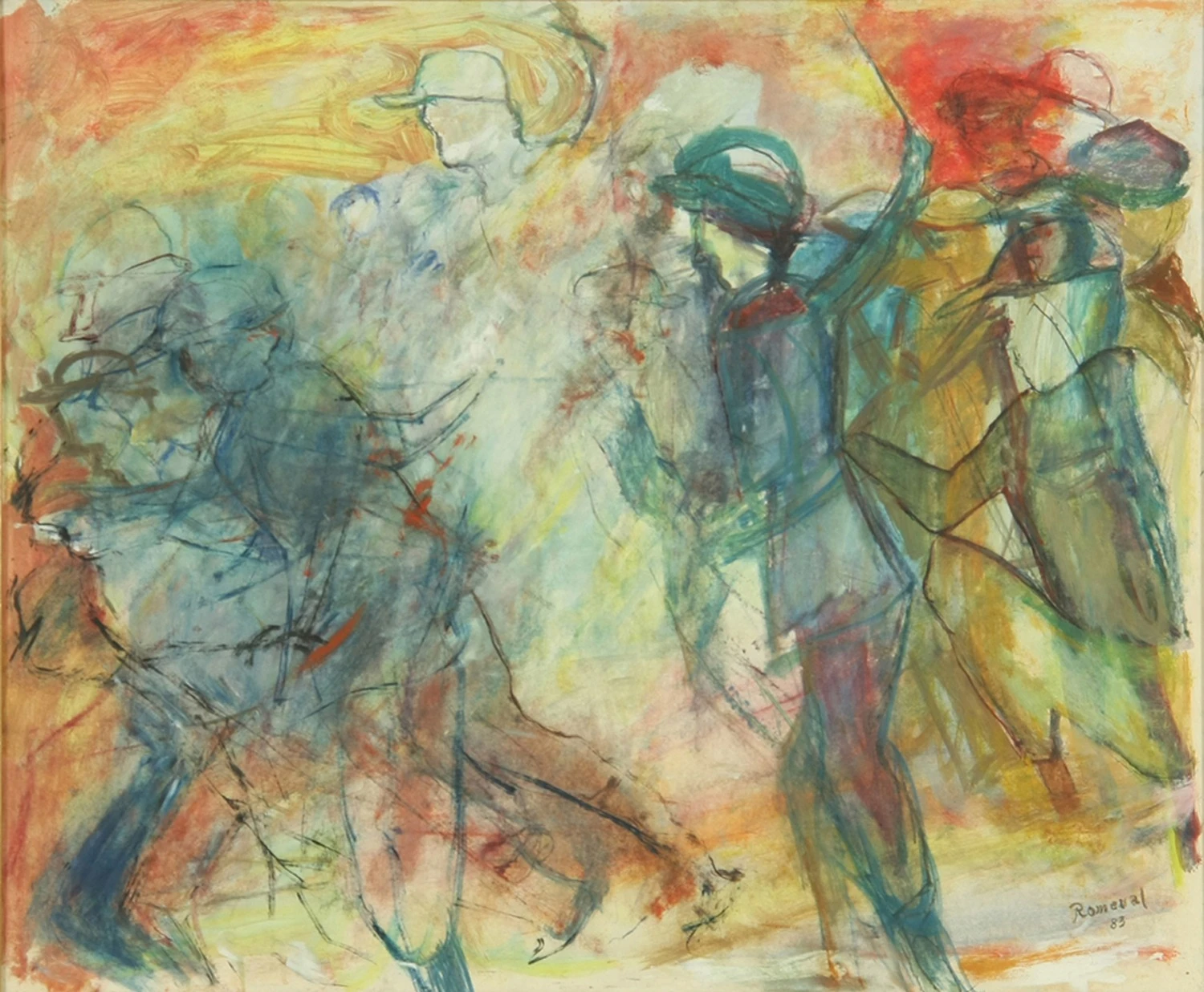
Rosa Mena Valenzuela (El Salvador), Calles [Streets], 1983. MARTE Collection.
This ‘pop authoritarianism’ that cultivates fear, hides behind its repression and propaganda its inability to resolve the structural inequality that leads to poverty and, at times, crime itself. It sells itself as a model against which there is no alternative, and the generation of leaders of the Angry Tide, who seek to restore colonial dominance over the entire region, obediently join the so-called Shield of the Americas, led by the United States as a solution to criminality. But it turns out there are alternatives.
Recently, political scientist Viri Ríos of Mexico Decoded noted that the progressive government of Claudia Sheinbaum has indeed been building a different proposal. In just 18 months, the daily homicide rate has fallen by 41 percent, even though its population is 20 times larger than that of El Salvador and Mexico’s security challenges go beyond gangs and criminal organizations to include large-scale transnational organised crime and drug cartels. Without implementing a state of exception, the Mexican prison population has risen by 11 percent after changing its security policy.
The key, Ríos underlines, is that the strategy does not shy away from directly confronting the sources of crime, equally abandoning the decapitation of cartels—which in previous six-year terms triggered violence exponentially—and the low-confrontation approach that predominated between 2018 and 2024. Mexican policy directly attacks the material causes of delinquency: it seeks, first of all, to halt the sources of crime financing by attacking problems at a national level according to territorial realities: fighting fuel theft in oil-producing areas, supervising customs points in border regions, attacking extortion in the countryside, among others. Ríos acknowledges that structural problems such as corruption persist in Mexico, but notes that despite its limitations, Mexico is managing to reduce criminality based on a policy that does not resort to Bukele’s unchecked violence.
Another experience from the left that is worth studying is that of the Great Peace Quadrants Mission (Gran Misión Cuadrantes de Paz) in Venezuela. Here, another decisive conceptual key is provided: the territorialization of security under a preventive logic and joint work between the community and police forces, instead of a prison-centric logic. According to official figures, the homicide rate dropped from 56 per 100,000 inhabitants in 2016 to nearly 4 in 2024. By the end of 2025, authorities reported a reduction of more than 25 percent in murders compared to the previous year.
What the Peace Quadrants model proposes is that a security policy built through organised community participation, working-class neighborhoods, and not against them, as in the Bukele model, can yield effective results. It can serve as a guide for the left, since anchoring security to the construction of people’s power in the territory is more effective than punishment.

Vlady (Mexico), Mecanismo Carcelario [Prison Mechanism], (1958-1959).
Popular forces that want to dispute the electoral field in the coming years must study these solutions thoroughly and also build their own proposals. First, the issue of security cannot be ignored because it is not a whim of the elite; it is a real concern of the working population, even if at times the construction of ultraconservative narratives seeks to terrorise the population by magnifying the conditions of criminality in our countries. Security must also be assumed as a right of the working population, and their double vulnerability must be recognized: being attacked both by crime and by reactionary policies of repression.
Secondly, we must ask ourselves what concrete institutional framework a popular government must build and finance to attack crime—greater professionalization of investigative and security forces? A direct attack on the sources of crime financing and the intermediate ranks that operate it? The construction of a work agenda between communities and authorities in the territory, based on respect and collaboration rather than persecution?
Thirdly, it must be demonstrated that repression and terror, in the long term, exacerbate exclusion and foster criminal practices. Repression is costly, and it is often outsourced to mercenary or, worse yet, foreign forces, which in the long term places national sovereignty at risk.
Addressing security without mirages is fundamental for the healthy development of a society. The popular camp cannot ignore this challenge, nor minimise it. But it must, above all, convince the population that it does have a viable alternative that implies neither the dismantling of the State nor deadly repression; an alternative that, on the contrary, invites the working class to be part of its own security strategy.
The debate is open. We would like to hear your opinions.
Affectionately,
Carmen Navas Reyes and Carlos Ron
Tricontinental Nuestra América
| Carmen Navas Reyes is a researcher at the Tricontinental Institute for Social Research. She is a Venezuelan feminist and former diplomat. Her research interests include democracy and political systems, social movements, the history of the African diaspora, and Afro-descendance. |
| Carlos Ron is co-coordinator of the Nuestra América office at the Tricontinental Institute for Social Research. He is a Venezuelan former diplomat who served as Vice Minister for North America (2018–2025) and President of the Simón Bolívar Institute for Peace and Solidarity Among Peoples (2020–2025). |
From | Tricontinental: Institute for Social Research via This RSS Feed.
You must log in or # to comment.