

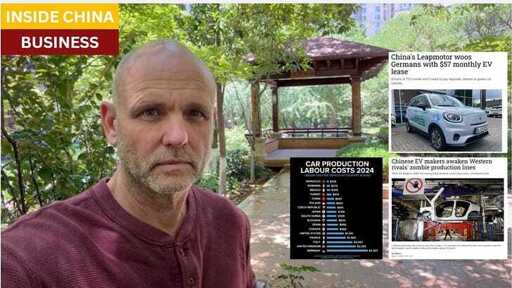
Bullets:
Chinese EV companies enjoy enormous advantages in cost and scale, compared to automakers in Europe.
Nevertheless, some Chinese brands are scooping up closed production lines and factory capacity in Europe.
The motivation is primarily to avoid the European Union’s high tariffs and regulations on cars inbound from China, and new policies on vehicles qualifying for government subsidies.
Skeptics point out that Chinese electric vehicles are taking over European markets right now, even while passing the high tariffs along to buyers. Further, that Europe’s high cost structures and regulatory environment represent real challenges for Chinese carmakers hoping to keep prices low.
Inside China / Business is a reader-supported publication. To receive new posts and support my work, consider becoming a free or paid subscriber.
Report:
Good morning.
Manufacturing industries in Europe are dying. Automakers and chemical companies are closing production and laying off in Europe, to invest in new capacity and headcount here in Mainland China. One of the primary drivers of that is the cost of electricity; Western Europe has some of the most expensive power bills in the world.
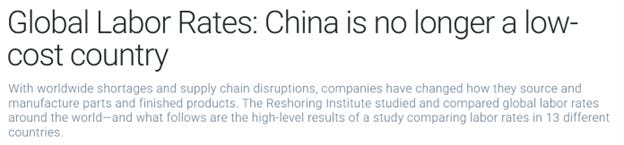
Labor costs are also far higher in Europe, compared to China and other countries in Asia. This is from the Reshoring Institute. The mission of the Reshoring Institute is to help companies set up in the United States, and pull manufacturing back to the US. This table is called “China is no longer a low-cost labor country”, and we can only wonder why they published it at all.
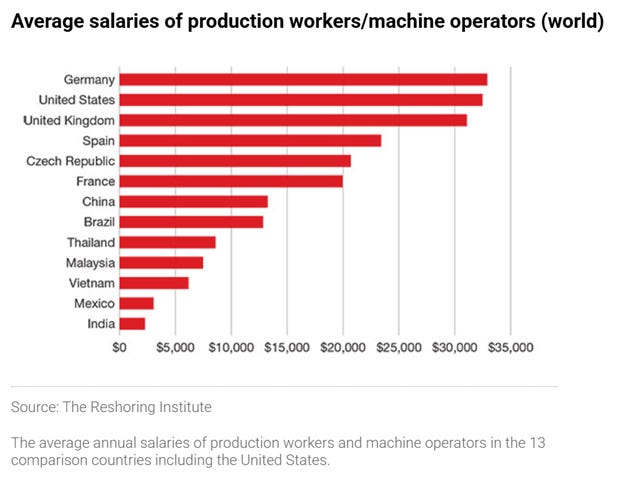
Only Germany has higher labor costs for manufacturing workers than the United States, and China’s salaries lower by more than half. Other countries in Asia are lower still. It’s hard to see why these data would serve as motivation to relocate factory production from China to the United States. Or to Europe.
Ironically though, Chinese carmakers are considering exactly that. Chinese electric vehicles are blowing up markets everywhere, and taking over everywhere they are allowed to be sold. Chinese companies tend to be vertically integrated, and their EV industry has monopolies on the supply chains for everything that goes into making batteries for electric vehicles.
Chinese carmakers are crunching the numbers and concluding that they can probably—probably—make more money by buying up factories in Europe, that automakers there are shutting down, and cutting excess capacity.
Volkswagen previously was building12 million cars a year, worldwide. They are cutting that down to 9 million. So VW capacity that was turning out 3 million cars a year will be idled, and they are looking for their Chinese partners to move in.
Ford Motor Company has a factory in Spain. Geely is planning to take over one of those lines.
To Chinese carmakers, it’s a complex math problem. European labor costs are lot higher. European power bills are a lot higher. So these companies are trying to solve the problem of import tariffs, on cars built in China and sent to Europe.
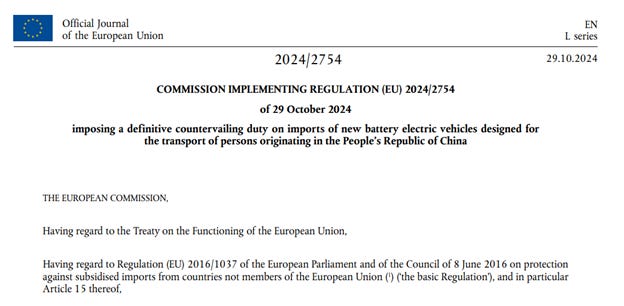
This document is the tariff schedules and rules on Chinese cars. It runs almost 200 pages, and the summary is here. The base import duty on Chinese vehicles is 10%, and these are the “countervailing” tariffs, which are added to that 10% baseline number. So the new tariffs on Geely car imports, for example, are 18.8%, plus 10%, for an effective tariff rate of 28.8%:
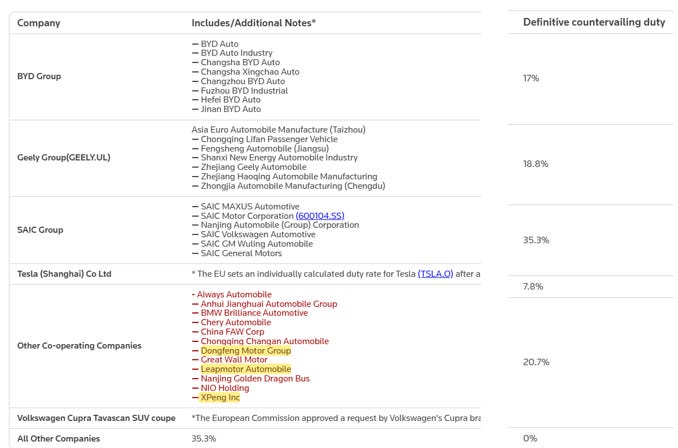
Leapmotor is also expanding in Spain, and they’re at 30.7%; once again, they’re at 20.7% plus the original 10%. So that math is already part of the decision making for these companies.
Then there is this: a proposed new regulation that says electric vehicles need at least 70% of their components—excluding the batteries— to be sourced in the European Union to qualify for government subsidies. So when that becomes law, carmakers can still buy and ship the batteries from China, while meeting the 70% requirement by building locally.
By doing that, government subsidies can be applied to the purchase of Chinese electric cars.
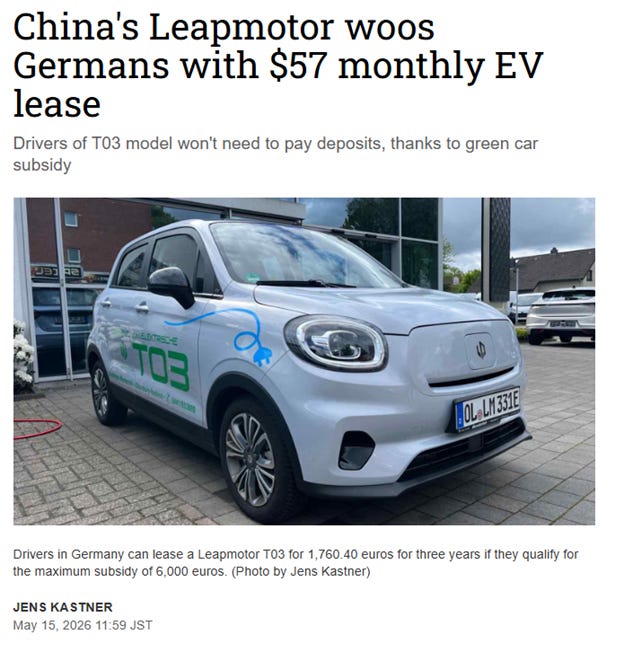
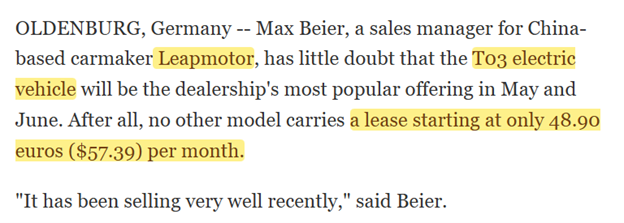
Here is a nuts-and-bolts example of how that works now, compared to what’s coming later. Leapmotor is offering this car for sale, the T03. European buyers – lessees, sorry-- don’t need to pay a deposit, and can make a lease payment of $57 – 49 euro – per month, for three years. This car is built in China. All of it. So when those new rules go into effect, this won’t work. Those 36 months times 49 euros means that they can drive this car for less than they would pay for a high-end bike.
This is an extreme example, to be sure. But there’s a big difference between driving off with that car for 49 euros per month, versus a down payment of 6,000 euro, then 49 euro per month. Then it’s not like buying a nice bike, and that’s the math that is driving some of these Chinese brands to buy up factory capacity from the Europeans, who already can’t make the math work in their own businesses.
There are skeptics, both here and in Europe. This auto industry analyst is dismissive of the whole idea. The costs will going up, a lot, and the Chinese are going to find out how hard it is to do business in Europe. New, higher labor costs, and the cost to build out new supply chains in Europe to meet the 70% component requirements.
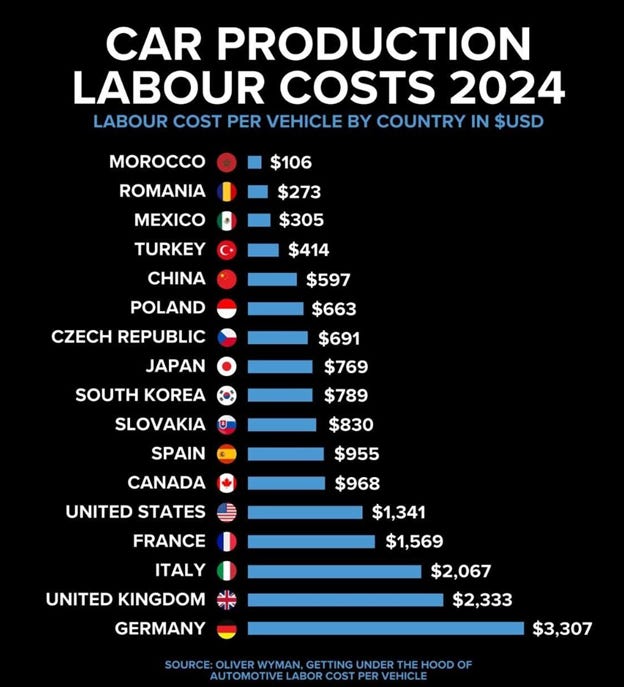
In 2024, the labor costs for cars built in China was under $600, on average. That’s less than Poland, less than efficiency-obsessed Toyota. Spain was at $955. Per car labor cost in Germany is over $3300, or five times higher than China:
Foreign investment in these joint ventures is capped at 49%, so we do see a lot of these announcements at 51-49%. And that’s true here in China, too—where it’s the other way around. That’s not the problem. But the proposed new regulations for Europe will mandate half the workforce be European and include technology-sharing requirements. So the Citigroup guy is saying that nobody should be too excited, just yet.
There is also hesitancy on the Chinese side. Chinese carmakers are growing market share in Europe, right now, while just passing along the higher tariffs to end buyers. China is killing everyone else on EV’s, and that was BEFORE the war on Iran doubled gas prices for everyone in the world. So why hurry?
That may be what industry insiders here are thinking. It’s true that buying an existing factory saves time, and saves upfront costs compared to just building one from scratch. But what if European carmakers shut down capacity even faster, now that internal-combustion engine cars are even faster falling out of favor? Could Chinese companies just wait until prices fall some more? Or wait, and see if the European Union decides that it’s more important to get car buyers into electric vehicles—no matter where they come from—instead of buying fuel-burning vehicles made in the EU?
And the upfront cost savings shouldn’t be assumed either. Elvis Cheng is a top executive at Xpeng, and he’s got another problem: Xpeng wants to expand production in Europe and is talking to VW and other European companies, but the factories are so outdated that Xpeng may be better off just building a new one.
All that is happening here, in Europe, and in automotive in particular, is counterintuitive at first glance. Europe is de-industrializing, and companies there are moving to China. Yet Chinese companies and investments are also heading the other way. Chinese investment into the EU was at a seven-year high last year and was 25% of total outbound FDI. It was a 67% increase from 2024, and a big chunk of it went to the supply chain for electric vehicles.
“Greenfield Investment” is what Elvis at Xpeng is thinking about—building facilities from the ground up—that number was up 51%. Looking at some of those data, here—large greenfield investments for EV battery plants, from CATL and CALB. BYD opened an EV plant in Hungary. And going back to the tariff table, BYD enjoys the lowest tariff rate of all the Chinese car brands.
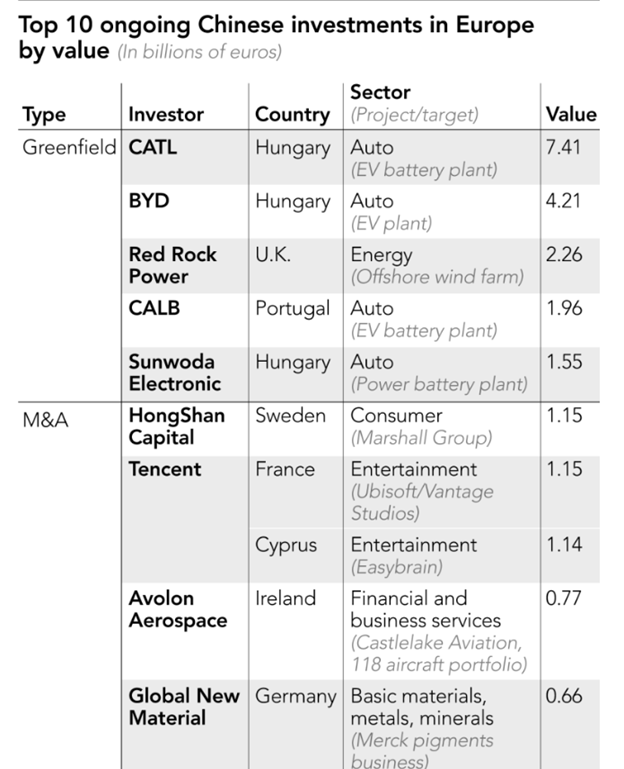
Hungary was also the first European country to join China’s Belt and Road Initiative, and so factories there can easily plug in to Mainland China supply chains, logistics, and banking systems. That’s over 12 billion euro in new greenfield FDI, just for Hungary.
There are a lot of moving parts here, and the skeptics are right to wonder just how much will result from all these discussions and negotiations. Because going back to that Leapmotor example, again. Right now the German subsidy is 6,000 euro, so drivers sign a 36-month lease for 49 euro a month. Suppose that subsidy goes away, for those cars that come in from China. Spreading out 6,000 euro over 36 months plus the 49 would mean about 220 euro a month.
It’s not apples to apples; the 6,000 euro are paid up-front, directly to LM by the German government, and no need to write to me and point it out. But charging the 6,000 euro to the lessees is still more affordable than anything coming out of a VW or Stallantis factory in Europe right now. But how much will that car cost Leapmotor to build in Europe, given all the higher costs and mandates?
Be Good.
Resources and links:
Mapping the impact of industrial decline on European regions
https://single-market-economy.ec.europa.eu/publications/mapping-impact-industrial-decline-european-regions/_en
The Deindustrialization Of Europe In Five Charts
[ Robert Bryce
The Deindustrialization Of Europe In Five Charts
The headline on a February 9 Bloomberg article concisely sums up Europe’s unfolding disaster: “Germany’s days as an industrial superpower are coming to an end.” The article says, “Manufacturing output i…
Read more
2 years ago · 411 likes · 41 comments](https://robertbryce.substack.com/p/the-deindustrialization-of-europe)
The Reshoring Institute: Our Mission
https://reshoringinstitute.org/our-mission/
Electricity price statistics
https://ec.europa.eu/eurostat/statistics-explained/index.php?title=Electricity\_price\_statistics
China took over another $5 trillion industry, and Europe is moving money and jobs
Global EV Sales Top 20 Million as Europe and China Lead Electric Car Boom
https://electriccarsreport.com/2026/05/global-ev-sales-top-20-million-as-europe-and-china-lead-electric-car-boom/
Cheap and sleek Chinese EVs turn European heads
https://asia.nikkei.com/business/automobiles/electric-vehicles/cheap-and-sleek-chinese-evs-turn-european-heads
China’s Leapmotor woos Germans with $57 monthly EV lease
https://asia.nikkei.com/business/automobiles/electric-vehicles/china-s-leapmotor-woos-germans-with-57-monthly-ev-lease
Stellantis and Dongfeng form EV joint venture for Europe
https://asia.nikkei.com/business/automobiles/electric-vehicles/stellantis-and-dongfeng-form-ev-joint-venture-for-europe
China’s investment in Europe hits 7-year high, still far from peak
https://asia.nikkei.com/economy/china-s-investment-in-europe-hits-7-year-high-still-far-from-peak
Chinese EV makers awaken Western rivals’ zombie production lines
https://asia.nikkei.com/business/automobiles/chinese-ev-makers-awaken-western-rivals-zombie-production-lines
Global Labor Rates: China is no longer a low-cost country
https://www.logisticsmgmt.com/article/global/_labor/_rates/_china/_is/_no/_longer/_a/_low/_cost/_country
As Chinese EV makers expand in Europe, are local automotive suppliers set to benefit?
https://www.scmp.com/business/china-evs/article/3354764/chinese-ev-makers-expand-europe-are-local-automotive-suppliers-set-benefit
COMMISSION IMPLEMENTING REGULATION (EU) 2024/2754 of 29 October 2024, countervailing tariffs on China-built vehicles
https://eur-lex.europa.eu/legal-content/EN/TXT/PDF/?uri=OJ%3AL\_202402754
EU tariffs on imports of China-made EVs
https://www.reuters.com/world/china/eu-tariffs-imports-china-made-evs-2026-02-11/
China’s SAIC Motor plans EV factory in Spain, Bloomberg News reports
https://www.reuters.com/world/china/chinas-saic-motor-plans-ev-factory-spain-bloomberg-news-reports-2026-04-24/
Stellantis and Dongfeng in $1.2 billion deal to make Jeeps, Peugeots in China
https://www.reuters.com/world/china/stellantis-dongfeng-sign-117-billion-deal-build-peugeot-jeep-vehicles-china-2026-05-15/
Inside China / Business is a reader-supported publication. To receive new posts and support my work, consider becoming a free or paid subscriber.
From Inside China / Business via This RSS Feed.