

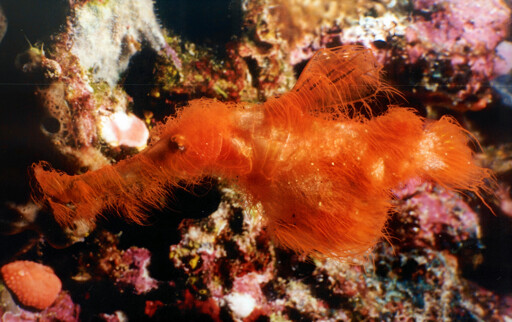
It’s “hairy,” bright orange or red and “exceptional” at camouflaging. Meet the hairy ghost pipefish, whose recent formal description demonstrates that even well-studied marine environments like the Great Barrier Reef still hold remarkable secrets for science. In a recent study, researchers shared the name of the ghost pipefish, Solenostomus snuffleupagus, for its “conspicuously shaggy appearance,” and long, trunk-like snout that makes it resemble the beloved Sesame Street character, Mr. Snuffleupagus. Ghost pipefish, with their long pipe-like snouts, are distantly related to pipefishes and seahorses. But they differ in how they reproduce: while males in pipefish and seahorses brood eggs in specialized abdominal pouches; in ghost pipefish, it’s females who do the same. Found across the tropical Indo-Pacific, ghost pipefish are also very well-camouflaged in their environments of coral reefs, seagrass meadows, and algal beds. Until recently, there were just six known species. The discovery of a seventh species, the hairy ghost pipefish, led by marine biologists Graham Short and David Harasti, is the culmination of a two-decade search. Harasti, a senior research scientist at the Port Stephens Fisheries Institute in Australia, told Popular Science he first spotted the animal in 2001 while diving near Papua New Guinea. “I was perplexed,” Harasti said, adding that after checking his reference books, he realized they “might be looking at something entirely new to science.” Since 2005, local divers had also regularly reported seeing the orange-red animal on the Great Barrier Reef on Facebook groups and citizen science platforms like iNaturalist, the authors wrote.…This article was originally published on Mongabay
From Conservation news via This RSS Feed.