

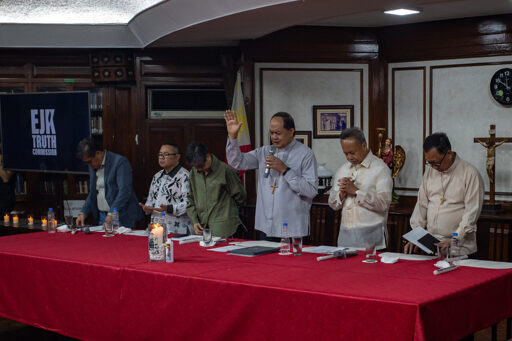
MANILA — A decade after the bloody anti-illegal drug campaign of then president Rodrigo Duterte, civil society groups launched the Philippine Truth and Reconciliation Commission (Truth Commission) on Wednesday, May 27. Families of the victims, however, call for direct and meaningful participation in a body that seeks to document and preserve their narratives.
“We know how to speak the truth. We have been telling our stories for years,” said Jane Lee, wife of drug war victim Michael Lee. “Consultations with the victims and our families must be integral in the process.”
The Truth Commission is a civilian-led independent body to build a credible public record of extrajudicial killings (EJK) survivor testimonies. It is chaired by former International Criminal Court (ICC) judge Raul Pangalangan, guided by Cardinal Pablo David as its Adviser. The commissioners include forensic pathologist Dr. Raquel Barros del Rosario-Fortun, peace and conflict practitioner Dr. Al Fuertes, theologian Fr. Daniel Franklin Pilario, and human rights researcher Carlos Conde.
“The Truth Commission was created to ensure that the stories of victims, survivors, and families are heard, verified, and preserved,” Pangalangan said in a statement. “This is not about replacing the courts or assigning guilt. It is about building a credible truth record that can guide accountability, healing, reform, and the prevention of future violence.”
Cautiously optimistic
Families of the victims during Duterte’s so-called war on drugs are cautiously optimistic with the new body. Rise Up for Life and for Rights called for more disclosure and questioned the lack of victims’ representation in the Commission.
“There is no victim representative. We will have to learn more about how they plan to work before we participate,” said Llore Pasco, mother of two EJK victims Crisanto and Juan Carlos Lozano.
Pasco emphasized that victims’ families had previously lobbied, through a proposed legislative measure seeking the creation of a Truth Commission, for guaranteed representation of victims and relatives in the panel. They also pushed for stronger gender representation, hoping that at least half of the commissioners would be women.
In the newly formed Truth Commission, however, only one woman was named among the commissioners. Fortun is widely known for her forensic work on cases involving human rights violations and drug related killings.
“We have high-regard for some of the civil-society leaders named for the panel. We appreciate that they want to help. We all want the truth to come out. Most of the truth that we need is with the police and other witnesses. Will this body be able to surface such truth?” asked Pasco.
Not a replacement
The Commission will conduct “Public Truth Hearings” to document lived experiences, institutional patterns, historical context, and the social impacts of violence. It may be public, semi-public, closed, anonymized, or representative depending on survivor consent, safety considerations, and risk assessment.
“This is not a replacement to the ICC or our judicial systems,” David said in Filipino during the press conference. “The courts look for criminal liability, but the Truth Commission seeks deeper truth and the voices of the victims, survivors, and families. Many of them are still looking for answers, recognition, and healing.”
The participants of these Public Truth Hearings may include victims, survivors, affected families, community representatives, witnesses, former participants in violence, heads of institutions, government officials, subject-matter experts, academics, historians, researchers, psychosocial practitioners, faith leaders, civil society organizations, and members of the media, subject to informed consent, confidentiality protocols, and survivor-protection measures.
“We do not even have an authoritative list of how many murders are investigated and prosecuted. Our sure record is that there are five cases — these are under the care of the Catholic Church. We cannot confirm what happened to other cases,” said Pangalangan. “The justice system has not responded adequately.”
In a message to Bulatlat, Conde said that the priority of the Truth Commission will be the victims and survivors during Duterte’s anti-illegal drugs campaign since 2016. “There are a lot of Filipinos out there who have not had the opportunity to speak their truth.”
‘Include killings under Marcos Jr.’
Rise Up for Life and for Rights families, together with Hustisya, another organization of families of extrajudicial killing victims and other human rights violations, urged the Truth Commission to include the extrajudicial killing victims under the administration of Ferdinand Marcos Jr.
In the monitoring of UP Third World Studies Center, there are almost 1,200 drug-related extrajudicial killings in the present administration.
“Arbitrary drug lists continue to exist in communities. It is imperative that no one, including the current administration and its State agents, is spared from scrutiny, as the majority of both direct and indirect perpetrators of killings and other rights violations committed in the name of the drug war remain free from accountability,” Hustisya said in a statement.
The insurgency-related extrajudicial killings, Conde said, are something to look into. However, he added that given the enormity of drug war atrocities, the Truth Commission is taking “one step at a time.”
Both Rise Up for Life and for Rights and Hustisya also call for the inclusion of political killings in the past and present administration. During Duterte’s time, more than 400 activists were killed with 21 victims of enforced disappearance. In the Marcos Jr.’s administration, there were at least 135 activists and ordinary civilians killed while at least 20 were forcibly disappeared.
“It is important that these efforts open the floodgates for all information and details into the operations of the Philippine National Police and Armed Forces of the Philippines, who were behind these killings and have been operating systematically upon orders of the Malacañang,” Hustisya added.
The Truth Commission seeks to send recommendations to the Commission on Human Rights (CHR), the National Police Commission (Napolcom), the Department of Justice (DOJ), the National Bureau of Investigation (NBI), and other lawful institutions while maintaining the independent civilian character of the institution. (AMU, RVO)
The post Truth Commission established, EJK families press for inclusion appeared first on Bulatlat.
From Bulatlat via This RSS Feed.