

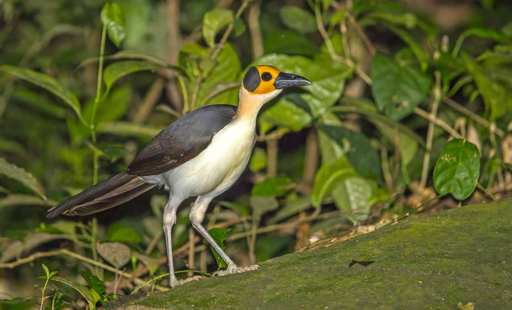
One of the first things H.S. Sathya Chandra Sagar noticed in Gola Rainforest National Park was its profusion of sound. Standing amid the tallest trees he’d ever seen, Sagar could hear the calls of countless birds, the hoot of primates, and in the distance, drumming: chimpanzees, beating fists and sticks on tree roots to check in with faraway friends. The din was a chorus of good news. Sagar, a conservation biologist, had traveled to the Sierra Leone national park as part of his Ph.D. research at the University of Wisconsin-Madison in the U.S. to try and figure out if economic measures aimed at conserving carbon in the Gola Rainforest also helped protect its animal biodiversity. In a study published in Conservation Science and Practice, Sagar and his co-authors find that its noisy soundscape suggests that it does. “We see that if it’s done well, carbon financing initiatives do have the capability to protect both biodiversity, beyond just habitat, and carbon markets,” Sagar says. Gola Rainforest National Park is one of the largest remaining portions of the Upper Guinean Tropical Rainforest, which once covered some 700,000 square kilometers (about 270,000 square miles) of West Africa. After a century of mining and logging, and a devastating civil war in the 1990s, Sierra Leone protected 700 km2 (270 mi2) of this forest that remained within its borders in 2010. In 2012, Sierra Leone established the Gola REDD+ project, a framework created through the United Nations Reducing Emissions from Deforestation and forest Degradation (REDD+)…This article was originally published on Mongabay
From Conservation news via This RSS Feed.