

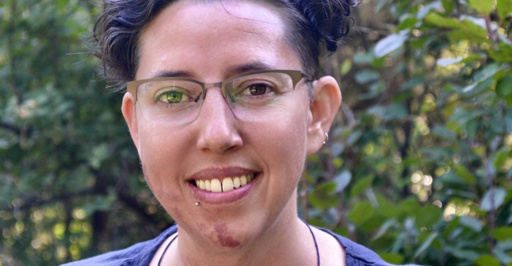
Janine Jackson interviewed UT Austin’s Karma Chávez about assaults on academic freedom for the May 22, 2026, episode of CounterSpin*. This is a lightly edited transcript.*
https://media.blubrry.com/counterspin/content.blubrry.com/counterspin/CounterSpin260522Chavez.mp3
KWTX (5/22/26)
Janine Jackson: The Texas legislature passed Senate Bill 37 in 2025, shifting decision-making power on questions around curricula and degree requirements from faculty to political appointees, in a way described as “unprecedented.”
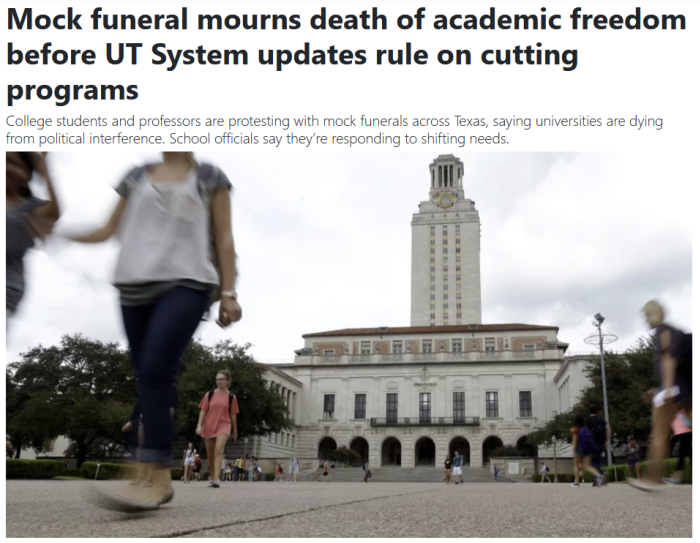
Fast forward to yesterday, May 20, when students of University of Texas at Austin staged a mock funeral, including a horse-drawn hearse, in protest of the death of academic freedom. And that wasn’t the first such protest.
You may not have heard much about SB37 and its impact on education in Texas, but you can guess that the people doing what they’re doing in Texas don’t plan for it to stop there.
Here to help us see what’s happening is Karma Chávez, professor of Mexican-American and Latina/Latino studies at the University of Texas at Austin, and president of the AAUP chapter at UT Austin. (That’s the American Association of University Professors.) She’s author or editor of numerous titles, including, I believe most recently, The Borders of AIDS: Race, Quarantine and Resistance, from University of Washington Press. She joins us now by phone; welcome to CounterSpin, Karma Chávez.
Karma Chávez: Thanks so much for having me.

AAUP (4/10/25)
JJ: It feels like we’re rocketing backward into the past on so many fronts; I’m not surprised when people aren’t keeping up with all of them. But it seems that we can’t overstate the alarm of what’s happening to Texas public universities. I know there’s a lot going on, but what highlights, or lowlights, would you have people know about the effects of SB37?
KC: So SB37 was what we can describe as kind of an omnibus bill that was meant to reorganize, particularly, what we would call faculty governance. Historically at universities, you would govern a university with what they call a tripod. You have a board of regents, a governing board, which are generally either elected or appointed. Then you have administrators, like presidents and provosts and deans, and then you have faculty. And typically, faculty are the ones who are responsible for decisions related to curriculum, as well as populating all the committees that make a university work.
And what SB37 did is it opened the door to ensure that those democratically elected bodies of faculty are no longer allowed in the state of Texas. And so the bill in particular—I guess the law now—says that they can only be up to 50% democratically elected, and the others should be appointed by the chief executive officer. So in Texas, that would be the president of each of the individual universities.
What’s happened in the University of Texas system, in light of SB37, is our board of regents decided to just dismantle faculty senates and faculty councils altogether. And so what that means is we don’t have any democratically elected faculty representatives at all, at any University of Texas campus.
So you might be thinking, “Well, at my job, we don’t have a democratically elected set of employees that run our office.” And I would say, first of all, that’s unfortunate. I think this should be something that all workplaces have.
But in the specific case of the university, one of the reasons why that’s so important is because faculty are the experts in making curriculum decisions, in determining new programs, and determining things like faculty promotions and these kinds of things. And all of that has been taken out of the hands of those who have spent their whole careers becoming experts, and put into the hands of people who have no expertise whatsoever.
Daily Texan (4/25/26)
JJ: And those people with no educational expertise do feel very strongly about some things. And so while this is all couched in “neutrality” and “balance,” we know they have very particular goals, and those goals are showing up in the fallout in terms of what you’re even describing as maybe preemptory compliance or eager overcompliance with the directives of this now law. Concretely, how is it reshaping curricula?
KC: So one of the other things that SB37 did was it suggested or mandated a overall core curriculum review at the different public universities in Texas. Normally that would be done, then, by a body appointed by members of the elected faculty council. That’s not, of course, what’s happening now.
So at UT Austin, where I work, our president, who is not an academic—he actually used to be an attorney in Ken Paxton‘s attorney general office, and then he came to UT to be the vice president of legal affairs, and then the chief operating officer. Now he’s the president, appointed with no search whatsoever last spring.
And what he’s done is he’s created these different appointed bodies to do the work of the university. They’re much smaller than the faculty council used to be. So one of those is a faculty advisory council, and another of those is a core curriculum review committee.
What’s interesting about those two bodies is they have virtually no representation from fields like mine—Mexican-American/Latina studies, Black studies, gender and women studies, that kind of thing—virtually no representation.
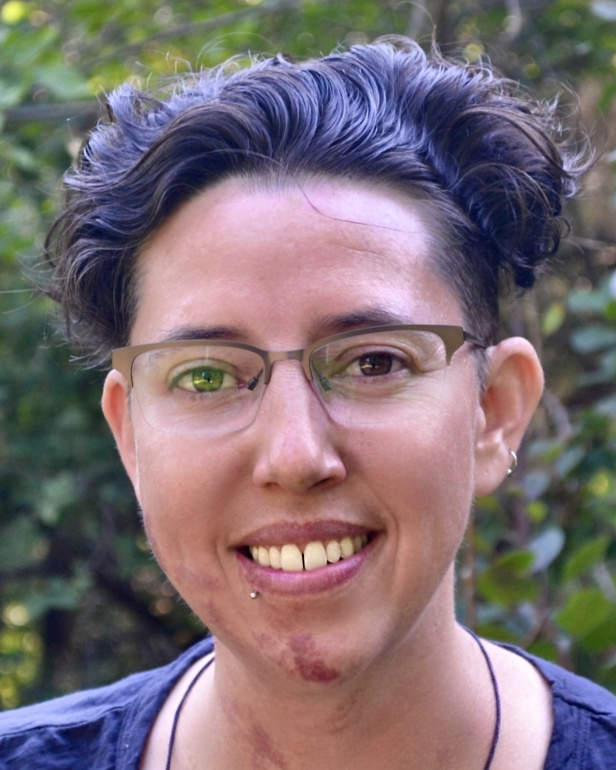
Karma Chávez: “Conservative politicians and their ultra-rich donors are infusing money into universities to create, essentially, conservative think tanks.”
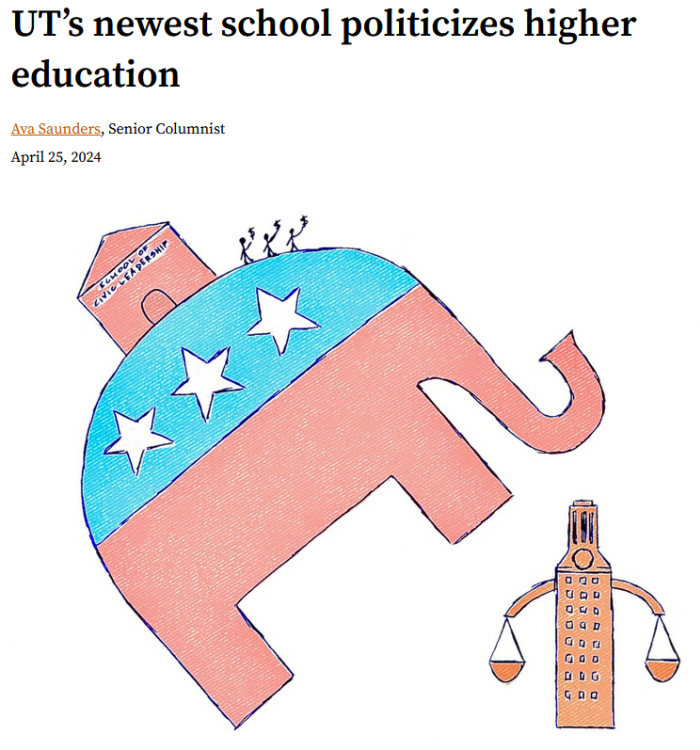
But they’re overrepresented by the new School of Civic Leadership at the University of Texas. So this is a new move that’s been happening over the last several years, where conservative politicians and their ultra-rich donors are infusing money into universities to create, essentially, conservative think tanks. And the goal, I believe, and I think we have a lot of evidence to support this, is to take the core curriculum out of the College of Liberal Arts, and to place it within these new Schools of Civic Leadership, which have as their mission “advancing the value of Western civilization and the importance of the American idea.”
In other words, they think that the College of Liberal Arts at places like UT is far too “woke.” And so conservatives are better equipped to teach in a more disinterested way. Of course, it’s not actually disinterested. It’s promoting a white supremacist view of culture and history.
And so we haven’t received the results of this core curriculum review yet. It was supposed to come out a couple weeks ago. We expect it in the next couple of weeks, but we’re fairly confident that what has happened with our core curriculum historically, as determined by faculty, is going to look very different by this very limited body of people who are reviewing now.
JJ: And have we not seen already the collapse of various race and gender courses being kind of shrunk into one thing, or eliminated across University of Texas?
KC: Unfortunately, it’s not just the University of Texas, although we are certainly ground zero. So one example is my workplace: Again, with virtually no faculty input and absolutely no student input, the College of Liberal Arts has determined that it will eliminate my department, Mexican-American/Latino studies; African-African diaspora studies; women’s, gender and sexuality studies; and American studies.
And so they’re getting rid of those departments, and then they’re shoving all of our faculty into a new Department of Social and Cultural Analysis—which, by the way, is not a field that exists, but essentially I guess it’s to herd all of the woke faculty, as they see it, into one place. That might not seem like a big thing to you, but let me explain why it is a big thing.
One, our fields are very different, so we don’t really know each other’s histories and trajectories, but now we’re going to be voting on each other’s tenure and promotion cases. Two, things like fellowship competitions; we’ve just gone from having four different departments that can nominate people for fellowships down to one department. So we go from four to one. And a bunch of other things such as this, right?
YouTube (5/6/25)
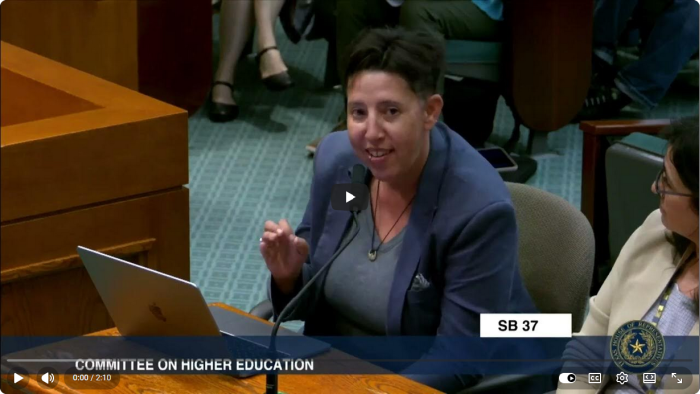
JJ: I watched your testimony at the Texas State House on SB37, and you had to take some time, first, to address some misinformation before you could even offer testimony, including the fact that one person had cited this large number of courses that had “race” or “gender” in the title, which was meant to raise hackles—why those words are inherently a problem to be rooted out is the bigger picture—but the point is, they’d included all the times a single course was cross-listed in order to get to that number. And students were complaining about being “forced” to take classes that were actually electives.
And it’s just to say that, before you got to even talk about freedom to think, and the value of free expression, you had to bat away a number of false ideas that have been sitting at the core of this conversation. And I see that as a representation of the media work and the public conversation work that we have to do around these things. We have to almost dig out the misinformation before we can even speak, yeah?
Texas Tribune (5/17/19)
KC: Yeah**.** I mean, that was such an interesting moment. I was sitting in the audience, rewriting my notes, because one of the things that the Texas Senate and House higher education committees typically do is they invite an expert witness from the Texas Public Policy Foundation. Now the Texas Public Policy Foundation touts itself as if it’s a research institute, but it’s really just an ideological think tank that has scholars who must not be able to do research, based on everything that we see that comes out from them.
And it was actually one of the heads of the TPPF that was saying there were all these classes with “race” and “gender,” and didn’t even bother to look at crosslists. And I’m like, that’s just basic sloppy research that I would downgrade my freshmen students for, let alone someone with a PhD who’s been invited as an expert witness.
But you’re right, that’s exactly what we’re up against. And they never invite actual experts in higher ed, who have a proven track record of peer-reviewed scholarship. And that tells you something, right? That tells you that it’s not about making decisions based on good, evidence-based reasons, but it is about promoting a particular ideology. And I think that’s really dangerous for our students and their freedom to learn.
JJ: Let’s talk, finally, about the resistance, because the students are onto it. They know what’s happening to them, in large numbers, and they’re putting up a fight. What should we know about the resistance from students, and not just students, in Texas, because, as we say, folks are going to be watching.
Texas Tribune (5/27/25)
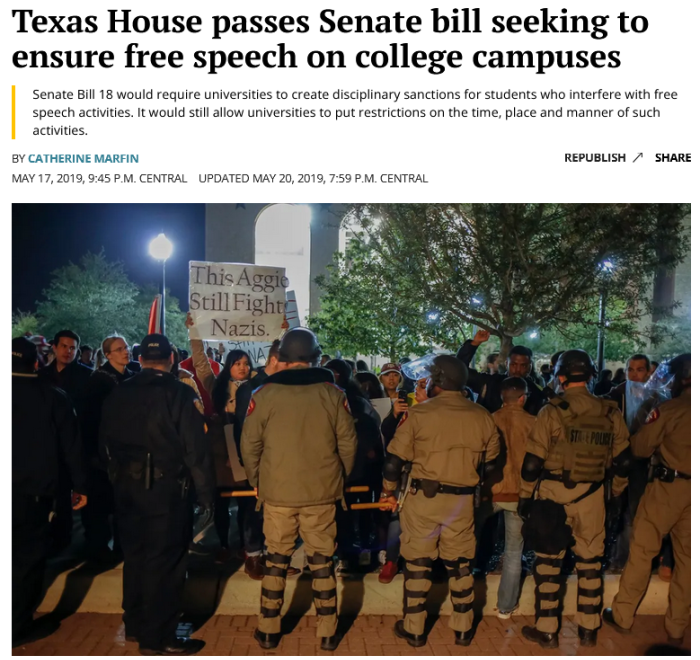
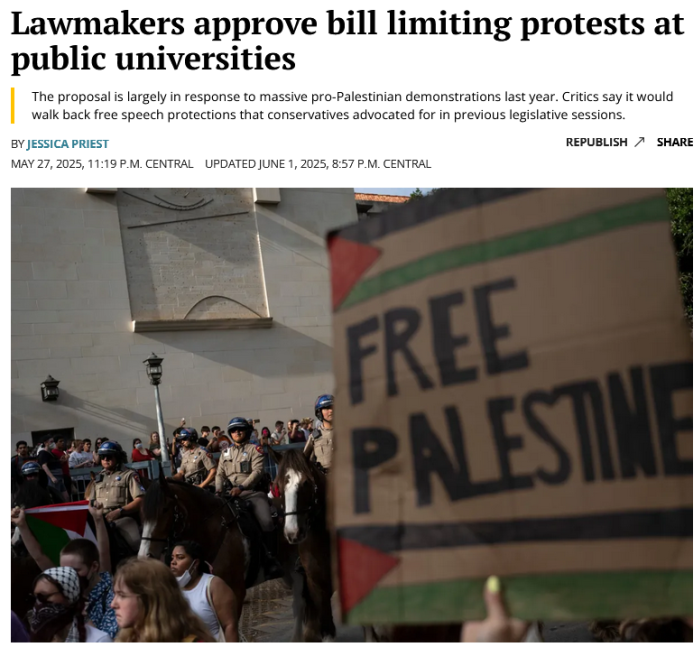
KC: So one thing to say, just preemptively, about that is after the pro-Palestine protests in 2024, the Texas legislature took it upon themselves to pass a rather draconian protest law, to limit student protest on campus. This was after, in 2019, when all these conservative speakers were coming to campus, they passed a very permissive free speech on campus law. So you can see the double standard there.
But despite the fact that they passed the law that makes it a lot harder to protest on campus, we have seen a number of student groups courageously step up and still try to demand something better for their institution. And so, yesterday, a statewide organization called Students Engaged for Advancing Texas, also known as SEAT at the Table, they had this brilliant idea to create a series of funerals to commemorate the death of the various institutions.
So the first one was at Texas Tech, and of course they’re dealing with a really serious situation, as Brandon Creighton, the new chancellor, who used to be the head of the Senate Higher Education Committee, has come in and made sweeping changes, which he’s able to do under SB37, to make it impossible to teach or research about gender and sexuality on that campus.
So they had Texas Tech first, and then yesterday, we had a funeral procession marching through the streets of Austin, here on UT’s campus, and it was a small turnout, it’s summertime, but everybody’s dressed in black, and we had those funny little hats with the veils and the parasols and some really impactful signs. And it just shows that students really care about their education, and they’re really offended by the fact that politicians think that they know better than the students themselves, who, by the way, are not children. These are adults.
New York Times (12/10/25)
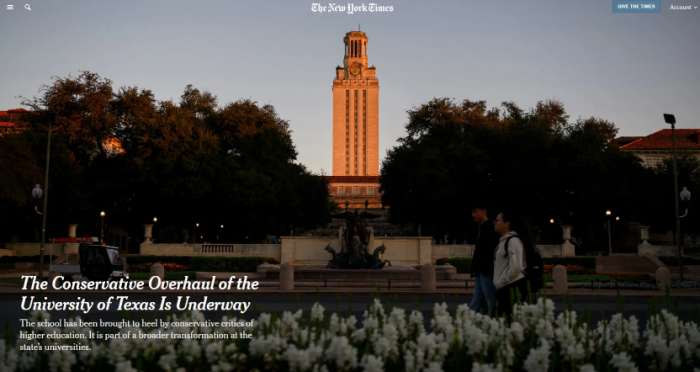
JJ: And I always wonder why an institution that’s an educational institution thinks it’s good to send the message that they value something other than education, because they’re not fooling everyone. The New York Times has a headline, “University of Texas Is Brought to Heel by Conservative Critics.” They’re kind of undervaluing, or maybe they’re just showing us that they mean something different by education than what many of us might think of.
KC: Yeah. I mean, the truth of the matter is, we can go back and look at Socrates, who was put to death for corrupting the youth. So we know that education is dangerous, because it does encourage students to challenge what those with power take for granted. And to me, if your ideas can stand up against criticism, then you should want a plethora of ideas out there, so that yours can emerge as the best. But it seems to me maybe they’re convinced, if we put a lot of ideas against each other, that theirs aren’t going to rise to the top. So they’re going to use power instead.
JJ: All right then. We’ve been speaking with author and professor Karma Chávez, from the University of Texas at Austin. Thank you so much, Karma Chávez, for joining us this week on CounterSpin.
KC: Thanks for having me.
From FAIR via This RSS Feed.